
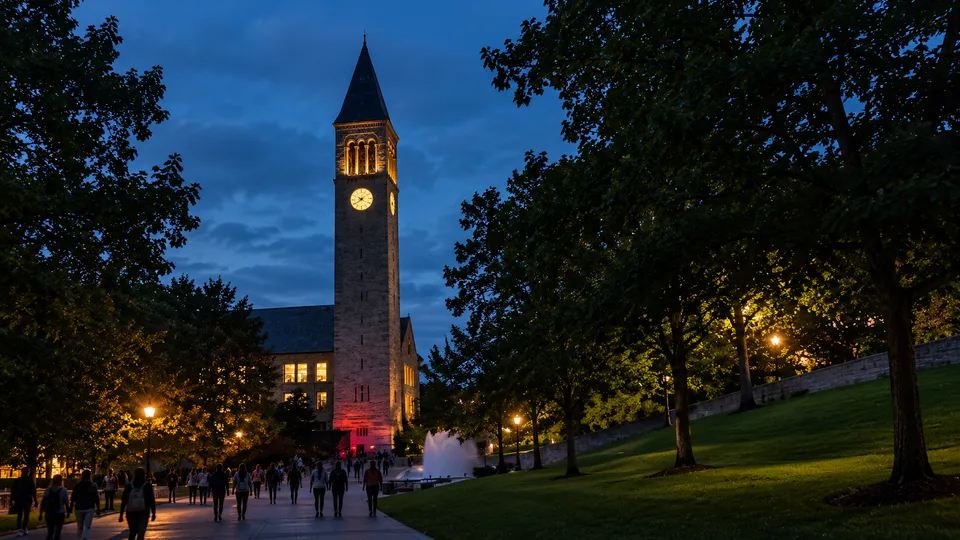
A lawsuit brought this month by a former Cornell University student, identified as Jane Doe, accusing seven students of raping her at a fraternity house in 2024 has set off anger and private reckoning on campuses across the country, and on Monday a New York prosecutor reopened a criminal investigation into the case.
The suit says Ms. Doe, then 20 and a member of the Tri-Delta sorority, was plied with alcohol and drugs at a Chi Phi fraternity party on the night of Oct. 19, 2024, and was sexually assaulted while, in the complaint’s words, she was “incapable of consent.” According to the complaint, she had consumed about 10 drinks in the three hours before she arrived, and fraternity members then pressured her to snort a substance described as ketamine. It includes a screenshot of a Snapchat message it says one brother sent the others: there was “free [expletive]” upstairs, referring to Ms. Doe. The seven students named — social media users have taken to calling them the Cornell Seven — are accused in the filing of “heinous criminal sexual acts.”
Cornell said it completed a Title IX investigation, expelled two of the students and penalized the others, and could not comment publicly on further discipline. On Monday, Matthew Van Houten, the Tompkins County district attorney, said his office would reopen its criminal investigation. In a statement, he described “a series of heinous and despicable acts” alleged in the complaint, which he said he first learned of on Sept. 18. The decision followed questions about what his office received from Cornell in 2024 — the district attorney has said he never got a transcript in which Ms. Doe said she was raped, an episode examined in an earlier rews story.
The case landed, almost to the day, as President Trump’s Education Department announced it would discard Biden-era Title IX rules on how schools handle sexual misconduct reports and return to a narrower definition of sexual harassment with more due process for the accused. The administration has also been dismantling the department itself, moving its civil rights work to the Justice Department and, said Shiwali Patel, senior director of education justice at the National Women’s Law Center, “leaving pending sexual violence complaints to languish with no transparency about what they plan to do with those complaints.”
That backdrop helps explain a feature of Ms. Doe’s suit that lawyers noticed at once: she is not suing under Title IX at all. “The bigger picture is that the 800-pound gorilla in sexual harassment investigations — which was the federal government — has been silenced here,” said Nancy Gertner, a senior lecturer at Harvard Law School and a retired federal judge. Going to state court under New York law, she said, suggests Ms. Doe’s lawyers do not trust the federal system to protect survivors.
Diane Rosenfeld, founding director of the Gender Violence Program at Harvard Law School, said the burden now falls harder on states, pointing to Illinois and California, which have passed laws of their own to strengthen campus advocacy and resources. Massachusetts requires its colleges, public and private, to survey all students on sexual misconduct at least once every four years. Title IX coordinators, though, answer to their institutions. Their role “implicitly is to protect the university,” said Liz Speakman, executive director of the Boston Area Rape Crisis Center, which works with many Boston universities. “We will support students in those situations and help them navigate the Title IX process as best we can,” she said, “and also let them know that this may not be the place where they get justice.”
On campuses, the conversation is both public and hushed. “Generally in classes, people are more hesitant to bring up things that are politically sensitive,” said Stella Lei, 22, a Harvard senior who helped found Take Back Harvard, a digital archive of sexual violence and gender discrimination reports at the university. Reyes Almeida, a Boston University junior who leads prevention trainings through the campus chapter of It’s On Us, said she was appalled by the Cornell news but not surprised, in a culture where people joke about the Epstein and Sean Combs cases. “Making fun of these things actually has effects on rape culture,” she said. “People don’t really understand that.”
Stacie Walsh, of the Victim Rights Law Center, which represents student survivors across Massachusetts, said rates of reporting campus assaults remain low while climate survey results have held steady. Still, she said, the conversation is starting to turn back to the perpetrators — and to questions about male loneliness and online misogyny in the manosphere. “A lot has changed. A lot of colleges are really trying to get this right,” she said, and yet, “it’s not enough.”
Asked about the Snapchat message in the complaint, Ms. Walsh put the problem plainly. “Why do students feel like they can openly discuss this in writing with a group of people — and not be fearful of any sort of accountability from their peers or their friends?” Adam McCready, an associate professor-in-residence at the University of Connecticut’s Neag School of Education who studies Greek life, said the fraternity structure itself invites abuse: “You give a group of 18- to 22-year-old men a mansion, and they tend to wield a great deal of social capital and power.”
Many women posting about the case online say it carried them back to their own college years — to 2014, when a Columbia student hauled a 50-pound mattress around campus to protest sexual assault, and to the candlelit Take Back the Night marches long before that. Ms. Rosenfeld said presidents could make a “huge difference” simply by hearing students out, as Amherst College’s president did in 2012, canceling classes for a day of campuswide discussion after a public rape allegation. “Schools should be much more afraid of their students being harmed than negative consequences and publicity,” she said.
Ms. Speakman sees a generational impatience in the response to Cornell. “We have to hold these systems to a higher standard,” she said. “The next coming generations believe that they should be able to do that.”