

The United Nations climate summit in Antalya, Turkey, ended on Sunday without an overarching agreement for the first time since Copenhagen in 2009, after the European Union, Britain, Norway, Panama and several island states refused to sign a text that never said “fossil fuels.”
In Dubai three years earlier, every government at the table had agreed to begin “transitioning away from fossil fuels in energy systems.” The final Antalya draft, written by a joint Turkish and Australian presidency, recalled that decision without repeating the phrase. It did spell out a goal for capturing carbon dioxide from industry: at least 500 million metric tons a year by 2035 in the version Saudi Arabia and other oil producers had pushed for, Reuters reported.
The drafts, the delegates’ statements and the industry’s own figures show three things. The capture goal was not a late substitute. It sat in the first draft beside six mentions of fossil fuels and outlived every one of them. The governments that fought the phrase, led by Saudi Arabia and Russia, have kept the fuels out of these texts for most of three decades, under a consensus rule that exists largely because Saudi Arabia blocked a voting rule in the 1990s. And the target is small: about 2 percent of the cut the U.N. says is needed by 2035, though more than seven times the capture capacity operating anywhere today.
The talks ran nearly 48 hours past their Friday deadline, making COP31 the longest climate summit on record, the Associated Press reported. The United States, one of the largest emitters, sent no delegation for the second year running after President Trump withdrew from the Paris Agreement.
How the phrase disappeared
The summit opened on Nov. 9. A week later the presidency circulated a first draft that used “fossil fuel” or “fossil fuels” six times, NBC News reported. According to CBS News, it called for “accelerated action to phase out fossil fuels,” urged an end to inefficient fossil fuel subsidies and resolved to bring warming back below 1.5 degrees Celsius as early as possible this century.

The same draft already carried the capture numbers. Its Paragraph 60 offered bracketed options to “accelerate Carbon Capture, Utilization and Storage to at least 500 MtCO₂ reflecting current policies by 2035” and “to work towards 1.3 to 2.5 Gt CO₂ per year by 2035,” Chris Lang wrote on his REDD-Monitor newsletter, quoting the text. The lower figure was pegged to existing policy.
A second draft, released Thursday, Nov. 19, removed every reference to fossil fuels. It cut the open issues from more than 140 to 79 and promised an “irreversible global transition” toward low emissions instead, MyJoyOnline reported. The capture options stayed. “I don’t think there’s any backsliding,” said Murat Kurum, Turkey’s environment minister and the COP31 president. He argued that the Dubai stocktake already covered the transition and that a target for electricity would cut fossil fuel demand indirectly, Carbon Herald reported.
On Friday, the scheduled last day, a coalition led by France and Panama rejected that version as too weak. The final 10-page text went out after 3 a.m. on Sunday, and negotiators had about three hours to object, The Irish Times reported. It opened by “recalling the United Arab Emirates Consensus in its entirety.” Accounts of its capture language differ: Reuters said it kept the 500-million-ton floor, while The Irish Times described a target of one billion tons and Down To Earth a collective aim of gigatonne scale by 2035. It was not clear which figure survived into the last version.
The European Union also objected to the weight the text gave carbon capture, saying it risked implying the technology could stand in for emissions cuts, Down To Earth reported. Darragh O’Brien, Ireland’s climate minister, spoke for the bloc in the plenary.
We will not endorse a cover decision or an Antalya pact that does not even mention fossil fuel, which is the key driver of climate change ... And we will not accept negotiating backward in time, and we will not accept a COP that greenwashes fossil fuel.
Mr. O’Brien later called the draft a “complete and utter fudge” on the Irish broadcaster RTÉ. Norway’s climate minister, Sigrun Gjerløw Aasland, said it “takes us backwards.” Kate Hughes, the spokeswoman for the British delegation, called it the “lowest common denominator.”
Who wanted it out
Saudi Arabia, speaking for the Arab states, defended the capture language to the end. “We believe that climate change requires all solutions on the table,” Mohammad Ayoub, a Saudi negotiator, said, Agence France-Presse reported. Maina Talia, Tuvalu’s climate minister, saw the week differently. “It seems like we are negotiating with the Saudis,” he said.
The kingdom has capture plans of its own. Saudi officials at the summit cited plans to abate 335 million tons of carbon dioxide equivalent a year by 2040 and a storage hub handling nine million tons a year, Carbon Herald reported. That hub, at Jubail in the Eastern Province, is 60 percent owned by Saudi Aramco, with Linde and SLB holding 20 percent each, and its first phase is due to be finished by the end of 2027, according to the companies’ agreement. Six million tons of that capacity is to come from Aramco itself.
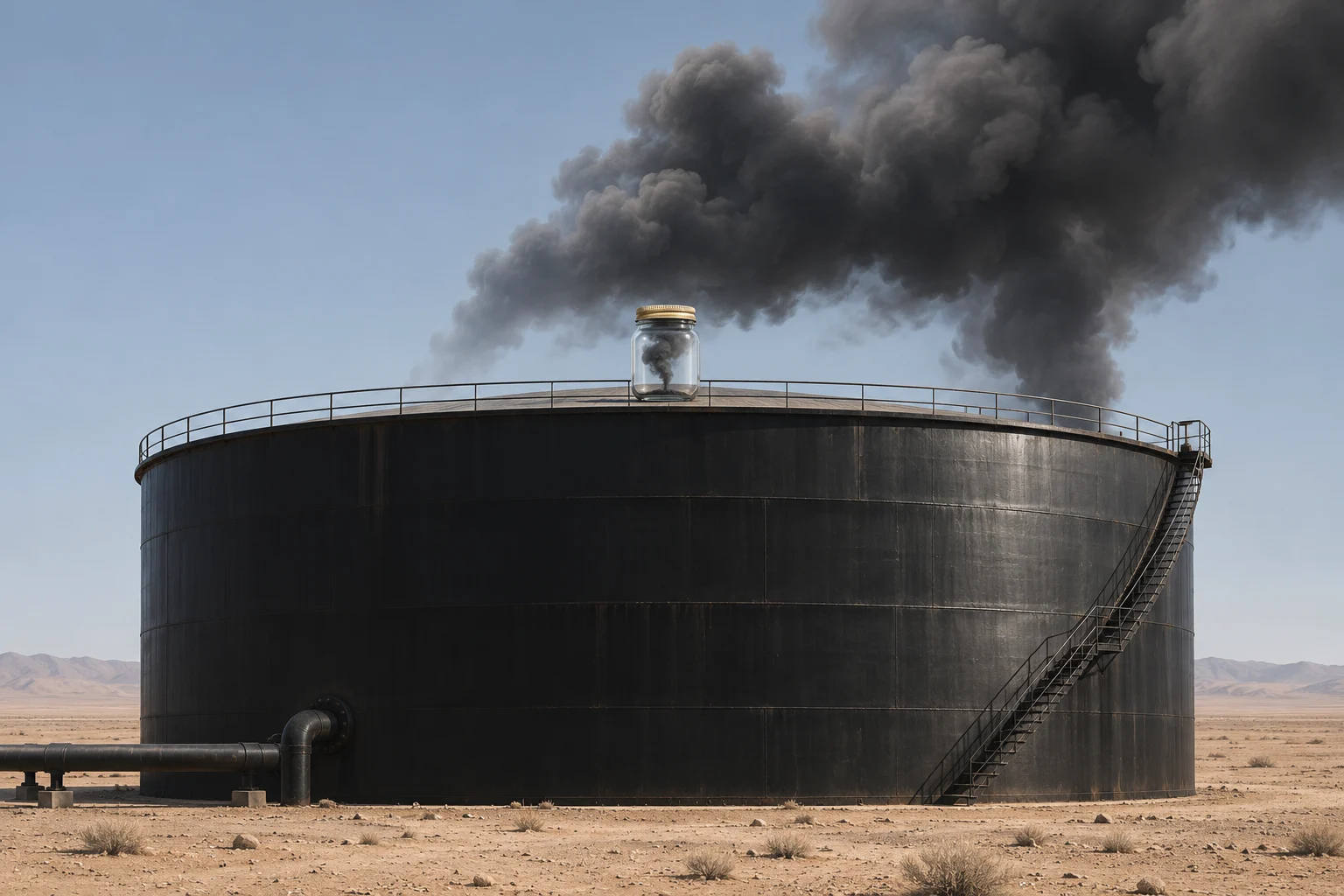
Russia was blunter. Sergei Kononuchenko, its delegate, told the closing plenary that his country “cannot agree to any formulation on fossil fuel,” warning of price shocks and energy poverty. NBC News reported that India also pushed back on any reference, and Amandeep Garg, an additional secretary in India’s climate ministry, framed its position around equity and unmet finance, according to Down To Earth. In the end China and India accepted the final text to keep the process moving, Reuters reported.
Events outside the hall pulled the same way. On Nov. 19, the day the fossil fuel language vanished, President Xi Jinping of China, President Trump and President Vladimir V. Putin of Russia met in Shenzhen and declared that “the three countries plan to increase the production and supply of refined petroleum products for the benefit of all nations,” Al Jazeera reported. Wopke Hoekstra, the European climate commissioner, cited the pledge as an obstacle, and Tlou Ramaru of the African Group of Negotiators called it “hypocrisy.” The war in Iran had already driven energy prices up.
The Center for International Environmental Law counted about 700 lobbyists from the energy and carbon capture industries registered for the summit, more than the 50 smallest national delegations combined. Mr. O’Brien said Saudi Arabia had exerted “far too much influence.” Chris Bowen, Australia’s climate minister and the president of negotiations, told reporters the words themselves had changed weight since the last two summits.
Things that were manageable in the past, in previous COPs like the last two where people wanted certain words mentioned but didn’t get them, it became a red line this time
Thirty years of consensus
The rule that let a minority stop the text dates to 1995. The draft rules of procedure went to the first climate conference that year with two options for draft rule 42, on voting: a two-thirds majority as a last resort, or consensus. Governments never settled it, and every session since has applied the draft rules “with the exception of draft rule 42,” according to the U.N. climate secretariat’s own training material. With no voting rule, any stated objection can stop a decision.
Saudi Arabia is largely responsible for that, Joanna Depledge, Kari De Pryck and J. Timmons Roberts wrote in a 2023 paper for the Climate Social Science Network. The lawyers Oberthür and Ott concluded at the time that “Saudi Arabia and Kuwait were determined to preserve their ability to block any strong international agreement,” as a Carbon Brief guest post on consensus recounted.
The rule has decided outcomes before. The talks in The Hague broke down in 2000. In Copenhagen in 2009, six countries declared their opposition to the Copenhagen Accord, so it was never adopted. A year later in Cancún, Patricia Espinosa, the Mexican conference president, gaveled through a deal over Bolivia’s objection, saying that “consensus does not mean unanimity ... one delegation does not have the right to veto.”
Fossil fuels went unmentioned in final COP decisions for more than 25 years, mostly because Saudi Arabia objected, Alden Meyer, a longtime analyst at the think tank E3G, said, according to an A.P. report. The record holds one partial exception. The Glasgow Climate Pact of 2021 called for “the phasedown of unabated coal power and phase-out of inefficient fossil fuel subsidies,” after India’s environment minister, Bhupender Yadav, had “phase-out” of coal changed to “phasedown” just before adoption, Carbon Brief reported. Glasgow named coal and subsidies, not the fuels as a whole.
Dubai did. Paragraph 28 of the 2023 global stocktake called for “transitioning away from fossil fuels in energy systems, in a just, orderly and equitable manner,” and the next subparagraph urged faster deployment of technologies including “carbon capture and utilization and storage, particularly in hard-to-abate sectors,” according to the Earth Negotiations Bulletin. In Dubai the two ideas sat side by side. Antalya kept one.

The retreat began a year ago in Belém, Brazil. Nearly 90 countries backed a road map away from fossil fuels there, and the final text did not mention fossil fuels at all, Climate Home News reported. Saudi Arabia was among the countries that blocked the road map. Brazil’s presidency promised voluntary road maps outside the formal process.
In April, 57 countries and the European Union met in Santa Marta, Colombia, at the first conference on transitioning away from fossil fuels, co-hosted by Colombia and the Netherlands. They negotiated no text but set up workstreams on national road maps, trade and fiscal dependence, and agreed that Tuvalu and Ireland would hold a second meeting in 2027, Carbon Brief reported. Both Antalya co-hosts, Turkey and Australia, were on the participant list. The United States, China and India stayed away.
What capture can deliver
Commercial carbon capture plants worldwide had a combined capacity of 68 million metric tons a year as of July 31, up from 64 million a year earlier, according to the Global CCS Institute’s 2026 status report. The institute, which promotes the technology, counted 113 projects in operation and 56 million tons a year under construction. It cautions that capacity “is not the same as actual annual CO₂ capture.”

Forecasts for capture have run ahead of it before. In 2008, Group of 8 leaders committed to announce at least 20 industrial-scale demonstration projects by 2010, the International Energy Agency recorded. The agency’s 2009 road map envisioned 100 projects by 2020, storing about 300 million tons a year. By 2016, 15 large projects were running, the agency wrote in a retrospective, and in 2020 it put actual capacity at about 40 million tons, 13 percent of the target, in its own review.
Plants that do run often capture less than they were built for. The Institute for Energy Economics and Financial Analysis, a think tank critical of the technology, studied 13 flagship projects in 2022. It found that ExxonMobil’s Shute Creek gas plant in Wyoming fell about 36 percent short of its capture capacity over its lifetime, and Canada’s Boundary Dam and Chevron’s Gorgon project in Western Australia about 50 percent, the Energy Institute reported. About 95 percent of the carbon dioxide Shute Creek captured went into enhanced oil recovery, pumped underground to push out more oil, according to the institute.

Then there is scale. Energy-related carbon dioxide emissions reached a record of nearly 38.4 billion tons in 2025, the I.E.A. reported, so today’s capture capacity equals less than 0.2 percent of them. The U.N. Environment Program’s Emissions Gap Report, released Oct. 21, says the lowest-overshoot path, which limits peak warming to 1.7 to 1.8 degrees, requires cutting emissions 18 percent by 2030 and 45 percent by 2035 from 2025 levels, U.N. News reported. Applied to the 54.1 billion tons of greenhouse gases the I.E.A. counted for 2025 in its World Energy Outlook, that is a cut of about 24 billion tons a year. A 500-million-ton capture goal covers about 2 percent of it. The draft’s top bracket, 2.5 billion tons, covers about a tenth.
The U.N.’s Intergovernmental Panel on Climate Change ranked the options in 2022. Measures costing $100 a ton or less could cut emissions to half of 2019 levels by 2030, with solar, wind, efficiency and methane cuts supplying large shares at under $20 a ton, according to its summary for policymakers. In the report’s cross-sector chapter, carbon capture and storage carried a 2030 potential of about 0.54 billion tons a year, against 2 billion to 7 billion for solar alone, and sat among the costliest options.
A week before Dubai, the I.E.A. calculated that if oil and gas use followed then-current policies, holding warming to 1.5 degrees would require 32 billion tons of carbon captured by 2050, 23 billion of it pulled from the air, using 26,000 terawatt-hours of electricity, more than the world used in 2022. Fatih Birol, the agency’s executive director, told the industry to let go of “the illusion that implausibly large amounts of carbon capture are the solution,” the agency said.
The case for capture
The case for the technology is not Saudi Arabia’s alone. The I.P.C.C. calls capture a critical mitigation option in cement and chemicals, and Dubai’s text endorsed it for hard-to-abate sectors. The U.N. Environment Program’s lowest-overshoot path also needs about 320 billion tons of carbon dioxide removed and stored over this century. The Antalya draft itself said removal should complement, not substitute for or delay, deep emissions cuts.
At the closing plenary, a Saudi representative said he was surprised that countries wanted the technology out of the text, CBC News reported.
If indeed the climate challenge, as some have mentioned today, is so important, it makes no sense that solutions, concrete solutions ... will be taken off the table.
Measured against the record, his argument holds where it is narrow. The I.P.C.C. backs capture for heavy industry, Dubai named it, and the European objection, as reported, was to the weight the text gave it, not its presence. The trade the final draft implied does not hold. It set a goal for capture and dropped the words for the fuels whose emissions capture is meant to handle, and the record since 2008 shows the technology arriving at a fraction of what was forecast.
The floor was also modest by the industry’s own plans. If every announced project is built, capture capacity would reach about 430 million tons a year by 2030, the I.E.A. said in the 2025 update of its project database. A floor of 500 million tons five years later, pegged in the first draft to “current policies,” asks for little beyond what companies have already announced.
The argument over blame
Much of the anger in the hall fell on the presidency. A hot microphone caught Mr. Kurum telling Simon Stiell, the U.N. climate chief, “to sit down,” and Antwi-Boasiako Amoah, who chairs the African Group of Negotiators, told him: “With all due respect, Mr. President, you have not shown respect to a group of 54 countries.” Rachel Cleetus of the Union of Concerned Scientists called the two presidents a “disgracefully incompetent duo.” In Canberra, Dan Tehan, the opposition’s energy spokesman, said Mr. Bowen was “personally responsible for this catastrophic diplomatic disaster,” while Fiji’s climate minister, Lynda Tabuya, said, “The failure here is not yours to carry,” ABC News reported.

Others pointed at Brussels. “It’s very hypocritical of the European Union to position itself” as walking out over fossil fuels when “at home, it’s expanding its fossil fuels,” Asad Rehman of Friends of the Earth said, Al Jazeera reported. The Climate Action Network said developed countries, “led by the European Union, stood in the way on every major negotiating track.” The money backs part of that complaint. The annualized value of developed countries’ multi-year public climate finance pledges fell from about $40 billion to $11.7 billion this year, a drop of more than 70 percent, according to a Carbon Brief analysis, and the final draft dropped a $120 billion adaptation finance target.
Not everyone called it a collapse. Li Gao, who led China’s delegation, said “we cannot see this as a failure of this multilateral process.” Richie Merzion of the Clean Energy Investor Group told ABC News: “I’ve been to 13 COPs now and most of them did not have a ‘cover decision.’” Mattias Frumerie, Sweden’s chief negotiator, read the obstruction as evidence of the opposite trend. “The fact that they are blocking so much is also an expression of the fact that we are accelerating the transition,” he said, according to a Reuters analysis.
On Hacker News, a reader made the economic version of that argument in a single line.
At this point fossil fuels are economically uncompetitive with solar energy except in fairly polar climates.
The price half of that claim has support. The I.P.C.C. found much of the potential of onshore wind and utility-scale solar at negative cost, and the I.E.A. estimates that solar, wind, nuclear, electric cars and heat pumps together avoided about 3 billion tons of emissions in 2025, according to its review. Energy emissions still rose that year, to a record. Cheaper clean power has slowed the growth. It has not reversed it.
Another reader on the same thread raised a question the negotiating texts leave alone.
You still have some remaining oil business. Who does it go to? Whoever can pump it the cheapest? Whoever has the fewest alternatives for export income?
The Dubai paragraph sets a direction and says nothing about who produces last. Santa Marta’s work on economic dependence is the nearest any forum has come. Juan Carlos Navarro, Panama’s environment minister, who said earlier in the week that a “petroleum mafia” was holding the talks hostage, described the producers’ pitch on Wednesday.
We love the petroleum guys ... We can’t live without them, and they are so smart, they have convinced us that they are doing this for our own good.
Al Gore, the former U.S. vice president, turned the argument to the rules themselves in a post on Sunday.
The failure of COP31 is an outrage — it is outrageous that a handful of petrostates have veto power over any mention of fossil fuels. They want you to believe that the climate crisis is a problem that the world is unwilling to solve. But the outcome at COP31 shows the opposite.…
What comes next
One piece of Antalya survived. Turkey’s goal of raising electricity’s share of final energy use to 35 percent by 2035 drew nearly 100 countries as a separate, voluntary pledge, the A.P. reported. Reuters counted more than 90. The two also differ on the starting point, about 21 percent by the A.P.’s figure and about 23 percent in the Reuters report carried by Al-Monitor.
A Hacker News reader argued that voluntary moves of this kind matter more than any text.
If a country wants to have cheap energy, and thinks clean energy can deliver, then whatever the UN decides is not relevant to its strategy.
For energy policy, the pledge fits that view. For the poorest countries it does not, because the money runs through the formal process. Adaptation finance, the details of the fossil fuel transition and work on gender were all deferred to next year, the A.P. reported. Separate decisions on the just transition work program, the Adaptation Fund, carbon markets and transparency did pass, according to Down To Earth.
Reform is now on the table. Mr. Stiell said, “I have taken steps in engaging external knowledge leaders in advising on areas of potential reform.” Andres Martin Garrido Sanchez of Peru’s Foreign Ministry said, “This system needs in-depth reforms.” Mr. Talia of Tuvalu urged action “not through consensus, but through a coalition of people that are willing to work together.” Sivendra Michael, Fiji’s chief negotiator, answered: “I do not know how else we are going to bring together all the parties.”
António Guterres, the U.N. secretary general, posted his verdict as the summit closed.
I’m deeply disappointed that #COP31 has ended without consensus on an overarching outcome.
I share the very profound frustration of all those who expected governments to rise to the moment the climate crisis demands.
But this setback does not change the facts.
There may be no…
Negotiators meet next in Bonn in June, and COP32 convenes in Addis Ababa, Ethiopia, in 2027, the year Tuvalu and Ireland host the second conference on transitioning away from fossil fuels. Mr. Stiell’s assessment of Antalya was short: “The world cannot afford a repeat of this moment.”