
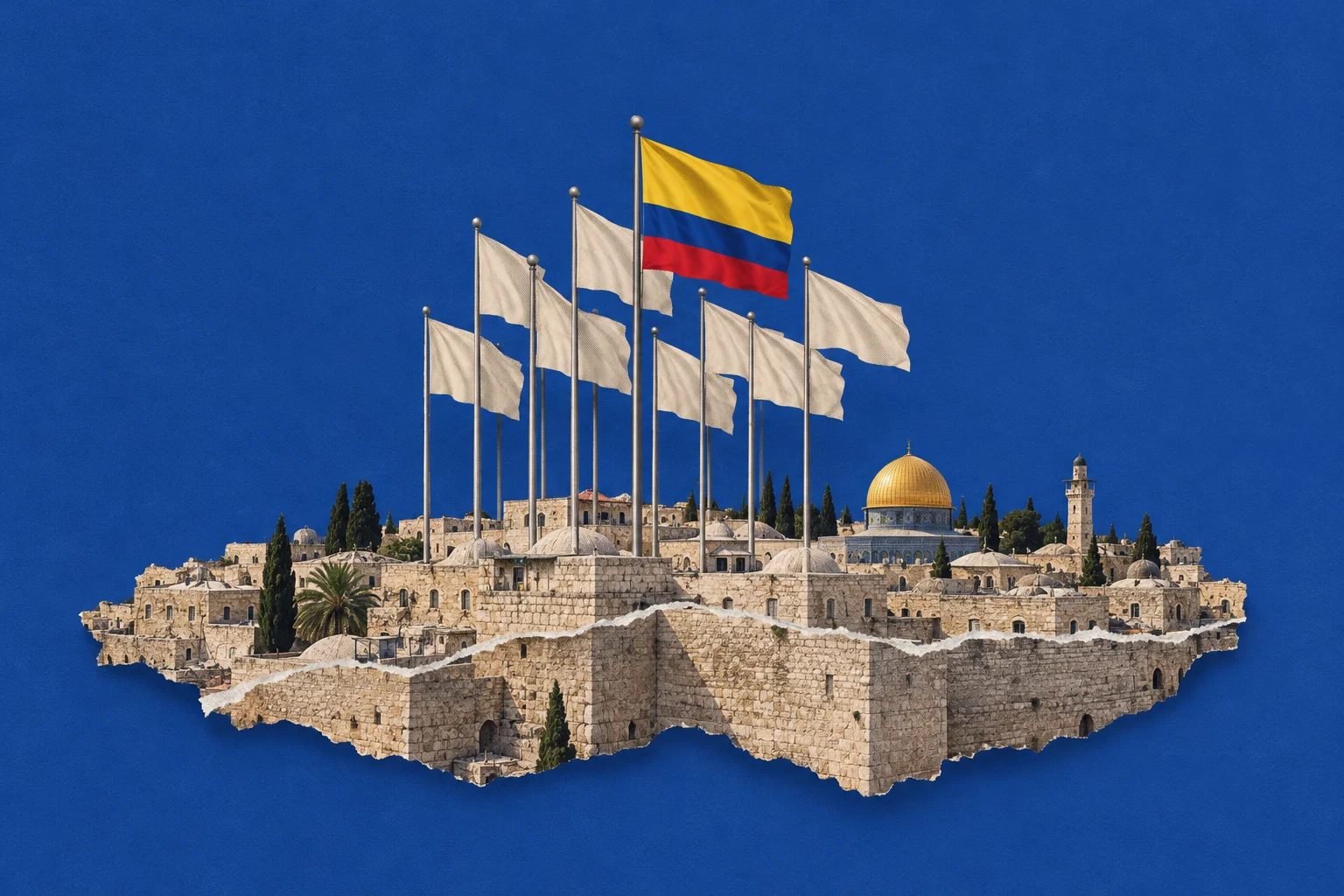
Ten countries now run their embassies to Israel from Jerusalem instead of Tel Aviv. Colombia became the tenth on October 14, 2026, when Foreign Minister Omar Bula Escobar cut the ribbon alongside his Israeli counterpart, Gideon Saar — a reversal of a rupture that, under the previous Bogotá government, had gone further than almost any country in the region. As Reuters reported, new President Abelardo De La Espriella used the opening to undo his predecessor’s break with Israel and restore the two countries’ free trade agreement in the same week.
Saar had telegraphed the move six days earlier. On October 8 he announced that Colombia would relocate its embassy, framing it as a win in a wider contest over narrative, as Al Jazeera reported.
We will work hard because this is the diplomatic battle over the truth. And the truth is, Jerusalem was always the capital of one nation.
At the October 14 ceremony he sharpened the claim. “Opening an embassy in Jerusalem is not only recognition of the simple political fact that Jerusalem is Israel’s capital,” he said, per Reuters. “It is also recognition of a historical truth that no honest person can deny.” Note what the number ten measures: states willing to treat the embassy question as settled. The large majority of countries with ties to Israel keep their missions in Tel Aviv, because East Jerusalem’s capture in 1967 and annexation are not recognised under international law, and the city’s final status is formally unresolved. Ten is the count of governments choosing to ignore that framing; it is also a count of how few have been willing to.
One election, one promise, two months
The mechanism here was not gradual diplomacy but an electoral transaction. Saar, the Jerusalem Post reported, met De La Espriella in Buenos Aires in November 2025 — before his election — and the future president pledged to move the embassy if he won. “He made a promise, and he kept it,” Saar said at the opening. “Just two months after he took office, we inaugurated the Embassy of Colombia in Jerusalem.” Colombia’s foreign ministry is also weighing joining an international Holocaust remembrance alliance, the Post reported. The Jerusalem Post’s count matches Reuters’s: Colombia is the tenth government with an embassy in the city.
What was reversed is worth listing, because it shows the distance travelled. Gustavo Petro, Al Jazeera notes, severed diplomatic ties with Israel over what he called the genocidal war on Gaza, stopped exporting Colombian coal to Israel and cut military and security cooperation. Colombia has been one of Israel’s main coal suppliers, and Israeli firms supplied much of the Colombian military’s hardware, so the break had real trade and defence content, not just recalled ambassadors. The restoration announced on October 14 includes the free trade deal; whether coal shipments and arms contracts follow at their old volumes is the number that will show how complete the reversal actually is. An embassy is an address. Coal is a flow.

The regional pattern, and the counter-pattern
Colombia is one instance of a broader substitution: left-wing governments that punished Israel after the Gaza war are being replaced by right-wing ones that court it. Argentina’s Javier Milei has built the closest relationship of the wave — Deutsche Welle describes the Netanyahu–Milei axis as the region’s tightest, part of a pattern in which Latin American allies of Donald Trump have opened their arms to Israel. The Jerusalem Post frames Brazil’s election as the next test of both the rightward shift and the Israel ties riding on it: former president Jair Bolsonaro was a vocal supporter of Israel, while incumbent Luiz Inácio Lula da Silva has been among its sharpest critics in the region.
The pendulum has precedent. When a three-week Israeli offensive in Gaza in 2008–09 killed more than 1,400 people, including an estimated 1,100 civilians by the figures DW cites, Venezuela’s Hugo Chávez expelled the Israeli ambassador and ended diplomatic relations. That was the left-wave version of today’s right-wave reversal: relations with Israel as a function of which coalition holds the presidency, resetting with each election rather than accumulating as state policy.
For Israel, the arithmetic of the week is two tangible gains — a tenth flag in Jerusalem and a restored trade deal with a country of about 50 million people — plus a diplomatic storyline that 2026’s electoral cycle keeps validating. The open questions are the ones with measurable answers: whether Brazil’s vote extends the pattern or checks it, and whether Colombia’s coal and defence imports from Israel return to pre-rupture levels or stay where Petro left them. The embassy took two months. The trade flows will take longer, and they can be counted.