
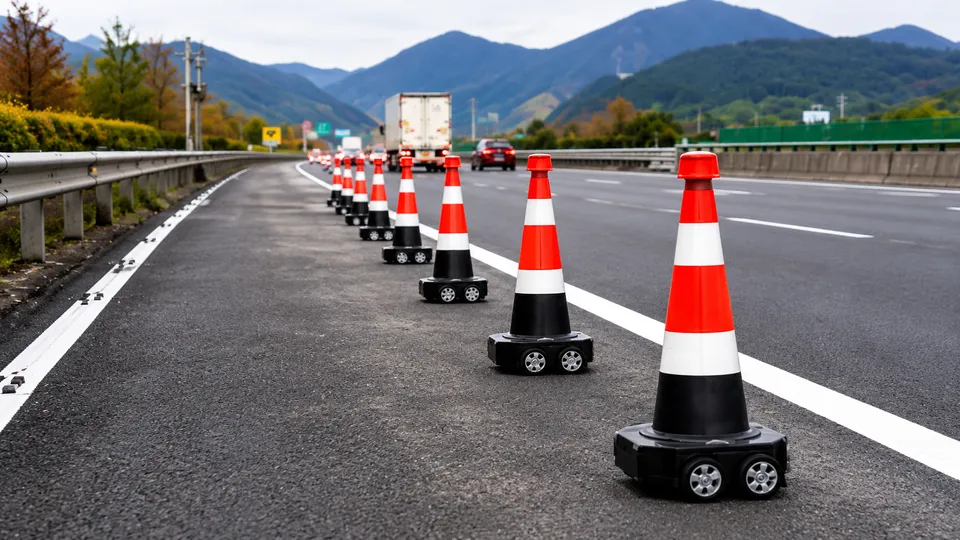
Of all the labors a man can perform beside a highway, few are as quietly lethal as the simplest: setting down a line of orange cones around a crashed car. The worker walks backward into a live lane, his back to the traffic, carrying his cones one at a time while vehicles close in from behind. It is, by the logic of every road-maintenance service in the world, the most dangerous moment of the job — and it is precisely this moment that a group of Chinese companies now proposes to hand over to machines.
The machines are traffic cones that move themselves. Wheeled, motorized, they roll off the back of a response vehicle, take up coordinated positions, and form a barrier line around an accident scene without any person stepping onto the roadway. The systems are at the testing, pilot, and limited-deployment stage; they are not a finished, standardized product, and their key performance claims remain unverified outside controlled demonstrations.
The Ten-Second Lane
Several developers are building versions of the idea, most of them in China. The devices travel on motorized bases and can be arranged into straight barrier formations, with some secondary reporting describing curved arrangements. Operators steer them remotely over 4G or 5G networks, or direct them on the spot. Some models reportedly navigate autonomously with the help of onboard sensors — a claim that varies by maker and should be read as a reported feature, not a confirmed specification. Reported units carry flashing warning lights and draw power from solar panels, with docking stations as backup during poor weather or long deployments.
Among the companies named in the reporting are a Ningbo-based intelligent-equipment firm, Zhongwei Electronics, and Hefei Boteng Nengtong. That several firms are working the same ground at once suggests something more than a curiosity: it is the outline of a new product category, though not yet of one established device.
What the Numbers Promise
One developer says its system can close a highway lane in under ten seconds, under suitable conditions. The figure deserves respect and caution in equal measure: it comes from the company’s own description of rapid lane closure, not from independent standardized testing, and real roads will write their own numbers. By comparison, placing cones by hand can take several minutes depending on the size of the scene, the cones required, and the traffic; one Chinese report describes a traditional highway incident closure as taking roughly twenty to thirty minutes. It is not a controlled benchmark, but it marks the gap that remote deployment is meant to close.
Chinese reporting also describes uses beyond the crash scene: tunnels, bridges, stretches beside highway barriers, maintenance zones — all the places where a crew cannot safely linger on the pavement.
The Road Is Not the Demonstration Hall
Between the demonstration and the road lies a long list of unanswered questions. The available reporting contains no independently verified specification sheet for any of these systems. Their dimensions, weight, top speed, weather resistance, ability to handle obstacles, sensor packages, and failure rates are all unconfirmed.
Command links running over public 4G and 5G networks raise questions of reliability and cybersecurity; at least one developer uses public-network communications, according to Chinese reporting, and no independent security testing of the systems was identified. Solar panels weaken in rain, darkness, snow and shaded corridors — docking stations can compensate, but they add infrastructure. And the words “AI-powered” and “autonomous,” which hover over the devices, stretch to cover very different capabilities depending on the model; here, neither describes a confirmed technical standard. The regulatory approval status of these machines has not been established in any of the reporting.
What remains, after the caveats are weighed, is a sound idea: remove the man from the most dangerous minute of the incident. Bureaucracies have always found it cheaper to risk the worker than to reinvent the equipment; here, for once, the reinvention is underway. But the evidence so far supports promising pilots and limited use on real roads — not a proven system ready for broad deployment. Independent testing, performance standards, and regulatory frameworks have yet to catch up with the little wheeled cones already rolling out onto China’s highways.