
Empires once carved their intentions in stone. Today they read them out at symposiums. On 31 October 2026 in Beijing, at what was reported as the Seventh Manned Space Symposium, Wang Xiang, deputy chief designer of China’s crewed space programme, laid out a calendar. Three astronauts would fly to the Moon and two of them would go down to its surface. The deadline was before 2030, as Leonard David reported.
This programme usually tells outsiders very little, so a published timetable stands out. Eric Berger, writing in Ars Technica, describes it as China publicly putting a lunar landing within three years. Each step comes with a year attached.
A ladder of empty ships
In early 2027 an uncrewed Mengzhou spacecraft goes into low Earth orbit on a Long March 10A, the single-core version of the rocket with no boosters. In 2028 the full Long March 10 and the Lanyue lander fly without a crew, and the lander descends to the lunar surface and climbs back off it. In 2029 two Long March 10 rockets launch an empty Mengzhou and a Lanyue, and the two vehicles dock in lunar orbit. The crewed landing comes after that, again on two Long March 10s, sometime before the decade ends. No firm date has been given for that last flight.

Wang reportedly told the state broadcaster CCTV the principle behind the sequence: “for any crewed mission, we will try to fly it in an unmanned state first.”
One rung is missing from the ladder. Before Apollo 11, the Americans sent Apollo 8 to circle the Moon with men aboard. Artemis II was designed to carry a crew around the Moon in the same way. The Chinese plan has nothing like either. Every machine tests the path empty, and the first humans to leave Earth orbit on a Chinese ship will be going to land.
That is a bold choice or a confident one, and from outside it is hard to tell which.
What can be seen from outside
Outsiders can learn almost nothing about the technical milestones reached inside China’s space programme. Some evidence does get out, though, and it shows real progress toward the Moon. In August 2025 the China Manned Space Agency tested a high-fidelity mock-up of the 26-ton Lanyue at a site near Beijing. Giant tethers held the vehicle to imitate lunar gravity while it fired its main engines and fine-control thrusters, set down on a cratered surface and lifted off again.

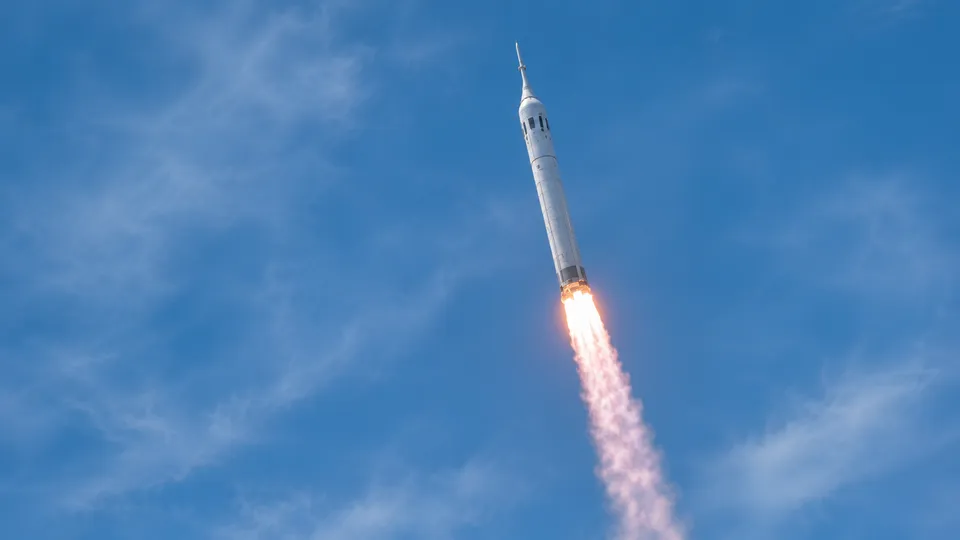
On 11 February 2026, at Wenchang, China carried out a low-altitude flight test of the Long March-10 rocket. More recently the Mengzhou spacecraft for the 2027 test arrived at the Wenchang Space Launch Site on the island of Hainan, where it will launch on a Long March 10A.
The calendar has already slipped once. In November 2025 the agency said Mengzhou-1 would launch in 2026. The flight now belongs to 2027. One lost year is a small delay for a space programme. It is still a reminder that a timetable read out at a symposium does not fix the dates.
Washington, in a hurry
Washington’s assessments of the Chinese programme are restricted. Congress acts as if it has read them. Over the past 12 months, the US Congress and the White House have given NASA Administrator Jared Isaacman broad latitude to streamline Artemis, the programme meant to put Americans back on the Moon. He moved quickly. He cancelled the Lunar Gateway, the small station that was to orbit the Moon, and he cancelled the planned upgrades to the Space Launch System rocket. Last week he announced that NASA would help Blue Origin develop its lander by finding a way to push the Orion capsule into low lunar orbit.
We have the mandate, we have the resources, and the support from our stakeholders to be able to execute, and that’s what we intend to do.

A bureaucracy will cut its own programmes when it has a rival in view, and such cuts are rarely made for any other reason. For years Gateway and the SLS upgrades survived in Washington budgets. A competitor’s timetable got them cancelled in under a year.
The weak point on the American side is the lander. SpaceX and Blue Origin both hold multibillion-dollar contracts to build one, and much remains uncertain about both. Depending on how that work goes, an American landing could slip to 2030 or even later. That would put it past the deadline Beijing has now set for itself in public.
After the flag
For a couple of years it has been clear that China is seriously committed to putting astronauts on the Moon, and would prefer to get there before the United States returns, for the geopolitical prize. The first footprint is only the start of the contest. Both NASA and China’s programme are building toward a long-term presence at the lunar South Pole, where water ice and dreams of permanent settlement have drawn governments and billionaires alike. Isaacman has committed NASA to building a base on the lunar surface within the next decade.
Beijing’s first step toward that future is already at Wenchang. It is an empty capsule, scheduled to fly in early 2027 on the smaller version of the rocket, with nobody aboard.