
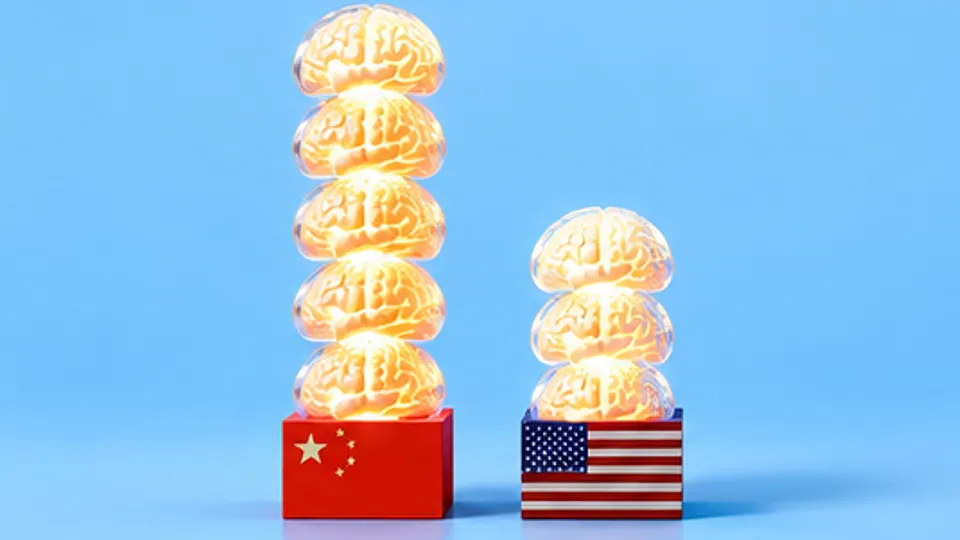
China has overtaken the United States as the leading workplace for elite artificial intelligence researchers, according to a study released in late September by the Carnegie Endowment for International Peace, even as America continues to draw more foreign talent than any other country.
The study, a revival of the defunct think tank MacroPolo’s Global AI Talent Tracker, tracked the careers of authors whose papers were accepted at the Neural Information Processing Systems conference, or NeurIPS, widely treated as the field’s premier venue. Its sample covered more than 10,000 authors — 40 percent of the 25,677 total on the 5,823 papers accepted for the 2025 conference — and compared them with the 2022 cohort.
By the headline measure, the reversal was swift. Forty-one percent of the elite researchers in the 2025 cohort worked in China, up from 27 percent in 2022, while the share working in the United States fell to 34 percent from 46 percent, according to figures from the study. By origin — measured by where a researcher earned an undergraduate degree — China’s lead grew more lopsided still: 57 percent of the cohort, up 11 percentage points from 2022, against 13 percent for the United States. The full study is published on Carnegie’s website.
Yet the United States remains the field’s great magnet, and particularly for Chinese talent. Among researchers working in the United States in 2025, the share holding Chinese undergraduate degrees rose 4 percentage points from 2022. The United States posted a net gain of 2,145 researchers against a net loss of 1,729 for China. The traffic was almost entirely one-way: in 2022 there were 46 Chinese-origin researchers working in America for every American-origin one in China.
What changed is retention. The share of Chinese-origin researchers who ended up working in China climbed from 57 percent in 2022 to 69 percent in 2025, passing Europe’s 60 percent retention rate, though still well behind America’s 89 percent. The study’s authors offered two explanations: Chinese graduates now find jobs readily in China’s booming A.I. industry, and tighter U.S. visa restrictions, particularly for Chinese graduate students in science and technology fields, have made coming to America harder.
The rest of Asia gained. South Korea posted the second-highest retention rate, 77 percent, and its leading science institute, KAIST, jumped 12 places to No. 3 among institutions producing elite A.I. talent. Singapore’s National University and Nanyang Technological University rose to 13th and 16th, from 25th and 29th. Google remained the top institution overall.
Europe faltered. Its two flagships, ETH Zurich and the University of Oxford, both dropped off the institutions ranking in 2025, though the continent became slightly more attractive as a workplace. India’s story resembled Europe’s: its share of top talent fell 2 percentage points, fewer of its researchers went to the United States and no Indian institution placed in the ranking in either year.
The Carnegie team, which took over the project after MacroPolo ceased operations in 2025, held to the earlier methodology but used A.I. tools — Claude Code and OpenAI’s Codex — to process a far larger sample than in past editions, with humans verifying the results. The authors cautioned that the 40 percent of authors with complete career histories is not a random sample: it slightly overrepresents academia and underrepresents industry, by less than a percentage point each way, and Europe’s direction in the findings remains sensitive to the sample. The main U.S.-China findings, they wrote, hold up under broader checks.