
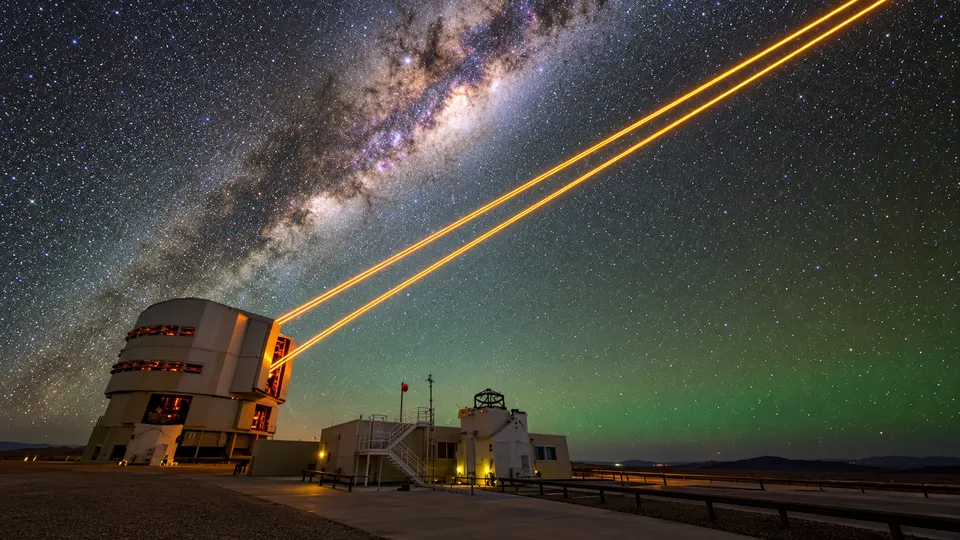
The Very Large Telescope on a mountaintop in Chile’s Atacama Desert is operating with up to seven lasers for the first time in its history, after engineers finished installing the last of them in late 2025.
Operated by the European Southern Observatory at Paranal, the telescope fires the lasers to excite a sodium-rich layer of the atmosphere about 90 kilometers (56 miles) above the ground. The excited sodium atoms release photons, producing a bright artificial star whose light the telescope’s instruments can measure, according to the BBC, which recently visited the site.
Telescopes on the ground face a problem that space telescopes do not: the atmosphere distorts starlight before it reaches the mirror, and the distortion changes constantly. “We are protected by our atmosphere, which is fantastic,” Amelia Bayo, a project scientist with the observatory, told the BBC. “But as an astronomer it is horrible, because the atmosphere basically messes with the sharpness of the light coming from stars and galaxies.”
The fix is a technique called adaptive optics. “The implementation is hard, but the idea is super simple,” Ms. Bayo said. Distorted light from the primary mirror bounces onto a smaller mirror that deforms to match and cancel the distortion. That mirror, made with piezoelectric materials that change shape “at crazy speeds,” in her words, hangs suspended in a magnetic field. “It’s stupidly cool. It is basically floating,” she said.
The correction needs a reference: a bright, fixed point in the sky. A bright star carries more usable information about the atmosphere’s distortion, just as a clearly heard melody is easier to name, Ms. Bayo said. When the patch of sky under study has no suitably bright star, astronomers fire a laser and build one. “Our atmosphere is sodium-rich,” she said. “It offers a canvas where we can put the star anywhere we want.”
The new lasers are a change from the previous generation, which required toxic liquid dyes and days of engineering work to keep stable, Ms. Bayo recalled. Now, she said, astronomers press a button and the beam holds in place all night.
Each laser delivers 22 watts of power, about 4,000 times the maximum allowed for a laser pointer, in a beam 30 centimeters (12 inches) wide. After an upgrade in 2016, one of the V.L.T.’s four 8.2-meter (27-foot) telescopes, Yepun, could fire four lasers at once, widening the corrected field of view. This year all four telescopes, Antu, Kueyen, Melipal and Yepun, gained the ability to fire together, combining into a single giant virtual telescope that can capture detail many times sharper than one alone.
The idea dates to the Cold War, when the American military developed technology to track Soviet satellites and astronomers later realized that similar methods could sharpen observations from the ground.
“Planes can of course pass above the observatory, but we have a safety mechanism,” said Itziar de Gregorio Monsalvo, the observatory’s representative in Chile. “If the planes cross near where we are observing, automatically the lasers switch off.”