
Researchers at Case Western Reserve University have mapped hair cells much like those in the human ear across the entire bodies of young squid, according to a study in the Sept. 21 issue of Current Biology.
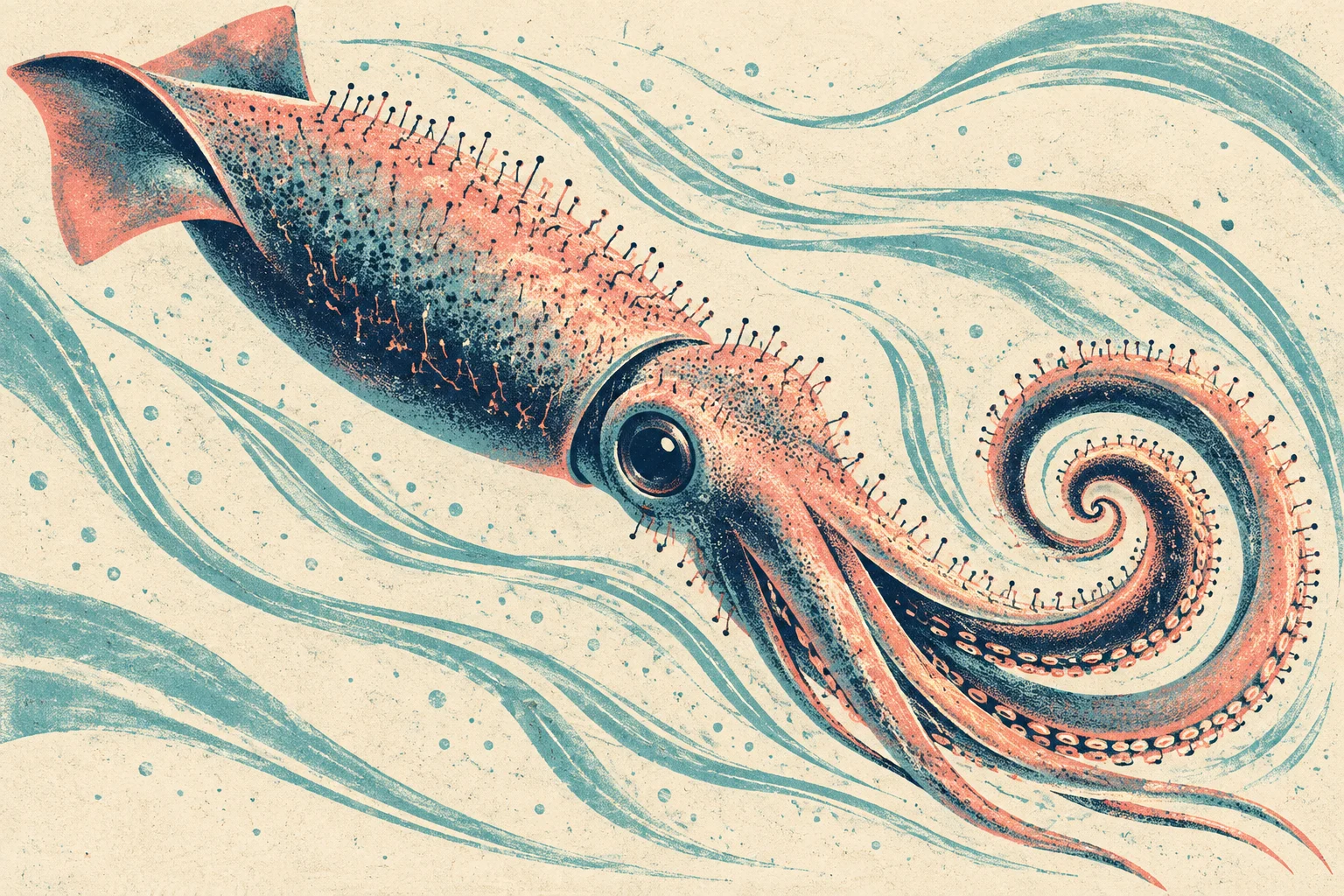
The cells, which sense moving water, cover the mantle, fins and siphon of hatchling longfin inshore squid, Doryteuthis pealeii. Until now they had been described only on the head and arms. In an Oct. 1 announcement, the university said the animals carry hundreds more hair cells than scientists had known about.
Dr. Brian McDermott, an otolaryngologist and associate professor at the Case Western Reserve School of Medicine who led the work, started out studying human hearing and deafness, Jess Cockerill reported for ScienceAlert. He followed the family history of the ear’s hair cells back to an animal separated from people by hundreds of millions of years of evolution.
“Often, when a child is born deaf or a hearing person loses their hearing, it is the hair bundle that has been damaged,” Dr. McDermott said. “So, studying the squid’s hair bundle holds promise for understanding how hearing loss occurs.”
These hair cells have nothing to do with the hair that grows from skin. Each one carries a bundle of tiny projections that bend when the fluid around them moves, and the cell turns that motion into a signal for the brain. In people they line the cochlea, the snail-shaped, fluid-filled organ of the inner ear. Their bundles come in different lengths. Long ones are better at picking up low-pitched sounds and short ones at high pitches.
Among vertebrates, only fish have hair cells outside the ear, in a sensing organ along the body called the lateral line. In fish the bundles are all about the same length.
Squid turned out to be different. Bundles on the mantle were much shorter than those on the lateral line of the head, and the authors wrote that “anatomical positions and corresponding variation in hair bundle lengths suggest some lateral lines detect distinct stimuli.” The university said the pattern suggests squid set the length of their bundles to tune the cells to different frequencies, the way the human cochlea does.

The layout surprised them too. “Unexpectedly, we identified hair bundles organized in two patterns: previously described linear arrays and broad regional fields that have not been explicitly reported in squid or fish, which we term lateral line fields,” the team wrote.
To find the cells, the researchers imaged several free-swimming hatchlings with light-sheet microscopy, which makes the hair cells show up in pictures. They also traced sensory neurons in the mantle to the stellate ganglion, a large nerve cluster, which the [paper](https://www.cell.com/current-biology/fulltext/S0960-9822(26)00955-3?rss=yes) presents as a sign that squid sense local water flow across the whole body.
Part of the work was done at the Marine Biological Laboratory in Woods Hole, Mass., under a three-year fellowship program on how squid hear. Dr. McDermott’s co-authors were Haoming Wang, Nicolas Pintozzi and Anna-Maria Petriv, along with Carsten Wolff, the laboratory’s associate director of imaging. The short paper was submitted on Nov. 27, 2024, and accepted on July 24.
“Our results show that the whole squid’s surface is elaborately ornamented with varied lateral lines that likely register specific types of local water movements,” the authors wrote.