
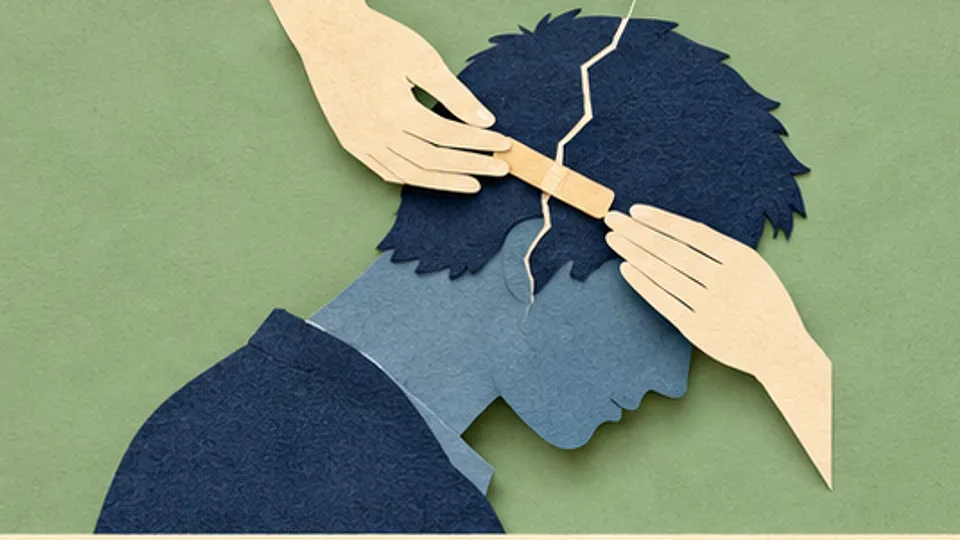
Ottawa is preparing Canada’s first mental health strategy aimed at boys and men, with a rollout expected by early 2027, as the government’s own figures document a decade-long decline in how young men are faring.
Between 2012 and 2022, the share of men aged 15 to 24 who reported mood disorders rose to 16 percent from 11 percent, and those reporting generalized anxiety disorders climbed to 10 percent from 4 percent, the government reported this year. The share calling their mental health “very good” or “excellent” fell to 52 percent from 70 percent. A separate report said men are three times as likely as women to die by suicide, the second-leading cause of death among males 15 to 34, behind unintentional injuries.
“There’s a common problem everywhere and it’s how men and boys are feeling. And they are not feeling great,” Marjorie Michel, the federal health minister, said in an interview with CBC News. “There is a lot of anxiety about their role as men and boys.”
Nick Cholmsky, 21, of Ottawa, could be Exhibit A against the stereotype of teenage boys doing fine. He was a competitive basketball player with friends and a close family, and by his account he was depressed from middle school on and entertaining suicidal thoughts at 16, because speaking up felt like shame. “Looking back, so much of that [congenial attitude] was for sure just a performance, me acting the way I thought I was supposed to act as a man,” he said.
Betting is one thread the research keeps pulling. Canada legalized single-event sports betting in 2021, and Ontario in 2022 became the first province to let private companies run books alongside the government. Health Canada says men are three times as likely as women to have a gambling problem, the Canadian Medical Association Journal has documented a steep rise in young men calling helplines with gambling addictions, and this month the Institute for Clinical Evaluation Sciences reported that emergency room visits for gambling disorders have doubled since 2022, largely young men arriving in psychological crisis, suicidal thoughts or psychosis, after gambling losses. “The gambling stats didn’t surprise me at all when I heard them,” Mr. Cholmsky said. “I saw kids in middle school gambling.”
Mr. Cholmsky said that at his lowest he was online constantly, during “really the height of Andrew Tate,” the American influencer famous for alpha-male rules who keeps a large following despite being in U.S. detention on charges including sex trafficking. “[Tate’s] message, and a lot of that manosphere messaging for boys, is ‘be a man, be tough, make lots of money,’” Mr. Cholmsky said. There are stranger currents: Braden Peters, an influencer known as Clavicular whose content has more than 40 million likes, has at times told boys to smash their own faces with hammers to look more conventionally beautiful; he was charged with rape last month. “The manosphere is radicalizing young boys who don’t know where they fit — and that should concern us all,” said John Oliffe, the Canada research chair in men’s health promotion at the University of British Columbia, who said the pandemic lockdowns “amplified” the isolation that sends vulnerable teenagers online.
Adam Kunder, 33, a former Toronto firefighter, describes the same silence. He hit “rock bottom” before starting to find help in the summer of 2024, and he has lost multiple friends to suicide without anyone knowing they were suffering. “As a man, you think you are supposed to be strong, push any bad feelings down, suppress depression or sadness or fear,” he said. “I think men are really trying to figure out what it means to be a man in today’s world.”
Behind the numbers, researchers point to shifting gender roles, few contact points with older men and years of thin public investment. “It’s not a crisis of masculinity, there’s a crisis of mentorship,” said Robert Whitley, a professor of psychiatry at McGill University in Montreal. Only 25 percent of Canada’s elementary and high school teachers are men, Statistics Canada data show, and 70 percent of volunteers at Big Brothers and Big Sisters of Canada are women. “We’re getting young men who are getting to the age of 18, 19, 20, who have never had a male role model in their lives,” Mr. Whitley said. Mr. Oliffe noted falling rates of boys going on to university and said government investment in men’s mental health has been low for a decade.
The coming strategy would put money into “mentorship, peer support, sport and recreation” while “promoting healthy relationships, positive social norms and safer online environments,” the government told CBC. Ms. Michel said that when she raised the subject in cabinet, colleagues called it “courage,” as if talking about men’s mental health were politically risky. “I said ‘courage’? This is not courage. We are ministers of health, it is our job to take care of the entire population,” she said. “Men don’t know how to ask for help. And when they are struggling, they don’t know how to express it.”