
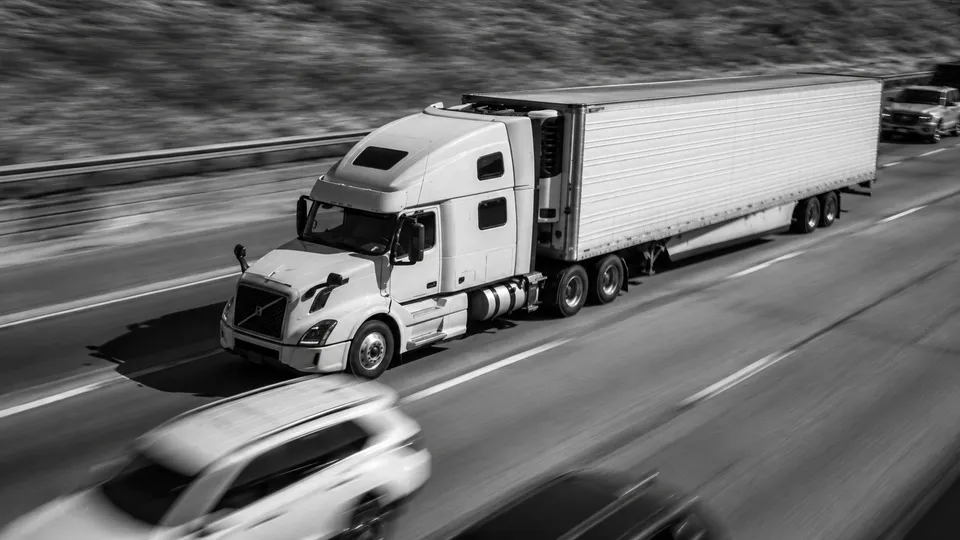
In July 2021 a truck driver named Baljit Singh, heading to an Amazon distribution center in Kern County, let his semitruck drift over the median on Merle Haggard Drive and killed a 26-year-old man on a motorcycle. California Highway Patrol investigators alleged that Singh had driven past the 12-hour limit and was fatigued. In an overhead compartment they found pages from his log book, the record that is supposed to track his hours at the wheel, “ripped into small pieces.” They recommended a vehicular manslaughter charge. The Department of Motor Vehicles knew about the crash and had the power to suspend his license. It didn’t.
Eleven months later, in June 2022, traffic slowed outside Fresno. Singh’s red Freightliner, carrying fertilizer from Missouri at 65 miles per hour, did not slow in time. A fully loaded big rig at that speed needs close to two football fields to stop. It hit the back of an SUV carrying Loren Chow, his wife Jenny and their 17-year-old son home from a college visit, and flipped it. Jenny Chow died. Law enforcement said Singh caused the crash by driving too fast.
That is the opening case in an investigation by Lauren Hepler and Robert Lewis at CalMatters, and Loren Chow’s view of it is simple. “The death was completely avoidable. That accident never should have happened,” he told them. “She would have seen so much if only the DMV had done what any person in his right mind would have done, which is to suspend the license.” Singh and his attorney did not respond to requests for comment.
Two tracks, one of them slow
The mechanics matter here, because California has two ways to take a dangerous driver off the road, and they work very differently. The first is criminal. Under state law, a truck driver convicted of manslaughter is disqualified from driving big rigs for 12 months, and anyone convicted of felony vehicular manslaughter is generally supposed to get a three-year license revocation. That track is mostly automatic, but it waits for a conviction, and criminal cases can take years. Singh was not convicted of manslaughter in Kern and Fresno counties until 2024. Only then did the DMV take his license.
The second track is administrative. State law lets the DMV investigate drivers involved in fatal and serious-injury collisions and suspend their licenses with or without a conviction. The entire point of a discretionary power like that is that the criminal process is slow, and somebody has to decide what happens in the meantime. CalMatters found that the DMV routinely decides nothing.
The reporters went through court filings and DMV records for more than 130 commercial licensees charged with vehicular manslaughter between 2019 and early 2024, after fatal crashes either on the job or off duty in their own cars. Nearly half still held a valid Class A or Class B license as of late May. Nearly half of 130-plus means something like 60 people who have been charged with killing someone while driving and remain licensed to drive the heaviest vehicles on the road. A dozen of them got tickets for unsafe driving in a commercial vehicle after the fatal crash.
Then there are the points. Vehicular manslaughter is supposed to count as three points on a truck driver’s record. In almost every DMV record the reporters reviewed it was listed as two, which is the penalty for an ordinary driver. The DMV said in a written statement that it relies on the courts to tell it when a conviction involves a commercial vehicle. That handoff has failed before: a 2025 CalMatters investigation found convictions for killing people with cars that courts had never reported to the DMV.
Why the license is the lever
For most drivers a suspension is a weak tool, because plenty of people just keep driving on a suspended license. Trucking is different. Experts told CalMatters that a trucking company is unlikely to hand a loaded semi to someone without a valid commercial license, so for this group of drivers a DMV suspension really does keep them out of the cab. And the vehicles are enormous: a fully loaded semi can weigh 80,000 pounds, 20 times as much as a car. “One thing goes wrong, you’re gonna kill somebody,” said Joe Rajkovacz, a longtime owner-operator and advocate with the Western States Trucking Association. Federal data show about 4,000 people died in large-truck crashes in California from 2015 through 2024.
The other cases follow the same pattern. One driver killed a 55-year-old man in Bakersfield in 2023, four years after he allegedly injured a woman with his semi in Sacramento. His record shows no DMV response, and he had another truck collision in 2025. Another driver had a reckless-driving and hit-and-run conviction, a 2023 collision in San Joaquin County and a missed court date on a Sacramento traffic ticket, then killed someone in Amador County, and this year picked up a speeding ticket and another collision. The DMV suspended his commercial license in September, after CalMatters asked about him. A third driver, with five earlier collisions including a fatal one in Riverside County in 2021, renewed his license last year, quickly got two speeding tickets in a commercial vehicle, and was still licensed as of September.
The DMV declined an interview and wouldn’t discuss specific cases. Shortly after CalMatters sent its list of drivers, it took action against a dozen of them, suspending licenses or removing commercial privileges. Spokesperson Jonathan Groveman wrote that the agency had recently updated how it handles fatal crashes and manslaughter convictions:
During this modernization process, the DMV identified some cases that had not been previously reviewed and have now been processed or are currently being processed.
In other words, some files had been sitting unopened. He added that law enforcement and the courts have to report to the agency promptly for it to act. Earlier this year, asked by KGET about the Singh case, a DMV spokesperson said the department “carefully reviews each traffic incident and takes action under California law as appropriate.” Those two statements are difficult to fit together.
California’s licensing of truck drivers is getting plenty of attention right now, just about a different question. The Trump administration says the state has been improperly issuing commercial licenses to people who don’t meet immigration or language standards, and in January Transportation Secretary Sean Duffy moved to withhold about $160 million in federal highway money over it; the final figure was $158.3 million. The records CalMatters reviewed don’t include drivers’ immigration status. That fight is about who should get a license in the first place. Much less attention goes to what happens after a licensed driver kills someone.
Tami Friedrich, president of the Truck Safety Coalition, whose sister, brother-in-law and their two children died in a crash with a big rig just after Christmas in 1989, said professional drivers carry “a certain level of responsibility above and beyond a regular car driver.” The cases CalMatters examined suggest California doesn’t hold them to it.
There is one area where the DMV does not wait for the courts. In 2023, months before it finally suspended Singh’s license, the agency started sending Loren Chow letters threatening to garnish his wages, seize his property and put a lien on his home. The issue was a late registration fee on the SUV, which had been totaled by the driver the DMV left on the road.