
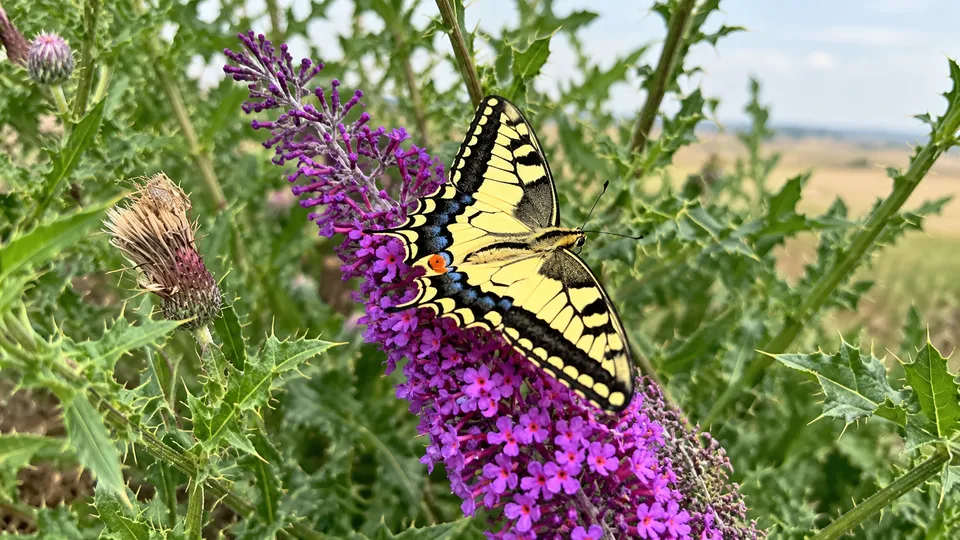
The bold patterns on butterfly wings work like the spinning stripes of a barbershop pole, scrambling a predator’s ability to judge speed and direction in the instant before it strikes, researchers in Britain reported this week.
The study, published in the journal Nature, offers the first direct evidence that butterfly wings produce what biologists call motion dazzle, a form of camouflage that works only in flight. The team combined high-speed video of real takeoffs, simulations of nearly 400 European species, touch-screen tests with human volunteers and more than 50,000 wing patterns evolved by computer.
The experiment grew out of a paradox. Many butterflies are vividly marked, yet almost no predators can catch one in the air, while plainly colored moths are the preferred prey of many hunting birds. George Hancock of the University of Exeter in Cornwall, a co-author of the study, suspected the wing patterns themselves were part of the defense.
“The stripes and spots on many butterflies’ wings interfere with the way visual systems try to guess the direction and speed of moving things, boosting false motion cues while hiding the butterfly’s true heading,” Mr. Hancock said. “The illusions interfere with the predator’s most basic visual targeting system and disrupt the final ‘ballistic attack’ in the tens of milliseconds when it commits to grabbing its prey, with no time to change course. As a result, birds and other predators will often simply miss.”
The mechanism is mechanical. A butterfly’s wings deform as they flap, coming together on the upstroke and separating on the downstroke, so the stripes on them shift angles and point in new directions beat by beat. Paired with a flight path no one can predict, the effect sends false motion signals to anything watching.
Jolyon Troscianko, also of the University of Exeter, saw it as soon as he ran the footage through a model built to mimic bird vision. “The first slow-motion video of a butterfly I put through our bird-vision computer model was glowing with downwards motion even though the butterfly was moving up,” he said. “First I checked this wasn’t a coding error, that I’d swapped up and down somehow, but then it dawned on me that this would be a perfect way to confuse attacking predators.”
The simulations that followed found the illusion across nearly all of the roughly 400 European species studied. When human volunteers tried to catch virtual butterflies on a touch screen, the patterns tripped them up as well. Then the researchers ran genetic algorithms through more than 50,000 wing designs, rewarding whatever produced the strongest dazzle, and the winners came out looking much like the wings found in nature, which suggests evolution itself selected for the effect.
Motion dazzle has been suspected elsewhere for years. A 2014 simulation study argued that a running zebra’s stripes mislead both predators and biting insects through this illusion and the related wagon-wheel effect, which reverses perceived motion. In 2024, researchers at Macquarie University showed that the humbug damselfish, a striped reef fish, speeds away from cover and blurs its own outline, so predators misread its speed and course.
The dazzle effect can come from contrasting vertical stripes on the forewing, a single vertical band or strongly contrasting patterns along the wing margins, and it likely works alongside the other proposed purposes of wing markings, from sexual signaling to regulating body temperature. Next, the authors plan to add the patterns on the underside of the wings and more realistic flight dynamics to their models, though they do not expect their conclusions to change.
“The dazzling stripes on zebras and snakes have long been suspected of confusing predators’ motion perception, but firm evidence has been hard to come by,” Mr. Troscianko said. “Our study gives us a genuinely new way to analyze motion vision, and we think motion confusion is likely to be far more widespread in nature than previously realized, from the flapping wings of birds to the flicking tails of lizards and fish.”