

Seventy-seven children, out of 128 excavated at two Bronze Age cemeteries in northern Serbia, got placed in their graves according to the same rule that governed adult burials: men on one side, facing one way; women on the other side, facing the other way. That is the headline number from a study of the Maros culture, published in Archaeological and Anthropological Sciences by Mina Amzirkov of the University of Belgrade and colleagues, which used proteins preserved in tooth enamel to establish the biological sex of children whose skeletons were too undeveloped to sex by eye.
The two sites are Mokrin, used from roughly 2100 to 1800 BC, and Ostojićevo, used from roughly 1900 to 1550 BC, both in Vojvodina near the border with Romania. Mokrin is one of the larger Maros cemeteries known: 312 graves excavated in campaigns in the 1960s and 1970s, with eight more added since a renewed excavation began in 2020, and the original excavator estimated 50 to 100 more graves remain unexcavated. The Maros culture itself spanned parts of modern Serbia, Hungary and Romania during the Early and Middle Bronze Age.
The rule, and the problem with testing it on children
The adult pattern at both cemeteries is consistent: men were laid on their left side, head to the north, face to the east; women on their right side, head to the south, also facing east. Archaeologists had documented this for adults for decades. Whether it applied to children was a harder question, for a mechanical reason: the skeletal markers used to sex adults (pelvis shape, skull robusticity) only develop at puberty, so a child’s skeleton usually gives no reliable signal of its biological sex independent of its burial position. Testing whether children got sexed burials against what sex the children were risks circularity if sex is inferred from the same position the study is trying to explain.
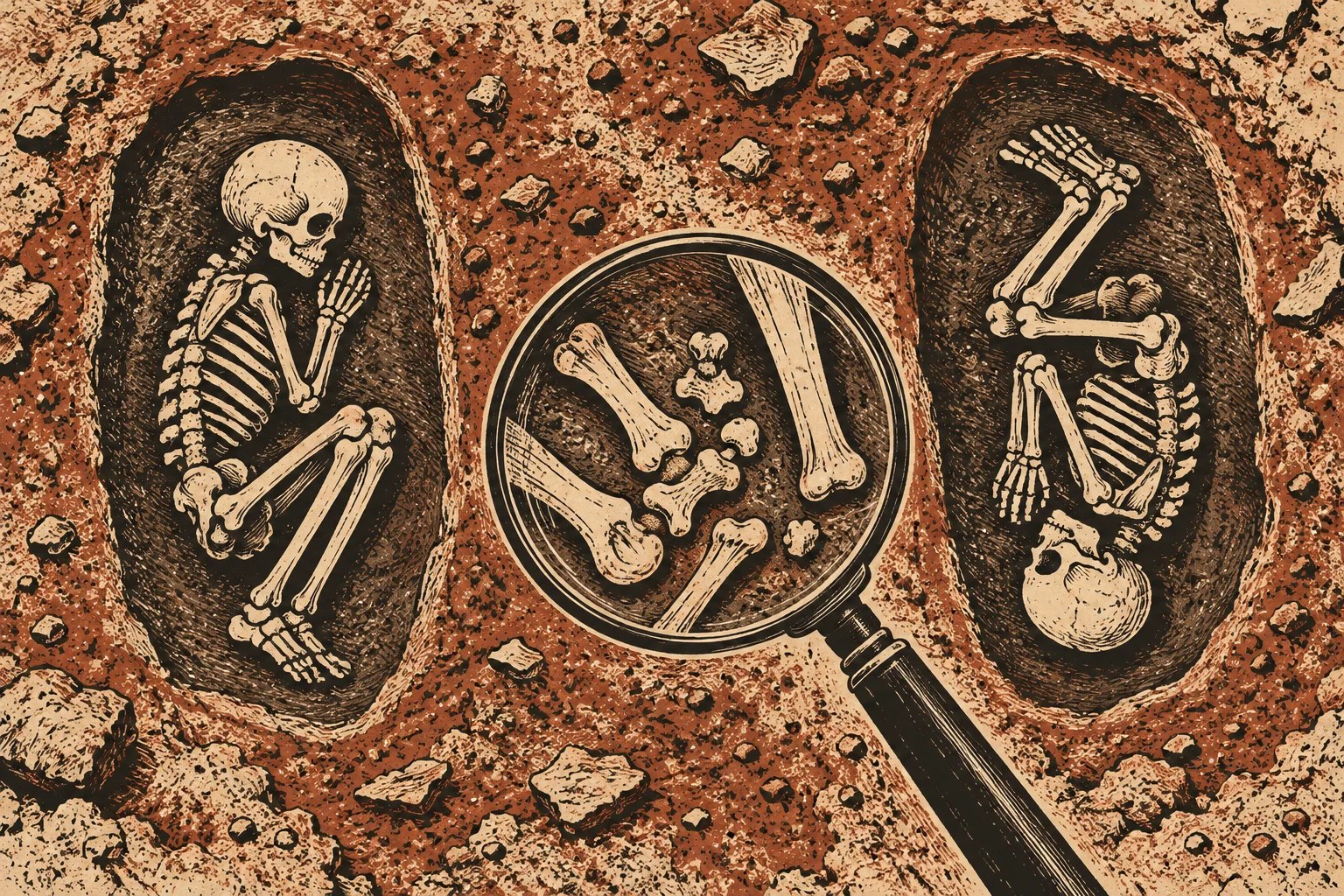
The fix is a method that does not depend on bone shape at all. Amelogenin, a protein in tooth enamel, comes in two forms, one encoded on the X chromosome and one on the Y. Mass spectrometry on a tooth sample can detect which form, or both, is present, giving a sex call independent of skeletal development. Amzirkov’s team got usable protein results for 76 children; a 77th had already been sexed by ancient DNA in an earlier study. That left 77 sexed individuals out of 128 total children and subadults in the sample, ranging from roughly 9-to-12 months old to 18-to-22 years.
What the comparison showed
At Mokrin, head orientation (north for boys, south for girls) tracked sex closely; the side the body was laid on tracked less closely. At Ostojićevo the fit was closer: among the 17 children whose position could be scored, no boy lay on his right side and no girl lay on her left, matching the adult rule with no exceptions in that subset. Grave goods followed a parallel split in the wider Maros record: weapons cluster with adult male burials, ornaments such as pins and necklaces with female ones, though children’s graves generally hold fewer objects than adults’, which is part of why body position carries more evidential weight for them.
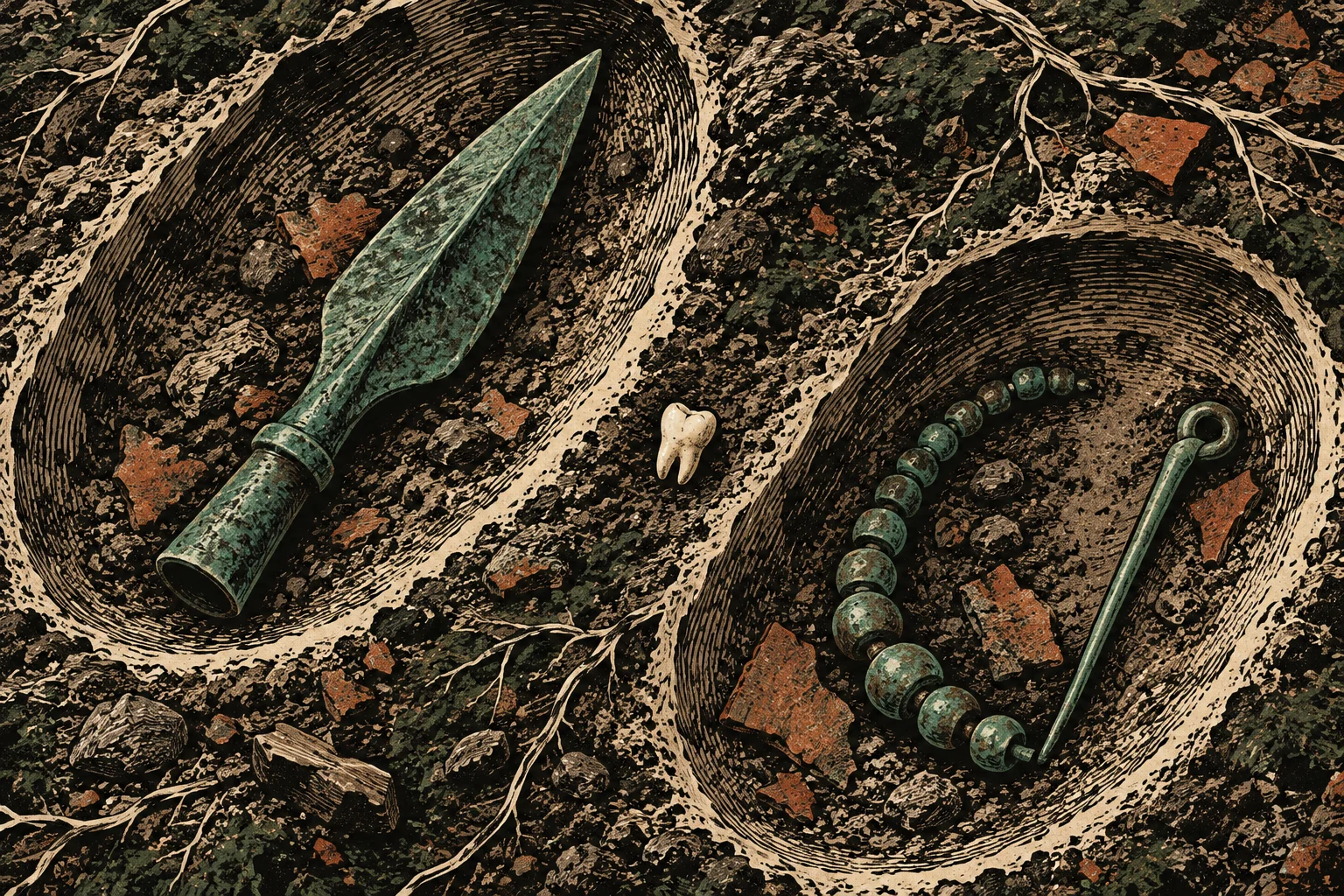
Six graves at Mokrin broke the pattern: four boys buried on the female side/orientation, two girls buried on the male side/orientation. Three of the boys, in graves numbered 25, 103 and 236, were about four to seven years old, and their skeletons were poorly preserved; the authors flag that the recorded body position for these three could itself be an excavation-era recording error, not a real exception. The other three are harder to wave away. Grave 220 held a boy of about 10 to 11, sexed by the earlier DNA study, buried on his right side with no grave goods, following the female pattern. Grave 216 held a girl of about 8 to 9, buried on her left side with no grave goods, following the male pattern. Grave 238 held a girl of about 14 to 15, buried with pottery and animal bone, also on her left side.
That last case shows how much excavation-record quality matters to this kind of analysis. An earlier publication had listed the Grave 238 girl as lying on her right side, which would have made her burial conform to the female rule. Amzirkov’s team went back to the original excavation photographs and found she actually lay on her left, flipping her from a conforming case to an exception. The authors found no common thread among the three better-preserved exceptions: different ages, different grave locations, different numbers of grave goods, which leaves the explanation for each open rather than pointing at one cause.
The Serbian results line up with the one other study that has run the same test elsewhere. At Franzhausen I in Austria, a large Early Bronze Age cemetery of 716 burials, researchers led by Katharina Rebay-Salisbury used a comparable protein method, mass spectrometry on tooth enamel, to sex 70 of 75 sampled children reliably. There, 62 of 63 scorable burials matched the adult-style sex/position rule used in that part of Central Europe, a 98% hit rate; the lone mismatch there, as in Mokrin, did not point to an identifiable cause. Rebay-Salisbury’s team is also a co-author on the new Serbian paper, which makes the two studies a matched pair rather than independent confirmations drawn from unrelated groups.
Put the two together and the exception rate across both cemetery systems sits in a narrow band: 6 of 77 at Mokrin/Ostojićevo (8%), 1 of 63 at Franzhausen I (1.6%), though the Serbian figure is inflated by three cases the authors themselves say may be recording errors rather than real departures from the rule. Strip those out and the Serbian exception rate drops to 3 of 77 (4%), closer to the Austrian number. Neither study can say what, if anything, distinguished the children buried against the pattern: whether illness, status, adoption, a death away from the settlement, or simple excavator error in the 1960s dig notes decided it. The authors are explicit that grave position measures funerary custom, not how a child or their community understood the child’s identity in life, a distinction the paper keeps separate from its statistics.
The open question is whether the same protein method, applied to the dozens of Maros cemeteries that have never been resampled this way, will keep producing exception rates in the low single digits, or whether Mokrin’s three unexplained cases are evidence that the rule had more give in it than the Austrian data alone suggested.