
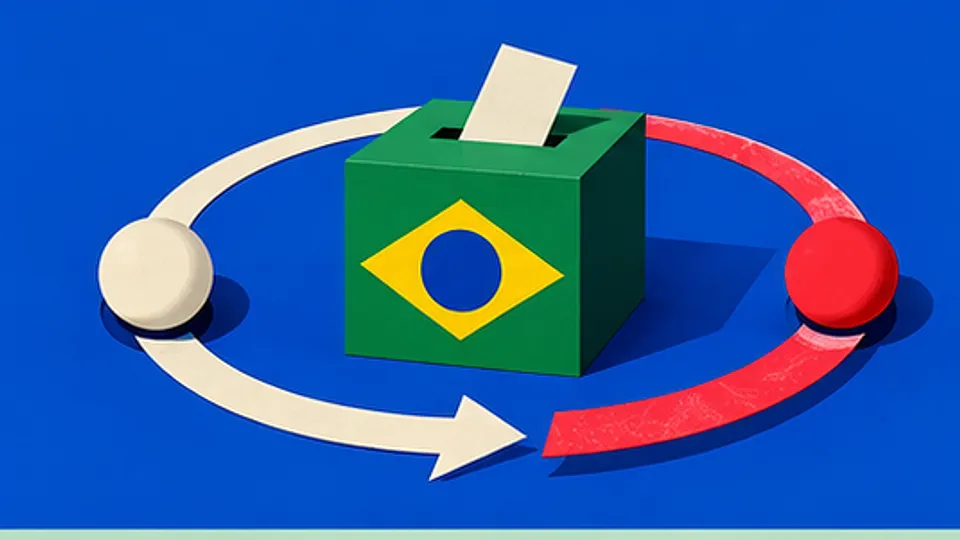
Brazil spent Sunday holding the first round of a presidential election and, for the second cycle in a row, earned itself three more weeks of Lula versus Bolsonaro. This time the Bolsonaro is the son. Senator Flávio Bolsonaro, the 45-year-old heir to his father’s right-wing movement, finished first with 47.1% of the valid vote to President Luiz Inácio Lula da Silva’s 45%, with 98% of ballots counted, according to Brazil’s Superior Electoral Court. In raw votes, the court had Bolsonaro just over 56 million to Lula’s 53.7 million with 99.8% reporting. Neither cleared the 50% needed to win outright, so they meet again on October 25.
The interesting part is not that the race is close — polls going in had a runoff with the two roughly tied — it’s that the order was wrong. Private surveys had Lula leading the first round by about 3 percentage points. Analysts who spoke to Reuters had a specific theory for the miss: Flávio was vacuuming up “protest votes,” ballots cast against Lula rather than for him, that voters were supposed to save for the second round. The standard logic of a two-round system is that you vote your heart in round one and your grudge in round two. Brazil’s anti-Lula vote apparently decided not to wait. Flávio said beforehand he was counting on “a protest vote from people who would otherwise vote for another candidate but are opposed to Lula,” adding, “I hope it’s enough to secure a victory in the first round.”
It wasn’t, quite. But the voters Reuters and NPR found on Sunday suggest the mechanism was real. Thaise Lima, a 41-year-old lawyer in São Paulo, said her main goal was evicting the Workers’ Party: “I don’t think Flavio is the best candidate, but I might decide to vote for him in the next few minutes.” Fernando Tempel, a management consultant, had planned to vote for Minas Gerais governor Romeu Zema before switching to Bolsonaro. Caio Farias, a Rio businessman, preferred other right-wing candidates but backed Bolsonaro in the hope of ending the whole thing in one round.
The arithmetic
Now do the runoff math, which is the part that should worry the incumbent. Lula and Bolsonaro together took more than 92% of the vote. The eliminated candidates collected 7.82%, and — per NPR — the third-, fourth- and fifth-place finishers are all right-wing, giving Bolsonaro what looks like a natural pool of transfers. El País went further and called those votes “virtually guaranteed” for him. Two moderate also-rans, Ronaldo Caiado and Renan Santos, have previously said they won’t endorse either finalist, though their voters don’t need permission. Lula, meanwhile, was already running as the lone progressive in the field, so he has no obvious coalition to absorb; his main untapped reservoir is the roughly 21% of eligible voters who stayed home on Sunday, and both campaigns will now spend three weeks trying to drag them to the polls.
The geography was worse for Lula than the topline. The Southeast holds nearly 40% of the electorate, and Bolsonaro won both São Paulo and Minas Gerais — the latter a state that has backed the national winner in every presidential election since 1989, and where Lula managed just 43.21%, down from the 48.3% he took there in the first round of 2022. He also failed to build the margin his campaign wanted in his Northeastern stronghold. Flávio, for his part, improved on his father’s 2022 first-round score by nearly four points and drew more raw votes than Jair ever did, which is why CNN’s read — that he may have expanded the movement rather than merely inherited it — is the scarier sentence in this story for the left. Down-ballot, the right also made significant gains, particularly in the Senate, and took governorships in key states.
Both men claimed the moment. “Brazil wants change, that’s the reading of what happened today,” Bolsonaro said outside his Brasília home. “It’s the end of the Workers’ Party era.” (El País noted, a little cattily, that he mentioned neither his father nor God.) Lula called the result “unexpected” — he had thought he could win in one round — and promised, “Tomorrow we start a new campaign. I am very good in the knockout stage. We will see who has the best plan.” Then he went for the biography: “On the other side we have an uncertainty with a biography of a dark past.”
The biography cuts both ways, and this is a genuinely strange family business. Jair Bolsonaro is serving a 27-year prison sentence under house arrest for plotting to overturn the 2022 election he lost to Lula by about 2.1 million votes. His eldest son has pledged to pardon him if elected and campaigned on bringing him back to politics. Meanwhile Flávio is himself being investigated by federal police for money laundering connected to the Banco Master affair — the collapsed bank whose arrested owner, Daniel Vorcaro, stands accused of a multibillion-dollar fraud and whose contacts reportedly reached from Supreme Court Justice Alexandre de Moraes to the candidate himself. Flávio denies wrongdoing, though he confirmed raising millions from Vorcaro to finance a movie about his father, a sentence that really does stand on its own. The whole tangled case has hung over the campaign for weeks, and the scandal’s brush with Moraes — widely seen as a Lula ally — threw the court into crisis a month before the vote, which is part of why the policy debate was so thin that both leading candidates simply skipped the major TV debates. Roughly half the country disapproves of the Bolsonaro family; roughly half disapproves of Lula’s party. Pick your poison, twice.
The Washington variable
The big difference from 2022 is that Donald Trump is in the White House and has views. He hosted Flávio in the Oval Office and praised him publicly — whether that amounts to a formal endorsement depends whom you ask: CNBC says he has not formally endorsed anyone, CNN says he openly endorsed Bolsonaro earlier in the campaign. Lula’s accusations are more concrete: tariffs on Brazil, the revocation of his ambassador’s visa, and sanctions on government officials and a Supreme Court justice, all of which he calls election meddling. The US denies interfering and declined to comment to CBS on whether it is trying to. Since Trump’s return, no left-wing candidate has won a presidential election in Latin America, and CNN reports that Washington hopes a Bolsonaro win would complete what it calls the “Donroe Doctrine” and help contain China in the region’s biggest economy.
What’s notable lately is the silence. Trump has been conspicuously quieter in recent weeks, and international relations professor Farid Kahhat told CNN that is strategy, not boredom: “They’ve noticed that in Brazil, [interference] might not work the same way as it does in Honduras or Colombia.” Political scientist Manuel Alcántara Sáez agreed, saying another open intervention would probably help Lula, who has been campaigning on national sovereignty and currently enjoys strengthened approval whenever he stands up to Washington. Argentina’s Javier Milei, who insulted Lula at Bolsonaro’s campaign launch, has likewise piped down. The regional right, at least, is celebrating: Colombia’s president posted that “True change is defeating the left,” and Milei declared that “The American continent is made up of citizens who want to live in freedom.” Bolsonaro rallies have featured American flags and a giant inflatable Trump holding a jailed Lula doll, which at least makes the alignment easy to photograph.
The vote itself, it should be said, went fine. The OAS observer mission reported that “the voting has been going smoothly and under adequate safety conditions,” and electoral court chief Kassio Nunes Marques said there was “no concrete indication of international interference” — a sentence doing a lot of work in a campaign where Brazilian intelligence reportedly briefed French and German officials on alleged US and Russian meddling. No significant fraud has ever been detected in Brazil’s electronic voting system since its adoption in the 1990s.
Whoever wins takes office on January 5, 2027, inheriting 214 million people, public debt above 82% of GDP and growth forecasts just cut to 2.0% this year and 2.3% next. In 2022 the runoff period brought a sharp spike in political violence; voters this time told NPR the campaign felt muted mostly because everyone is tired of fighting. Lula says he is very good in the knockout stage. For the next three weeks, Brazil gets to find out — with the incumbent trailing, the challenger under criminal investigation, and both of them disliked by half the electorate. The market had priced this as a binary; it never was one. Washington, having concluded that saying less helps more, can be expected to keep not saying so at considerable volume.