
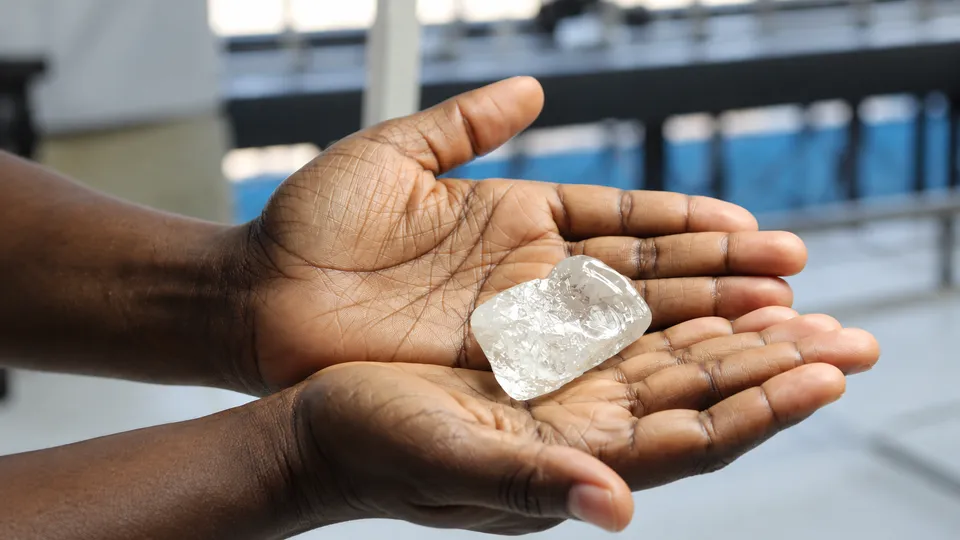
Botswana marked 60 years of independence from Britain this week with Diamond Jubilee celebrations across a country that began statehood as one of the poorest on earth and is now an upper-middle-income economy.
In 1966, the former Bechuanaland Protectorate had barely 12 kilometers of paved road, 22 university graduates and about 100 secondary-school graduates. Between 1965 and 1980, the economy grew 13.9 percent a year on average, and by 2025 gross domestic product per capita had reached about $7,800 — above South Africa’s roughly $6,600, in a reversal of the two countries’ standing on the continent.
Botswana in 1994 became the first country ever to graduate from the United Nations’ least-developed list. Its road network now runs nearly 35,000 kilometers. By 2024, 80.2 percent of the population had electricity, and the 2022 census found 66.5 percent of Batswana living in urban areas, up from 9.1 percent in 1971.
The gains ran through public services. Secondary schools held 192,151 pupils in 2022, and 60,287 students were enrolled in tertiary institutions in 2024. The national poverty rate fell from 30.6 percent in 2002/03 to an estimated 14.5 percent by 2022. Today, 85 percent of Batswana live within five kilometers of a health facility, and almost all births take place in one.
The record on H.I.V. is stronger still. In 2002, Botswana started Africa’s first national free comprehensive H.I.V. treatment program. Twenty-three years later, the World Health Organization recognized it as the first high-burden country to reach Gold Tier status on the path to ending mother-to-child transmission. Ninety-eight percent of pregnant women with H.I.V. receive treatment, transmission to children has fallen to about 1.2 percent and life expectancy stands at 69 years.
Politics held, too. In 2024, after 58 years of Botswana Democratic Party rule, voters chose the opposition Umbrella for Democratic Change, and the outgoing government handed over power peacefully. On the track, Letsile Tebogo won the country’s first Olympic gold medal in Paris in 2024, Collen Kebinatshipi took the world 400-meter title a year later and in May Botswana staged the World Athletics Relays in Gaborone, a first for Africa, and won the men’s 4x400-meter title before the home crowd.
Diamonds paid for much of it. Botswana owns 50 percent of Debswana, the mining venture it runs with De Beers, and the Pula Fund, its sovereign wealth fund, sets aside revenue for future generations and cushions the economy against mineral shocks. Foreign reserves equal to 7.5 months of imports give another layer of protection.
The same stones are the country’s chief exposure. Over the past decade, diamonds made up almost 90 percent of goods exports, and they still bring in about a third of state revenue and three-quarters of foreign-exchange earnings. When demand for natural diamonds softened and lab-grown stones selling for a fraction of the price took share, the economy contracted 2.8 percent in 2024 and another 0.7 percent in 2025. The latest household survey puts unemployment at 21 percent, and 28.9 percent among people aged 15 to 35.
“Botswana largely avoided the resource curse, yet it never overcame its heavy reliance on diamonds,” Tafi Mhaka wrote in an analysis published by Al Jazeera this week. The challenge at 60, he added, is “no longer how to turn diamonds into development, but how to create prosperity that can survive without them.”
A 2025 agreement with De Beers gives the state-owned Okavango Diamond Company 30 percent of Debswana production, rising to 40 percent after 2030 and potentially 50 percent thereafter, with provisions for jewelry manufacturing, diamond grading and vocational training.
Beyond stones, some foundations exist. Internet access reached 68.9 percent of households in 2024, up from 40.6 percent a decade earlier, but information and communications technology still accounted for only 2 percent of employment in 2025. Tourism provides about 50,500 jobs, 6.7 percent of total employment, and more than 60 percent of services exports, with roughly 40 percent of the country’s land under protected status. A 500-megawatt solar plant with 500 megawatt-hours of battery storage is being built at Maun. Yet more than 95 percent of private-sector sales stay domestic, and only 9 percent of surveyed firms export at all.
The stakes reach past Botswana’s borders, Mr. Mhaka argued, because its record stands against other resource-rich African states. In Zambia, where copper dominates exports, 71.7 percent of people live on less than $3 a day, according to World Bank figures cited in the essay. The share is 85.3 percent in the Democratic Republic of Congo, rich in copper and cobalt, and 41.8 percent in Nigeria, Africa’s largest petroleum producer.
Mr. Mhaka closed with an old Setswana saying, “Moenyane o pele lebone la waabo” — the one who goes ahead becomes a light for those who come after. “May Botswana light the way for Africa,” he wrote.