
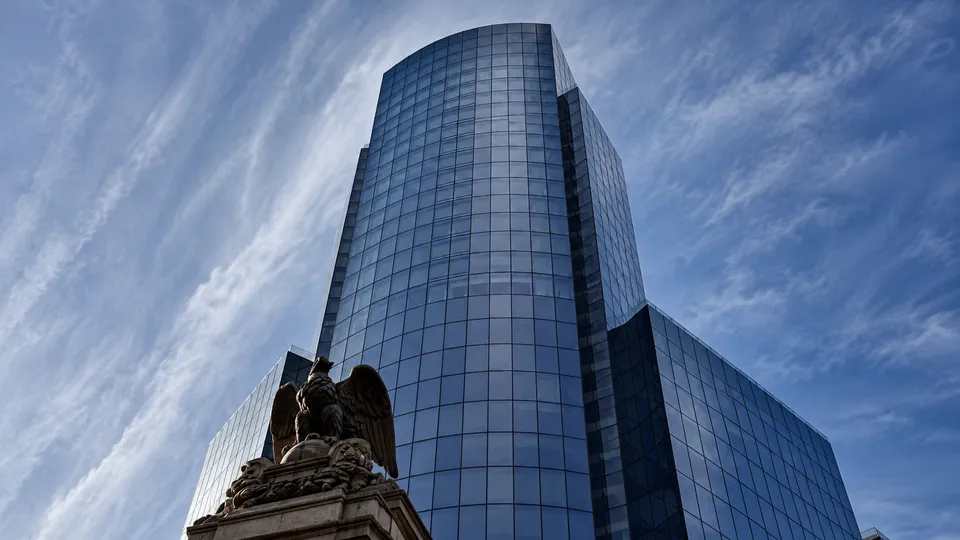
Here is roughly what it costs to buy the empty air above the busiest train station in Boston. The Boston Redevelopment Authority sold the air rights over South Station to the developer Hines for $7.2 million, payable over 13 years. Hines also agreed to make “tower payments” of $93,750 a month to the city until 2044 — that’s about $1.1 million a year, or roughly $28 million if the payments run the full 25 years described in the deal — plus 1 percent of the value of initial condo sales to a city affordable housing fund. Call it $35 million and change, spread over decades, for permission to stack a $1.5 billion skyscraper on top of the city’s rail hub. Plus, to be fair, a bus terminal upgrade the developers had promised long before, valued at $39 million back in 2006.
What Hines built up there is genuinely astonishing, as Catherine Carlock reports in the Boston Globe, in the seventh installment of a Globe series on the Massachusetts economy. South Station Tower rises 51 stories and 690 feet — more than two football fields stood on end — directly above live train tracks, subways, buses, and the commuters flowing through Dewey Square. It contains 166 Ritz-Carlton-branded condos, 680,000 square feet of Class A office space, and a private park with nearly an acre of landscaping, walking paths, and amphitheater seating in front of a grand fireplace, all of it 120 feet in the air on the 11th floor. Twenty-five floors above that, a 72-foot-long pool on an outdoor terrace overlooks Back Bay. There is a “casual fine dining” restaurant called The Moseley on the ninth floor. There is also a duplex penthouse — three bedrooms, five bathrooms, two parking spaces — with a contract pending at $12.5 million.
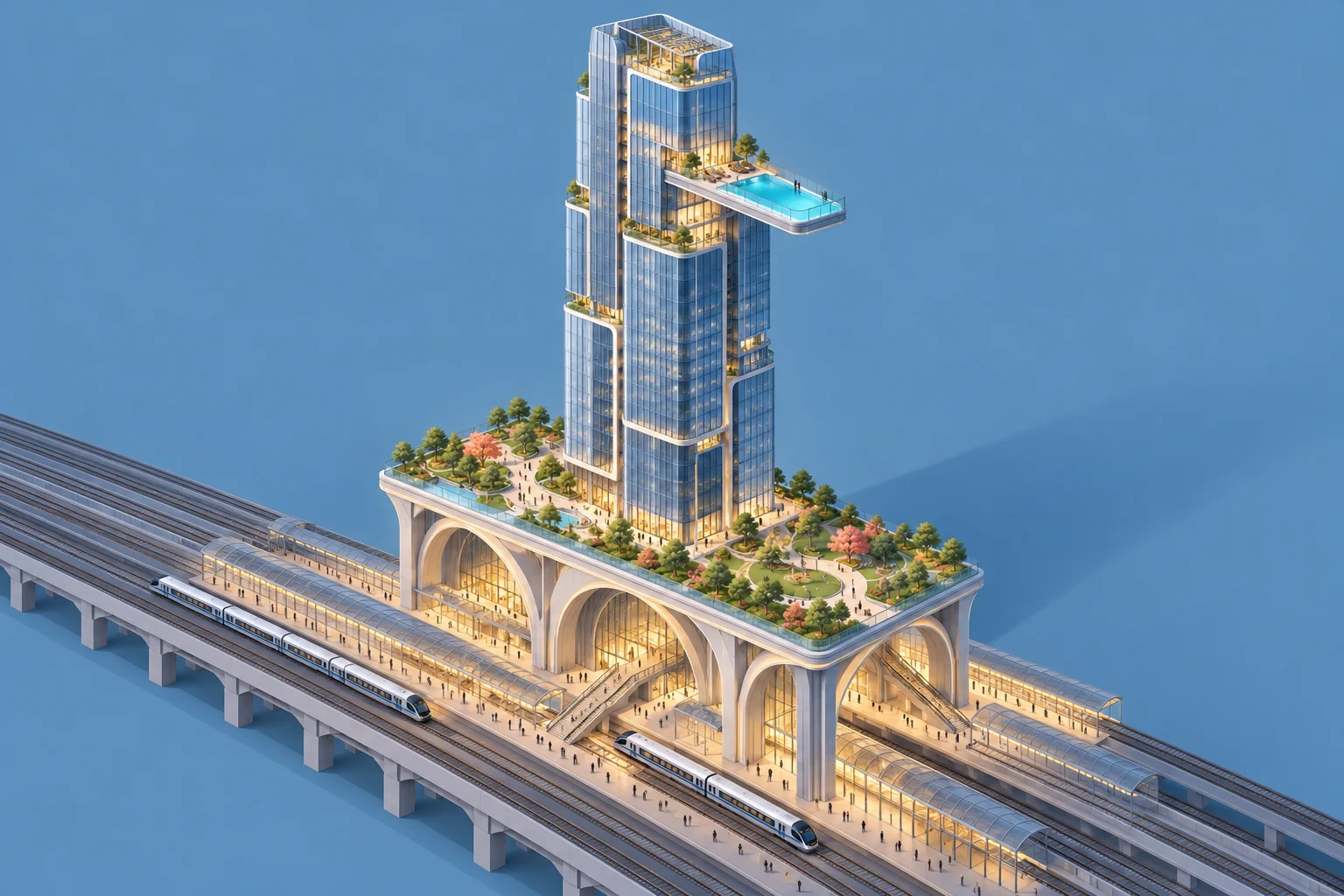
It is also, for the moment, the end of something. Investors spent much of the past decade treating Boston commercial real estate as one of the safest bets on Earth, and half of the city’s ten tallest towers were built after 2015: Millennium Tower, Winthrop Center, One Dalton, One Congress. South Station Tower is the last of the boom to be finished, which gives it the peculiar distinction of being both a triumph and a cautionary tale at once.
The cautionary part starts with the calendar. The tower opened last fall; it was first envisioned in the 1970s, by Jean Mayer, the longtime president of Tufts University. Former Tufts provost Sol Gittleman remembers Mayer as a visionary — “a charming Frenchman ... a brilliant, manipulative, wonderful, creative guy” — who looked down from Medford at a struggling downtown and imagined labs, apartments, offices, and a hotel rising over the grand old station, to the benefit of Tufts and Boston alike. Universities think on generational timelines, and this one took it literally: Tufts brought in Hines, a Texas firm with air-rights experience above Grand Central Terminal, in the late 1990s, and the two began the mammoth work of figuring out how to build over an operating rail hub.
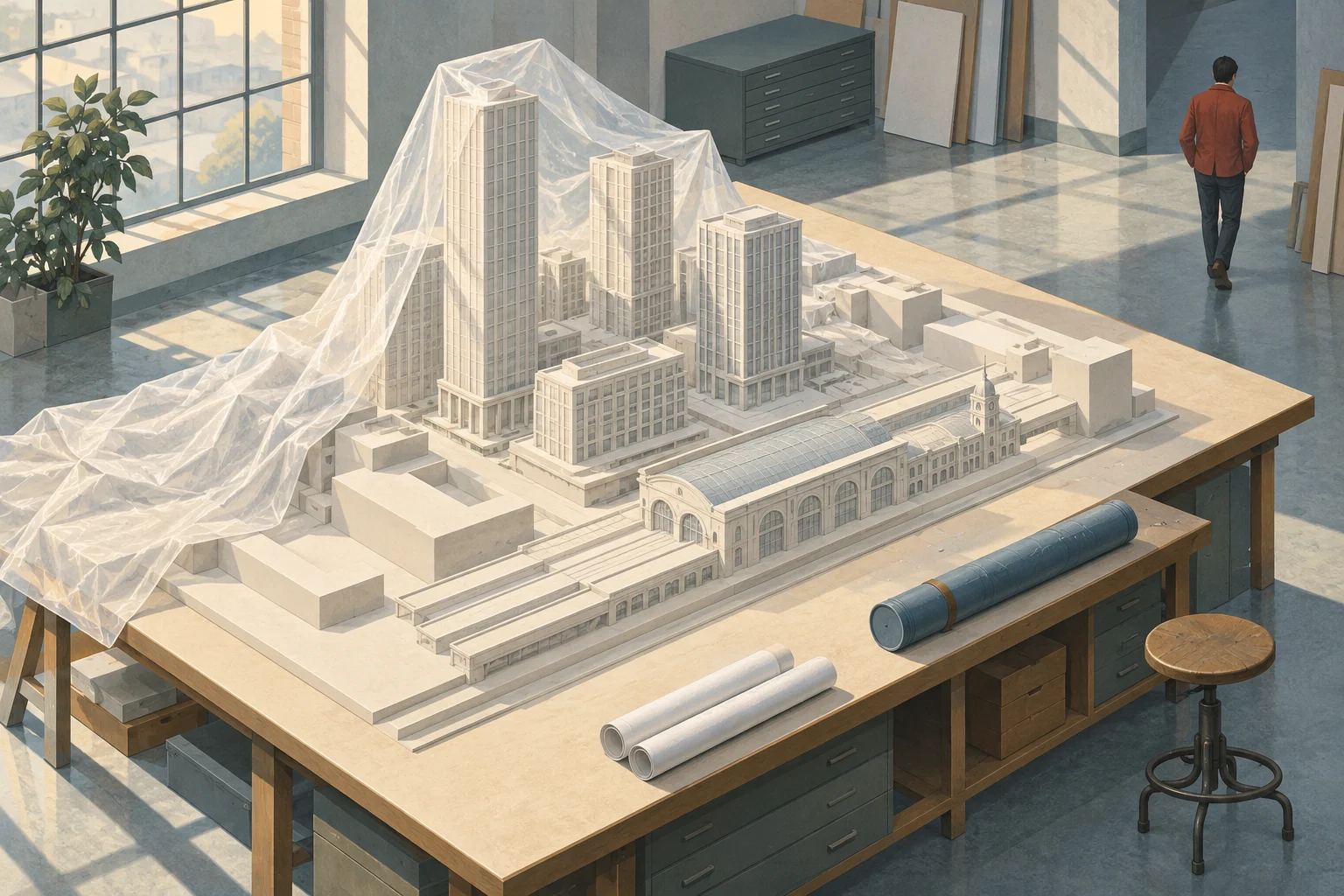
In 2006, the BRA approved the pair to build up to 2.36 million square feet — an office tower, a hotel, housing, a second office building, 755 parking spaces — sweetened by the promised $39 million bus terminal expansion. A miniature of the project sat in the BRA’s model room. Then came the Great Recession, and Tufts, under new leadership, walked away.
When Hines brought the project back to City Hall in 2016, it was alone, and the building had changed: the tower would now be split between offices and condos, with parking bumped past 1,000 spaces — because, as the Globe dryly notes, people paying seven figures for a condo expect to park in the building. The more consequential change was in what the city asked for. By then, under Mayor Martin J. Walsh, Boston had started leaning harder on big developers for public benefits. At nearby Winthrop Center, proposed around the same time, Millennium Partners agreed to pay up to $153 million for a crumbling city-owned parking garage, to finance an affordable housing project in Chinatown (which still hasn’t been built), and to keep the building’s ground floor open to the public as a “Great Hall.”
At South Station Tower, the ask was softer. The Walsh administration raised the project’s affordable housing contribution to just under $5 million — the Globe notes a similarly sized project newly proposed in 2016 would typically have owed more than double that — and the city didn’t push for the community space or programming that had become standard. Brian Golden, then head of the Boston Planning & Development Agency, says that was deliberate. “The BRA was very sensitive to the possibility of destroying or further delaying the project,” he said. “It called upon the agency to be very careful at ensuring that we got all the benefits of the project without breaking it.”
Which is a real argument, you should admit. The tower broke ground just before COVID-19 rewired every assumption underneath it, and then an army of workers actually had to assemble 51 stories of steel and glass in the air above a functioning station. Mahesh Daas, president of the Boston Architectural College, calls it among the most complicated things ever built in Massachusetts, second only to the Big Dig: “It’s an accomplishment of mammoth proportions. It is an engineering wonder, and an architectural wonder, too.” Fine. But “don’t break the project” is also a sentence every developer’s lobbyist would happily print on a mug.

And the project, as a business, arrived just as the cycle turned. A skyscraper is a bet that a downtown will still want downtown things, and South Station Tower opened years into a public-health hangover that upended how downtowns function. It took six months after opening to lease even half the office space. The tenants are mostly law and financial firms relocating from elsewhere in Boston — jobs moving sideways, not new ones. The corporate logo that will soon light the tower’s crown belongs to JPMorgan Chase, which is headquartered in New York.
The disparities are harder to summarize, so here are two facts from the Globe’s account, and no jokes. Last winter, a $14.1 million penthouse in the tower sold a few weeks after an unhoused man froze to death on the sidewalk hundreds of feet below. Most Bostonians’ experience of the building will be passing beneath its vaulted archways on the way to a train.
The tower did produce public goods: the expanded bus terminal is critical infrastructure paid for with private money, and an estimated $600 million in condos fattens the property tax base. Alicia Sasser Modestino, director of Northeastern University’s Dukakis Center for Urban and Regional Policy, gives the whole saga the most accurate available review: “It is a really great example of the good, the bad, and the ugly. As a city, we keep trying to do better at this, and I think we do get better at it. But we’re still pretty far away from the ideal.”
The next Boston skyscraper will get the city’s chance to prove the “getting better” part. Given where the office market is, it may be quite a while before anyone finds out — which means the last tower of the boom gets to stand there, blue glass and 690 feet, as the permanent record of a bargain City Hall was too nervous to strike harder.