
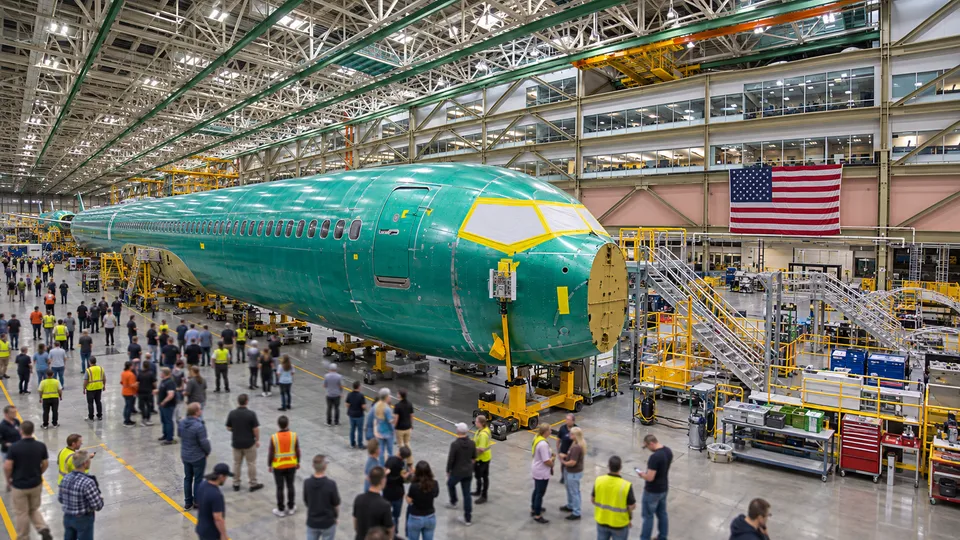
Some words in corporate language carry a whole argument inside them, and spare the person who uses them from having to make it. On Monday, 9 November, Boeing used one of them. The word was “overstaffed.”
It turned up in an internal memo from Stephanie Pope, chief executive of Boeing Commercial Airplanes, the division that builds the 737 and the other jets that carry millions of travellers around the world. Business Insider obtained the memo and published it in full. The division will cut about 5% of its workforce, Pope wrote, “through a combination of attrition and involuntary layoffs, with notifications beginning in December.”
Her explanation took one sentence:
Adjusting our production schedules and reducing aircraft output puts us in an overstaffed position.
The factories are not building planes as fast as the plan said they would. So the people who were hired to build them faster now count as surplus.
The arithmetic
The division, known inside the company as BCA, is Boeing’s largest business and employs about 50,000 people. Five per cent of that comes to roughly 2,500 jobs. Boeing has not given an exact figure, and it has not said how many of the departures will be forced rather than left to attrition.
BCA’s books explain the hurry. Last quarter it brought in 44% of the company’s revenue and lost $697 million. In Boeing’s third-quarter earnings release the division shows $10.7 billion in revenue on 161 delivered jets, out of $24.2 billion for the company as a whole. The defence and space business and the services arm both made money in the same period. The part of Boeing the public knows best, the part that makes airliners, is the part that bleeds.
The number 47
The story begins with a door plug. In January 2024 a panel blew out of an Alaska Airlines 737 Max in flight, and Boeing fell into a crisis over quality and safety that it has been trying to climb out of ever since. One measure of the climb is the production rate of the 737 Max, its most popular aircraft. The target for this year was 47 a month.
That target slipped. On the earnings call on 27 October, Boeing’s chief executive, Kelly Ortberg, told investors that “it is taking us longer than we had expected to demonstrate performance at rate 47.” The company now expects to reach that rate in early 2027, and is aiming for 52 a month in the second half of that year. As CNBC summed it up, there will be no significant increase in 737 Max output until late 2027.
The market answered in its usual way. Boeing’s shares fell 10.7% after the call, and the stock is down 25% so far in 2026. Two weeks later, the workforce got its answer too.
Two years of investment
Pope’s memo opens on a note of pride. Over the past two years, she wrote, the division made “significant investments in talent, training, and infrastructure” to steady the business. Those investments, together with the employees’ work, brought better quality and delivery performance, certification of the 737-7 and 737-10, and “positive changes to our culture.” Then comes the turn: “While we have made substantial progress, we have not yet fully recovered.”
Read as a whole, the memo describes a familiar cycle. A company in disgrace hires and trains people so that it can recover. The recovery runs slower than promised, and some of those same people end up on the cost side of the ledger. The memo never says this. Its timeline says it for it.
There is a pattern behind the pattern. Bloomberg reported that these are Boeing’s first job cuts since Ortberg took over in 2024 and eliminated 17,000 positions that year, and called them a sign that the turnaround is far from finished. Each round of cuts gets presented as the cost of a recovery. The recovery stays in the future.
The language of the memo also tells you something about power. When the plan is made, it is “we” who invest, “we” who make progress. When the plan slips, the slip belongs to the “production rate ramps” and to the “supply chain partners” who need “additional time to achieve stability.” Pope does not name any executive who misjudged the pace. The weight lands on payroll.

Dignity and respect
Pope wrote that she knew “how difficult these actions are and the impact they will have on all of us, our families, and our communities,” and that the company would “never take that lightly.” In a statement issued after the cuts were announced, Boeing said it was working with staff to “minimize the impact” by “supporting their career transition through company-sponsored outplacement services, layoff benefits, and employee assistance program support.” The memo promises that through all of it the company will “ensure that everyone is treated with dignity and respect.”
It is a strange calendar. The notices go out in December, in the weeks before the holidays. The factory rate that would have justified keeping those 2,500 jobs, 47 aircraft a month, now has a date in early 2027. By the company’s own schedule, those workers will be gone before the planes they were hired to build start coming off the line at the promised pace.
Pope signed off with her first name only. “By continuing to care for one another, uphold our standards, and work together with purpose,” she wrote, “we will complete our recovery and build a stronger future for BCA.” About one in twenty of the people she addressed will not be part of that future.