
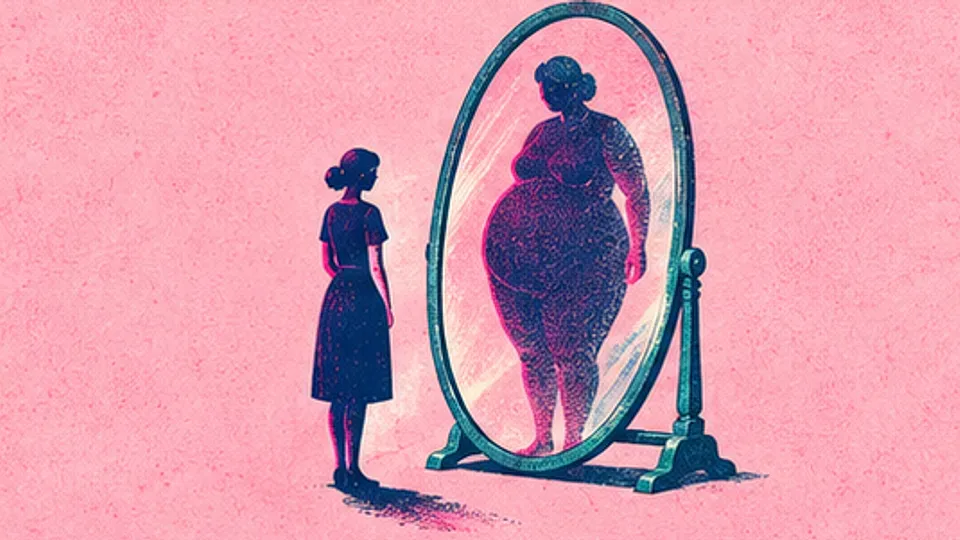
Asked to match a computer-drawn figure to their own bodies, women misjudged in opposite directions — thinner women picked a figure slightly too large, heavier women one slightly too small — and women who worried about their shape added size at every weight, according to a new study of 269 women published in the journal Frontiers in Psychology.
In the test, each woman moved a slider that swelled or slimmed a figure on a screen until it matched what she thought her own body looked like, 20 times in all. The pattern that emerged, reported by Lise Gulli Brokjøb and six colleagues in Norway and Britain, came down to two separate forces. The first is a normal habit of perception that drags any guess toward the average. The second is a woman’s anxiety about her own body, which pushes her estimate up whatever her real size.
The first force is what researchers call contraction bias. With no tape measure in the head, the mind estimates from a fuzzy signal mixed with what experience says is likely, a strategy that lands closer to the truth over many guesses but pulls extremes toward the middle. The same drift shows up when people judge how loud a sound is, how far away an object or how long a moment. The farther a woman’s real size sat from average, the farther her guess slid toward it, so the thinnest and heaviest women missed by the most. The team called it “a perfectly normal perceptual bias” and had seen the same pattern in an earlier study.
The second force showed up when the women answered questionnaires about body dissatisfaction, worry over eating and the wish to be thin. Women who scored higher “consistently judged themselves to be larger” than women of the same size who scored lower, and the added size was about the same whether a woman was thin or heavy. The effect works like thick-soled shoes, which add the same height to a short person and a tall one: each force does its own job, and the two simply add up. Age behaved much the same way; older women picked somewhat larger figures than younger women of the same weight. Real size, age and body-image anxiety together explained 77 percent of the differences in the women’s guesses, with real size doing most of the work.
The findings fit a long-standing account of body image, the two-component model, which holds that how big people think they are depends on what their senses report and how they feel. Earlier work had squeezed the feelings into one score; Ms. Brokjøb, who did this research as a student, split them apart. Four clusters emerged: body-image anxiety, mood, awareness of the body’s inner signals, and pressure from family and peers to be thin. All four rose and fell together, and mood sat in the middle of the map linking the rest, its strongest connection running between feeling down and worry about eating. But when all four were tested against the guesses at once, only body-image anxiety still predicted them. It alone, the authors wrote, “directly influences behavioural judgments of body size.”
One of the clusters got special attention. Feeling what happens inside the body — a racing heart, a hungry stomach — is called interoception, and earlier work found that people who sense their own heartbeat more accurately are harder to fool with an illusion that makes a rubber hand feel like their own. Here, measured by questionnaire rather than heartbeat counting, body awareness made no clear difference to the size guess once weight and anxiety were accounted for, and parts of the questionnaire itself seemed to capture anxiety: women who noticed more bodily sensations also reported more worry, which the authors say may be a kind of “hypervigilance.” They suggest testing interoception directly next time, for instance by asking people to count their heartbeats.
The authors draw two lessons. First, healthy perception misses a little on purpose, so “deviations in body size perception should not automatically be interpreted as pathological,” or read as signs of illness. Women with a history of anorexia nervosa, an earlier study by the team found, got their size wrong in a different way: most accurate at very low weights, overshooting farther as weight rose, with no pull toward the middle at all. Second, any full account of body image needs both forces, the everyday drift toward average and the worry each woman carries.
The study has limits. It measured each woman only once, so the push could also run the other way, a bigger felt size feeding the worry. The 269 volunteers, mostly Norwegian women aged 16 to 64 recruited through ads, took the test online and reported their own height and weight, and more than a quarter scored in the range that flags a likely eating disorder. The four clusters, and the finding that only body-image anxiety was tied directly to the guesses, stay “provisional” until further studies check them.