
In the Pilbara, in the red far north of Western Australia, the iron ore does not move by itself. It moves because someone keeps the generators humming and the current flowing down the wires to the crushers, the railways and the shiploaders on the coast. For nearly six decades that someone was the miner itself: the region’s independent system operator records that the Rio Tinto Group has run its own power generation, transmission and distribution there since 1967, with four power stations, fourteen major substations and more than 900 kilometres of 220 kV and 132 kV lines feeding its mines, ports and the towns where its workers sleep. Now Rio Tinto wants to sell the heartbeat, and the keepers of the world’s savings are queueing at the door.
The latest arrivals in the auction are Blackstone, the private capital juggernaut, and IFM Investors, owned by Australia’s industry superannuation funds, Street Talk in the Australian Financial Review reported. IFM, advised by Macquarie Capital, lodged an indicative proposal late last week with Morgan Stanley, the bank running the process for Rio Tinto, sources told the paper on condition of anonymity. Its sights are on the miner’s roughly 500 megawatts of Pilbara power plants and the transmission, distribution and loading assets that go with them. The full package on the block — spanning Western Australia and Canada — is valued at $7 billion.
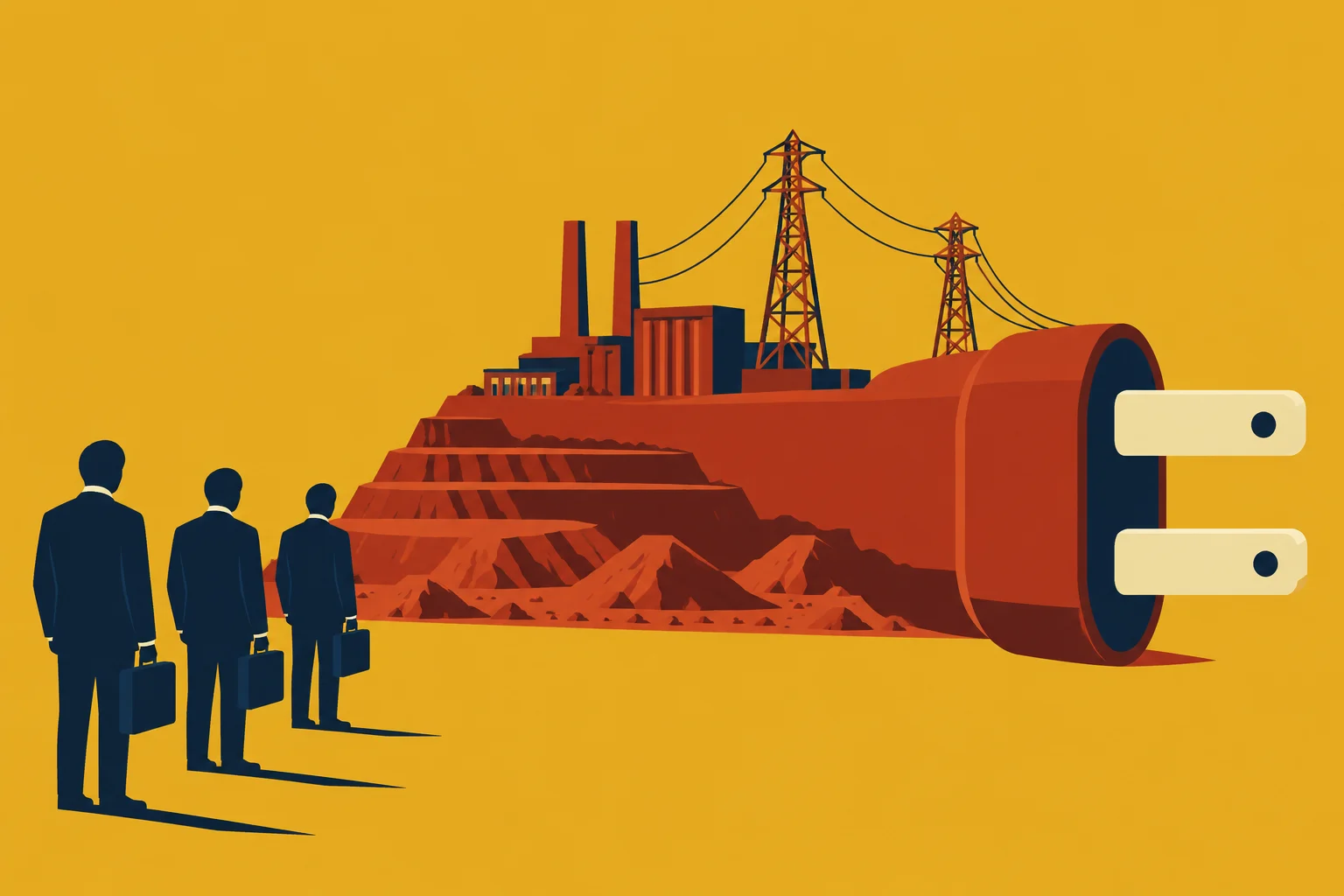
Every auction of this kind is a small history of an era. In the last decade Australia’s governments sold ports and poles and wires to whoever brought the largest chequebook, and the essay the Financial Review offers is that this sale reads as an echo of those privatisations — except that the seller is not a state treasury but one of the oldest mining houses on earth, and the bidder field is fat enough that some very big names will end up, as the paper puts it, on the cutting room floor.
The queue was forming before Blackstone and IFM arrived. Singapore’s sovereign wealth fund GIC has already mandated JPMorgan to ready a bid for both the Pilbara and the Canadian assets, and the global buyout firm KKR has been counted among the suitors preparing first-round offers. Sovereign funds, super funds, private equity: the money that now runs the world’s infrastructure prefers tollbooths to adventures, and a power plant contracted to an iron ore mine is among the dullest and safest tollbooths there are.
Why a miner sells its own lights
For the empires of the pit the logic is old and unsentimental. A mining company built power stations because nobody else would build them in the desert; owning them was the price of the ore. But capital locked in boilers and pylons is capital that cannot chase the next orebody, and a generation of shareholders has taught the big miners to prefer rent to ownership. What changes in the Pilbara is the name on the gate. What does not change, so long as the ore bodies last, is the demand: the mines must be lit, the trains must run, and whoever holds the wires will be paid — one suspects the buyers have done precisely that arithmetic — for a very long time.