

A petition with about 175,000 signatures and a letter from two shareholders holding a combined $2.15 billion of Nvidia stock are the public face of a question Nvidia’s board has not answered: whether to rehire the founder it let go eleven days ago over an affair and an unresolved national-security inquiry, not over anything in a quarterly report. Jensen Huang resigned as Nvidia’s president, CEO and sole executive board seat on November 12, after 33 years running the company he co-founded in 1993. He has since discussed a comeback with confidants, and allies are assembling what one described to the Financial Times as a “war room” of Silicon Valley executives to lobby for his return, RNZ reported, citing the FT. The same ally told the paper the group would seek backing from the White House.
The petition, titled “Stand with Jensen,” has grown by roughly 15,000 to 25,000 signatures a day since launching around Huang’s resignation: from over 100,000 to 115,000 to 130,000 across four days, then past 175,000 by Sunday, according to TechRadar, and nearly 180,000 by Monday morning per CNBC. By the petition’s own self-reported tally, about 5,900 signers identify as current Nvidia employees, 1,100 as former ones, and more than 62,000 as shareholders — affiliations the site itself says are unverified. Signatories include Elon Musk, Epic Games’ Tim Sweeney, Y Combinator’s Garry Tan, Shopify’s Tobias Lütke, former Uber CEO Travis Kalanick and Hugging Face’s Julien Chaumond.

Nvidia’s stock was already down more than 20% in the month before Huang quit. It closed at an all-time high of $239.24 on October 6; by Monday, November 16, it closed at $160.95, a 32.7% decline. On the day of the resignation it fell as much as 14% intraday, erasing up to $601 billion in market value at the low — a figure that, had it held to the close, would have been the largest single-day market-cap loss for any stock on record. The stock pared that to a 4% close. Nvidia then closed below $4 trillion in market capitalization on November 13 for the first time since July 2025, and posted its sixth straight weekly decline — the longest losing streak since 2012 — shedding roughly $1.7 trillion in market value that week. At least seven Wall Street firms cut price targets; Bernstein halved its target from $400 to $200.

The Board Holds Every Vote
Huang does not hold a controlling stake in Nvidia, which means the board, not public sentiment, decides whether he returns. Treasury Secretary Scott Bessent used a Sunday Fox News appearance to argue the opposite of what the petition wants: “They need a dramatic shake-up,” he said, telling Nvidia’s board it should look outside the company for a successor and, separately, answer questions about export-control compliance within ten days. Anthony Scaramucci, the former White House communications director, dismissed the comeback campaign outright, arguing the open investigations present obstacles a petition cannot overcome.
Not every major investor agrees the board should rule Huang out. Altimeter Capital’s Brad Gerstner (holding about 9.4 million Nvidia shares, worth near $1.9 billion) and Atreides Management’s Gavin Baker (1.2 million shares, near $250 million) sent the board a joint letter on Friday urging a “slow, measured, and deliberate process” that keeps “all options on the table, including the potential return of Jensen Huang,” while conceding the final call is “the Board’s prerogative.” Counterpoint Research’s Neil Shah told CNBC a Huang comeback would be “good for the stock,” since “the trillion-dollar capex... has to continue to make this train keep going” — though he questioned whether Huang could operate with the same speed under any new guardrails the board might impose.
The Investigation Nobody Has Finished
Nvidia’s board has hired former Manhattan federal prosecutor Joon Kim to run an independent investigation into the conduct behind Huang’s exit, and that inquiry is still open. Its origin: The New York Times reported on October 29 that Huang had developed a “close relationship” with Alice Huang (no relation), an executive at Singapore-based Nvidia customer Megaspeed International. US officials had flagged her as a possible Chinese intelligence asset as early as 2024; Singapore authorities confiscated her passport in June 2025 and later barred her from the country after she allegedly gave police “inaccurate information.” The Times reported on November 6 that China’s Ministry of State Security had specifically recruited her to target Huang — a claim US intelligence officials themselves reportedly disagree on the strength of. Huang admitted to an extramarital affair on November 8 without naming her; four days later, after the Times reported a second affair with Nvidia health-care vice president Kimberly Powell, a direct report, he resigned.

Megaspeed told CNBC that Alice Huang left the company on August 30, 2025, and said it has retained outside counsel for its own internal probe into its export-control compliance, calling itself a “compliant and legal company.” That timeline is disputed: short seller Culper Research cited a Megaspeed employee in a May report saying Alice Huang was “actually still our boss.” Singapore’s government says it opened its own investigation into Megaspeed in February 2025 over possible false declarations tied to server purchases, and that inquiry, along with police investigations into Megaspeed and six individuals, is ongoing.
A $4 Billion Customer and a Cabinet Feud
The China angle matters because Huang spent years pushing Washington to loosen chip export rules he saw as leaving money on the table — he told the Milken Institute in 2025 that China’s AI-chip market alone could reach $50 billion, “like Boeing — not a plane — the entire company,” as CNN reported. The Biden administration restricted advanced-chip exports to China anyway; even after Nvidia built a compliance-friendly chip for that market, the Trump administration restricted it too, a move Nvidia said would cost it $5.5 billion. Nvidia says its China revenue has been “zero” since those April 2025 restrictions. Yet by early 2026 the US government had cleared ten Chinese companies to buy Nvidia’s H200 chip, per Reuters, and Megaspeed alone is estimated by some analysts to have bought more than $4 billion of Nvidia chips before the scrutiny began. Treasury staffers reportedly wanted Megaspeed added to Commerce’s export blacklist months ago; Commerce Secretary Howard Lutnick was briefed on Huang’s relationship with Alice Huang around the same time and has not added the company, prompting Bessent to publicly accuse Lutnick’s department of stalling and triggering internal discussion of whether Lutnick should be removed — discussion the White House says Trump has rejected, calling Lutnick the “most transformative Commerce Secretary in modern history.” Lutnick has agreed to testify before the Senate Banking Committee. Separately, a Super Micro Computer founder was indicted in March over an alleged $2.5 billion server-smuggling scheme to China, evidence that chips have reached China through other channels regardless of the rule Huang argued against.
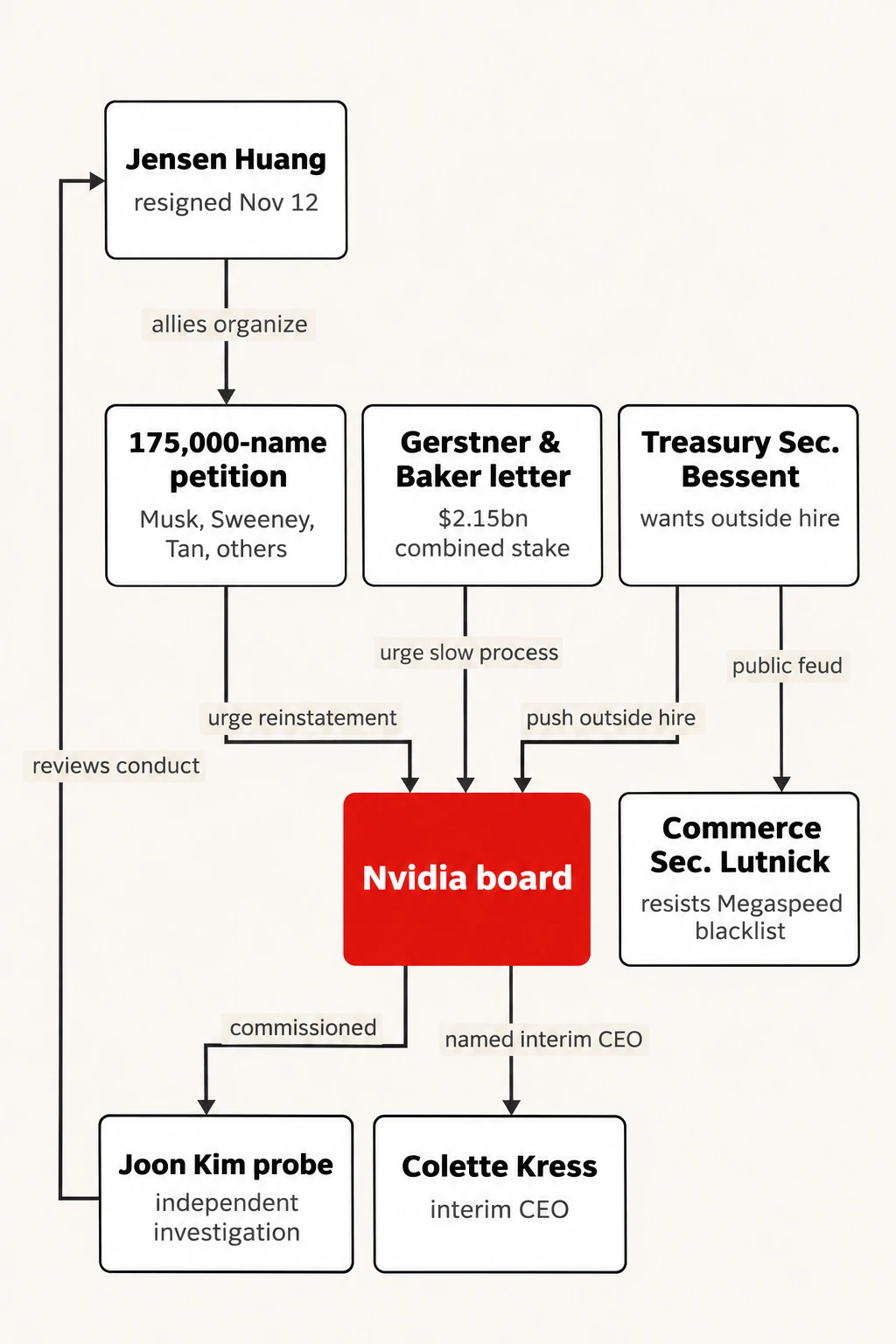
| From | To | How |
|---|---|---|
| Jensen Huang (resigned Nov 12) | 175,000-name petition (Musk, Sweeney, Tan, others) | allies organize |
| 175,000-name petition (Musk, Sweeney, Tan, others) | Nvidia board | urge reinstatement |
| Gerstner & Baker letter ($2.15bn combined stake) | Nvidia board | urge slow process |
| Treasury Sec. Bessent (wants outside hire) | Nvidia board | push outside hire |
| Treasury Sec. Bessent (wants outside hire) | Commerce Sec. Lutnick (resists Megaspeed blacklist) | public feud |
| Nvidia board | Joon Kim probe (independent investigation) | commissioned |
| Joon Kim probe (independent investigation) | Jensen Huang (resigned Nov 12) | reviews conduct |
| Nvidia board | Colette Kress (interim CEO) | named interim CEO |
Based on Nvidia SEC filing; CNBC and Financial Times reporting
Who Gets the Job
Kress, Nvidia’s CFO since 2013, is running the company day to day while keeping her finance title, per Nvidia’s November 12 filing with the SEC, which also named board member Harvey Jones as the company’s first-ever chair. The Financial Times reported the board had approached Arm CEO Rene Haas, a former Nvidia executive from 2006 to 2013, as a possible permanent successor. Nvidia denied it: “We are in the process of selecting a search firm for the NVIDIA CEO role. We have not formally engaged any potential candidates,” a spokesperson told CNBC, calling any candidate speculation premature. A Haas move would complicate matters beyond Nvidia — he also runs SoftBank’s overseas business operations, a role SoftBank (which owns about 86% of Arm) gave him in April. AMD’s Lisa Su and Apple’s Tim Cook have also been floated, without any reported approach.
The Skepticism, the Suit and the Next Number
Not everyone accepts the espionage framing that triggered the crisis. Representative Jim Himes, the Connecticut Democrat on the House Intelligence Committee, told Politico that US intelligence briefings left him unsure whether Alice Huang knowingly passed information to China; former White House AI adviser David Sacks posted that “the spy narrative is collapsing already.” Some in tech now argue, per Business Insider, that China hawks overstated the espionage case specifically to force Huang out, given his advocacy for chip sales to China. A shareholder lawsuit filed Monday alleges Huang was deceptive when the board asked him about the Alice Huang relationship; the Senate Banking Committee’s chairman has said Congress is prepared to subpoena Huang if he won’t testify voluntarily.
Nvidia reports fiscal third-quarter results on Tuesday, November 17, at 1:20 p.m. Pacific, per the same SEC filing that confirmed Huang’s departure — the first numbers investors get on the company’s actual business, rather than its personnel, since he left. The board’s own next disclosed step is naming a search firm, not a candidate. Whether that firm’s eventual list includes the founder it just pushed out is a question nobody with an actual vote has answered on the record.