
In the early 1980s the Press Trust of India, then the country’s largest news agency, ran its newsroom in New Delhi on telex machines, and the noise of them was constant. A student in his mid-20s named Daya Thussu had a subediting desk there. Two rivers of foreign news reached him. One came from the established Western agencies, Reuters among them. The other came down a little-known line joining newsrooms in Asia, Africa and Latin America: the Non-Aligned News Agencies Pool, or NANAP.
“We would check the ticker to see what the story was and where it had come from,” Thussu told Gouri Sharma, writing for Al Jazeera. “It could be from anywhere - the Philippines, Iraq or across Africa. My job was to select stories that we would then send out to the PTI wires.”
The work was slow. Copy was edited by hand and passed to a typist, who put it into the system. Thussu was doing a PhD in international relations at Jawaharlal Nehru University at the time, and he remembers the desk as good training. Today he is a senior research fellow at the Institute of Commonwealth Studies at the University of London, and in 1992 he co-wrote Contra Flow in Global News: International and Regional News Exchange Mechanisms.
The cartel
The second river was there because of the first. By the middle of the 19th century three European agencies ruled the international news trade: Germany’s Wolffs Telegraphisches Bureau, Britain’s Reuters, and France’s Agence Havas, which later became Agence France-Presse. In 1859 they signed agreements that divided the world’s news markets and territories among themselves. Those agreements went a long way towards deciding which stories travelled, and to whom.
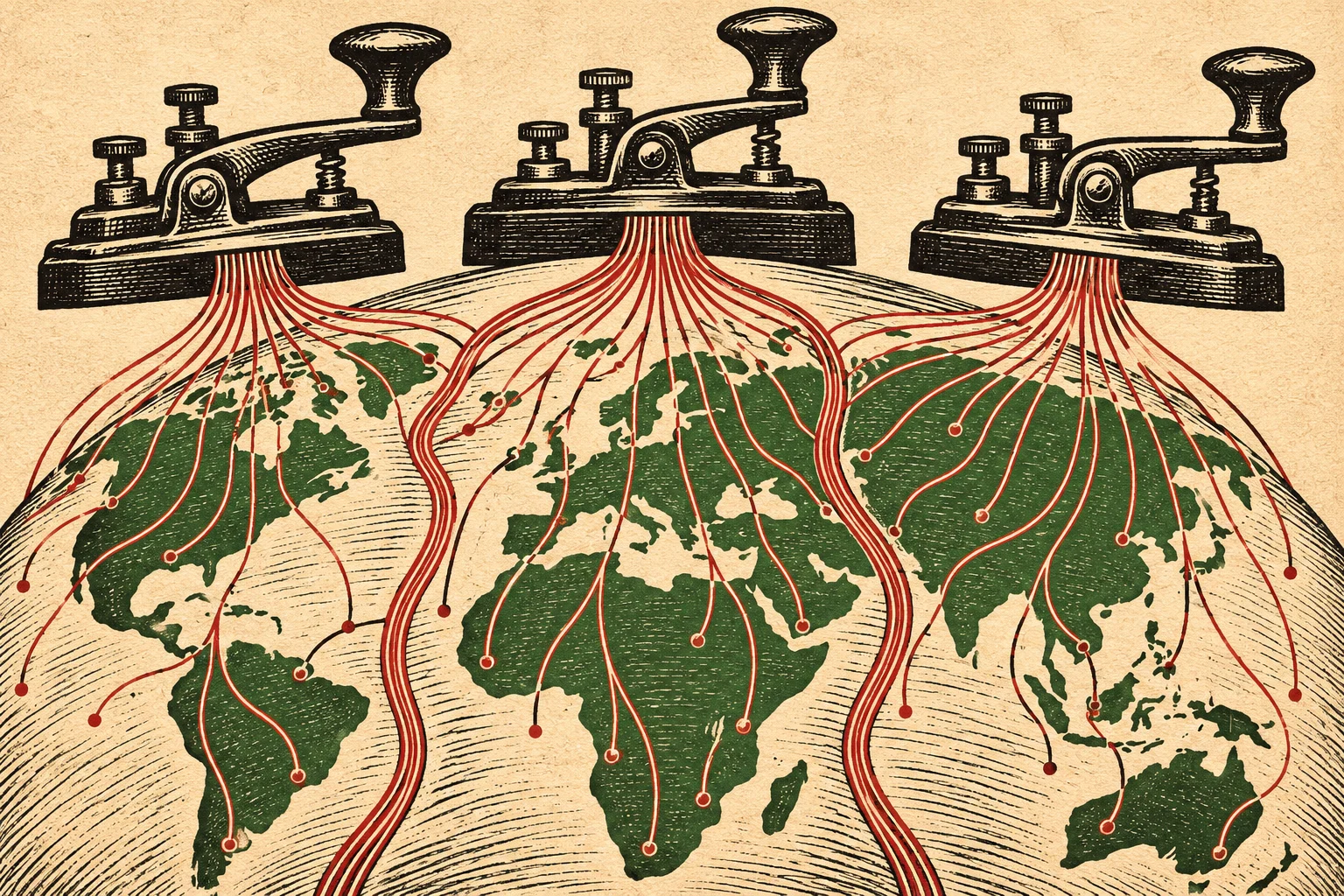
“It was a news cartel system,” Thussu says.
Reuters was founded in 1851, at the height of British imperial power. It used the telegraph and held exclusive rights to gather and sell news across much of the Empire, so its reach followed the Empire’s own lines. Scholars often call it “an empire within an empire”.
Here is one reflection, and it is offered as nothing more than that. Flags come down on a set date, and the ceremony is filmed. The wires that report the ceremony stay where they are.
From Bandung to Belgrade
In 1955, delegates from 29 Asian and African countries met in Bandung, Indonesia, to talk about a future after colonial rule. Six years later the Non-Aligned Movement was founded in Belgrade, then in Yugoslavia. The leaders linked to its founding were Tito, Nehru, Nasser, Nkrumah and Sukarno. At first the movement was loosely organised, and over time it took in Fidel Castro’s Cuba and Muammar Gaddafi’s Libya. By the time of the OPEC oil embargo in the early 1970s it had become more structured.
Sima Kokotovic, who studies global communication at the University of Pennsylvania, dates the practical steps to the movement’s conferences in Lusaka in 1970 and Algiers in 1973. As members pushed for self-reliance, they began asking about mass communication, about “how much it was being controlled and dominated by the media companies from the West and, to a degree, the Soviets”.
The Non-Aligned Movement became the home of debates about imbalances in the international system whether economic or cultural or information.
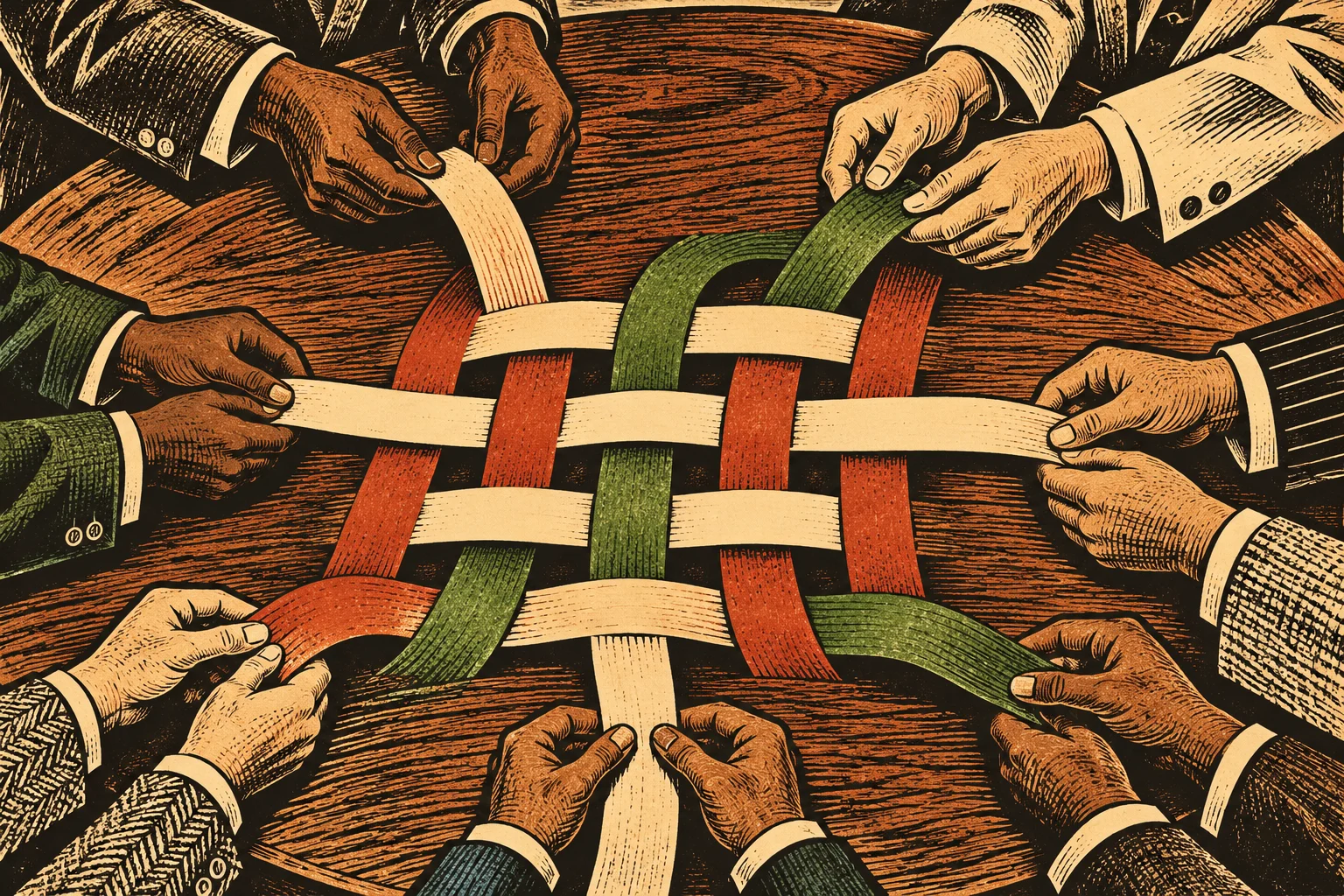
That is Thussu again. Those debates fed a campaign at UNESCO for a New World Information and Communication Order. Its backers wanted poorer countries to build stronger news agencies, their own broadcasting infrastructure and direct channels to one another.
Nabil Dajani, now 89 and an emeritus professor of media studies at the American University of Beirut, served on UNESCO’s International Panel of Experts on Communication Research from 1971 to 1975. He remembers feeling both energised and overwhelmed. “The Non-Aligned countries believed that the wealthy Western nations had imposed information imperialism on them, which was essentially a form of neocolonialism,” he says. In their view the big agencies reported on developing countries only when there were disasters, wars or epidemics. “So the underlying principle was that information is not merely a commodity but a fundamental human right.”
Thussu explains the same idea through geography. “Brazilians who were reading or watching news about the Philippines, for example, were getting information mediated through London or New York and vice versa.” The aim, as he puts it, was horizontal communication between nations with similar struggles, carrying culture and daily life as well as bad politics.
The first telex
The pool went live in January 1975. Tanjug, the Yugoslav state agency Tito had founded in 1943, sent a statement by Sri Lanka’s prime minister, Sirimavo Bandaranaike, by telex to the other participating agencies. A study of the pool’s creation by the Slovenian scholar Slaček Brlek, based on archival records, gives the start date as 20 January 1975. It also describes two motives behind the project. Tanjug wanted more global reach and a stronger place in the market, and Yugoslavia’s federal leadership saw the agency as a tool of foreign policy.

Ljubica Markovic was 24 when she joined Tanjug’s foreign desk, where she worked closely with the NANAP desk. She is 78 now and lives in Belgrade. “There was a great deal of enthusiasm for international media cooperation, largely as a result of Yugoslavia’s position in the world at the time,” she says. Belgrade was communist but outside Moscow’s camp, which made it a natural host for countries that wanted to answer to neither bloc.
What the powerful did next
The argument reached its high point in 1980 with the MacBride report, Many Voices, One World, produced by a UNESCO commission chaired by the Irish statesman Seán MacBride. Its full text criticised one-way flows of information and concentrated ownership. UNESCO’s General Conference approved it by consensus, in Belgrade. Major Western governments attacked it. The United States and Britain withdrew from UNESCO and took their funding with them. Britain came back in 1997 and the United States in 2003.
The pool did not last as long. When Yugoslavia broke apart, Tanjug went from founding member to observer. The pool fell into disuse in the mid-1990s and was replaced in 2005 by the NAM News Network. Al Jazeera describes Tanjug as still in existence. Yugoslavia’s old state agency was formally dissolved on 9 March 2021.