
There is a particular genre of lawmaking in which the law never names the thing it exists to prohibit. The drafters get asked, did you ban the headscarf? And they get to say, with complete technical accuracy, no. We banned clothing that violates the principle of secularism. If a headscarf happens to fall into that category, well, that is a matter for the school gate, not the statute book.
That, in essence, is what Azerbaijan has done. As Al Jazeera reports, an amendment approved last month stopped short of explicitly banning the Muslim headscarf in schools, but barred school clothing that the government says violates the “principle of secularism.” The effect has not been subtle: protests have broken out as some schools have begun preventing students and teachers from attending classes.
The mechanism here is worth dwelling on, because it is doing real work. A law that says “no hijabs” is a religious law. It invites a religious argument, an international one, and probably a constitutional one, and it gives everyone a single clear sentence to argue about. A rule that says “secular dress standards” is an education policy. It routes every dispute down to the level of a head teacher at a classroom door, deciding, case by case, morning by morning, whether what a particular girl is wearing complies. The ban stops being one decision made once in parliament and becomes thousands of small decisions made daily, each one too minor to appeal.
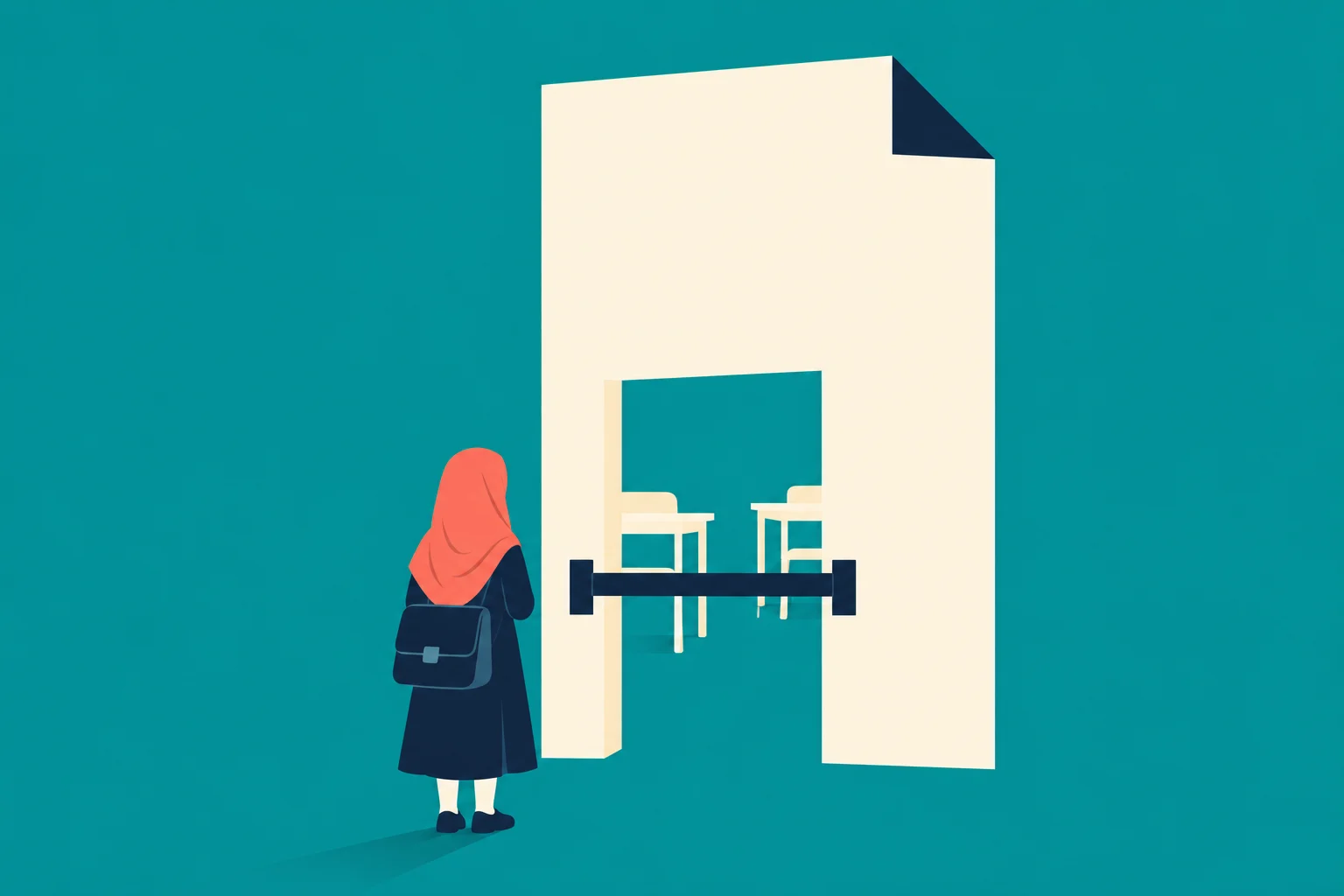
You can see why the government prefers the second framing. Azerbaijan is a majority-Shia Muslim country that is also, by the standards of the Islamic world, deeply secular — a legacy of decades of Soviet rule. The push and pull between those two facts is old. Restrictions on the hijab in schools, enforced through uniform rules, go back well over a decade, as a chronology of the dispute makes clear. What the September amendment does is put fresh regulatory language on top of an old practice, and this time it reaches teachers’ dress as well as pupils’.
The response, this time, has been the schoolchildren themselves. Protests have erupted, and one report describes students boycotting lessons after girls wearing the hijab were barred from classrooms under the new rules. That is a striking constituency for a street protest — people whose main obligation on a weekday morning is supposed to be double maths — and it suggests the enforcement is landing exactly where you’d expect: at the school entrance, on children.
Notice, too, what the arrangement does for everyone in the middle. The ministry never has to defend a hijab ban, because it never wrote one. The school never has to defend its own judgment, because it is merely applying the ministry’s standard. And the family never gets a single decision they can formally challenge, because each morning’s refusal is a fresh, tiny, local act of discretion. Everybody involved can point at somebody else. That is not a bug in the drafting. That is the drafting.
The honest way to describe the policy is Al Jazeera’s: an indirect prohibition. The government’s way is “secular education.” Both descriptions can be true at once, which is precisely the point of writing a rule this way — and precisely why the argument about it keeps breaking out at the school gate, where the abstraction finally has to look a child in the face.