
Nine graves, five women, two men, two of undetermined sex because disturbance destroyed the skeletal evidence needed to tell. That is the whole excavated sample from a seventh-century Avar cemetery found this year under the military airport at Kecskemét, in central Hungary, and it is small enough that every object in it can be counted and argued over individually.
The dig was commissioned by the Hungarian National Museum as part of ground-levelling work at the airport and carried out in early summer 2026 by staff of the Katona József Museum in Kecskemét, led by the archaeologist András Kristóf Fazekas. The museum published its own account of the find on 28 September 2026, on its site; Arkeonews picked it up this week in English, in a story crediting the museum’s photographs and figures throughout, which it calls reporting on Byzantine cosmetic tools and jewelry found in 1,400-year-old Avar women’s graves. The graves date to the first half of the seventh century CE, roughly 1,400 years before either publication.
The burials sat unusually close to the modern surface, which the museum attributes to construction history, not luck: building the airport between 1935 and 1937 flattened the site’s previously uneven terrain, pushing high ground into the low spots. That levelling probably destroyed other graves nearby; what survived did so because it happened to sit where the later work didn’t cut as deep.
What came out of the ground
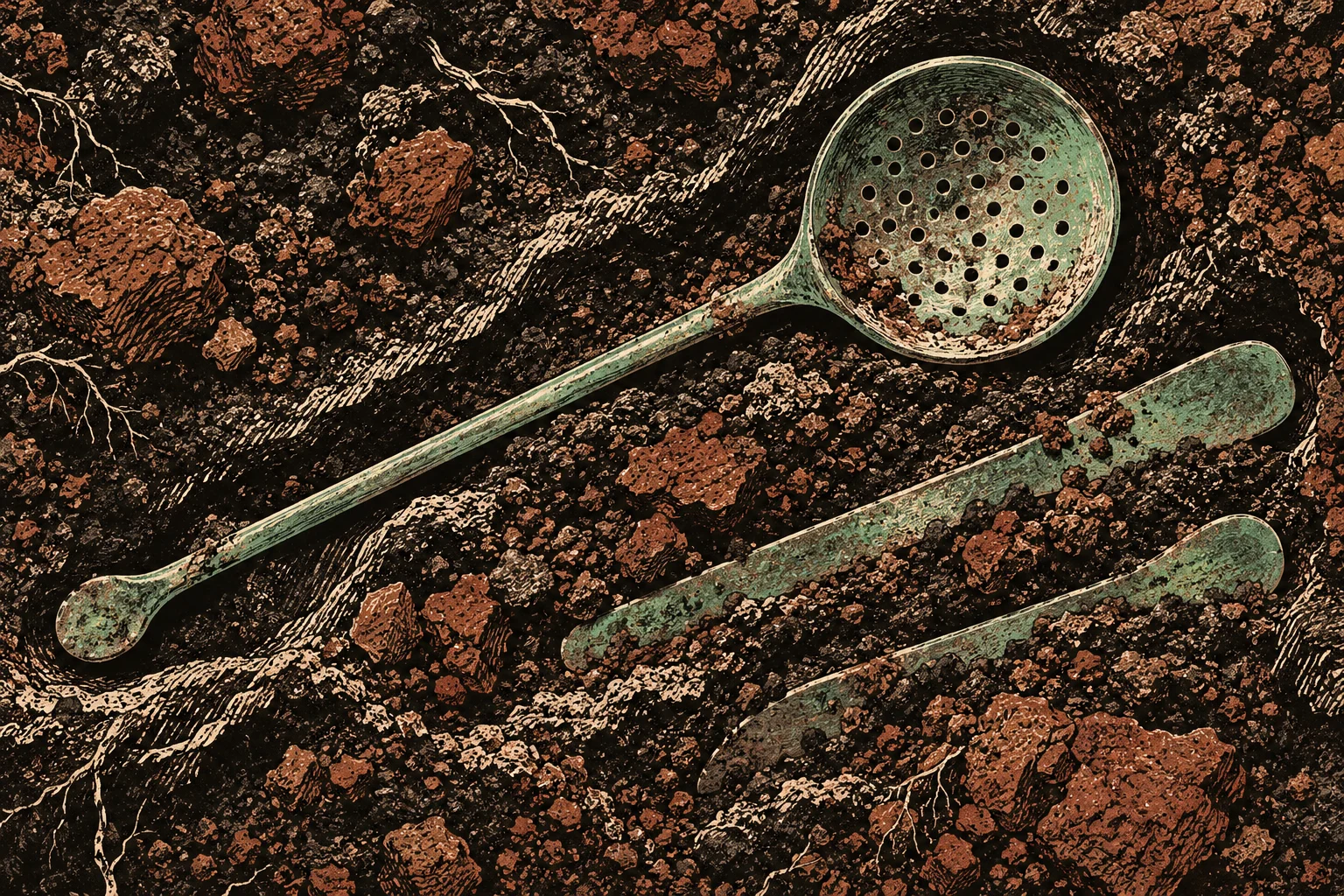
Grave 4, one of the five confirmed female burials, produced the find both accounts lead with: a bronze strainer-spoon and several spatulas. The museum’s own narrative text describes them only as toiletry items, probably used to strain, sift or mix creams and powders. A photo caption in the museum’s gallery goes further, labelling the same objects of Byzantine origin. That distinction is worth keeping straight: a stylistic resemblance noted under a photograph is a lighter claim than one argued in the findings themselves, and the museum’s main text never makes the Byzantine attribution explicit. The Arkeonews report folded the caption’s wording into its summary as if it were the museum’s settled conclusion.
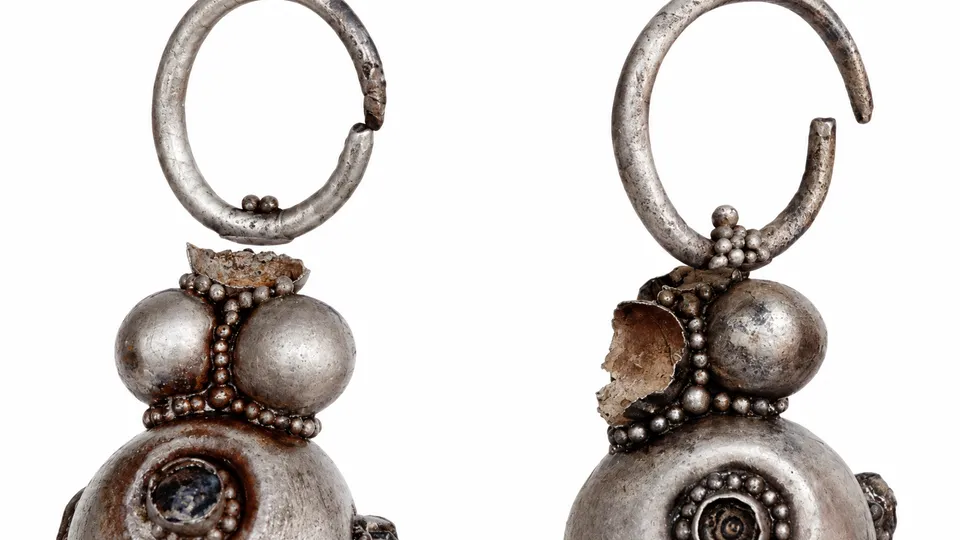
The same grave held beads clustered at the pelvis, which the excavators read as the contents of a pouch that has since rotted away, plus one of the cemetery’s five pairs of earrings: silver, with large sheet-metal globular pendants and blue glass inlay. Across the whole cemetery, earrings turned up as pairs in five of the nine graves, four female and one male. Two pairs were bronze, three silver, a 60:40 split toward the costlier metal in a sample too small to generalize from, but concrete enough to note.
Graves 3 and 9, both female, contained bone panels, front, back and side pieces, decorated with a ring-and-dot pattern and once assembled into small boxes. The museum calls the object type characteristic of the region between the Danube and Tisza rivers and says its function is open: cosmetic storage is a plausible guess, not a finding. No residue analysis has been reported that would confirm what, if anything, the boxes held.
Every one of the five female graves contained a clay spindle whorl, the weight that gives a hand-spindle the momentum to twist fibre into thread, and an iron knife. Buckles, all iron, were the single most numerous clothing fitting in the cemetery. Both male graves carried belt sets with bronze and silver sheet-metal mounts and strap ends, the kind of hardware that in other Avar cemeteries tends to track status rather than mere function.
| Object | Where found | Material |
|---|---|---|
| Earring pairs | 5 of 9 graves, 4 female and 1 male | 2 bronze, 3 silver pairs |
| Spindle whorls | all 5 female graves | clay |
| Iron knives | all 5 female graves | iron |
| Decorated bone boxes | graves 3 and 9, female | bone, ring-and-dot pattern |
| Cosmetic implements | grave 4, female | bronze strainer-spoon, spatulas |
| Belt sets with mounts | both male graves | bronze and silver sheet metal |
| Composite-bow fittings, arrowheads | grave 7, male | bone, iron, bronze |
| Animal-bone food offerings | 6 of 9 graves | poultry in female graves, 1 mammal in a male grave |
Source: Katona József Museum
Grave 7 held the richest weapon set: bone stiffeners from the tips and grip of an unstrung composite bow, two iron three-edged arrowheads, bronze quiver-suspension hardware and a buckle, and additional iron thrusting and cutting weapons, all positioned to the skeleton’s left. Grave 8 held one three-edged arrowhead and two knives, a much thinner kit. Avar composite bows, built from wood, horn and sinew laminated under tension, are the technology usually credited for the Avars’ military effectiveness on horseback; only the bone and horn stiffeners survive archaeologically, since the organic laminate itself does not.
Doing the arithmetic the museum didn’t spell out
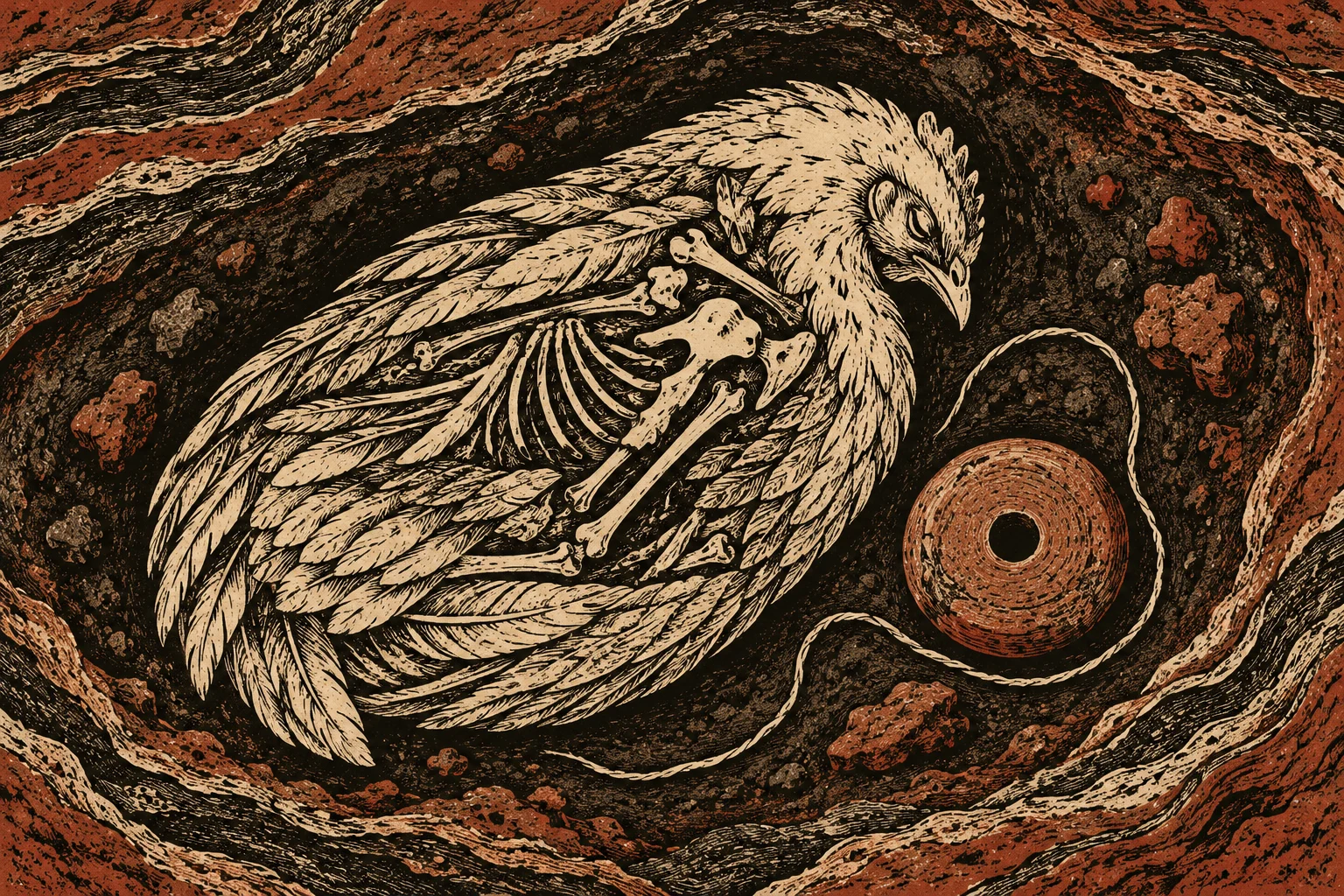
Six of the nine graves contained animal remains, read as food offerings. The museum’s own text says poultry bones occurred without exception wherever animal remains turned up in a female grave, and that one male grave held a mammal bone, but it never states outright how many of the five female graves had bird bones. The arithmetic resolves it anyway: one of the six animal-bearing graves is the male one with the mammal bone, so the other five are necessarily the cemetery’s five female graves. Every female burial, then, got a bird. The Arkeonews claim to that effect checks out, even though the museum’s own account doesn’t quite say it in one sentence.
Who the Avars were
The Avars entered the Carpathian Basin around 567 to 568 CE and ran a khaganate there for close to 250 years, known to history mostly through hostile Byzantine accounts and, since 2022, through DNA. A team led by Guido Alberto Gnecchi-Ruscone sequenced genomes from 66 Carpathian Basin individuals, including what the Max Planck Institute’s own account of the paper calls the eight richest Avar-period graves ever found, and reported the results in Cell in 2022. The founding Avar elite carried ancestry that was, in the paper’s description, overwhelmingly Northeast Asian, closest to populations linked to the Rouran Khaganate, a Mongolian steppe empire the Turks destroyed around 550 CE, resolving a dispute that contemporary Byzantine and Turkic sources had never settled about whether the Avars really were Rouran survivors, as they claimed. By the seventh century that elite had picked up another 20 to 30 percent of ancestry traceable to the North Caucasus and western steppe, evidence of continued migration after the initial arrival. Burial sites on the empire’s edges, away from the Carpathian core, show far more genetic mixing with local European populations, consistent with a small immigrant elite ruling through local intermediaries and intermarriage rather than wholesale resettlement.
The khaganate’s dominance ended by the early ninth century under Frankish military pressure. The Kecskemét graves predate that collapse by roughly 150 to 200 years, sitting instead near the beginning of the period the genetic study covers, when the elite’s ancestry was still closest to its Northeast Asian founding population and the Byzantine contacts visible in objects like the grave 4 toiletries were, per the historical record, running alongside intermittent warfare between the khaganate and Constantinople.
What happens to the finds now is routine but slow: the objects have gone to the Katona József Museum for typochronological analysis, the comparison of an object’s form against dated reference sequences from other sites, and for whatever scientific testing, residue analysis on the bone boxes, isotope work on the skeletons, the museum chooses to commission. None of that has been reported yet. The open question is the same one the museum’s caption raised and its body text didn’t answer: whether the grave 4 toiletries are Byzantine imports, Avar copies of a Byzantine style, or something else again, and whether anyone runs the chemistry needed to find out.