
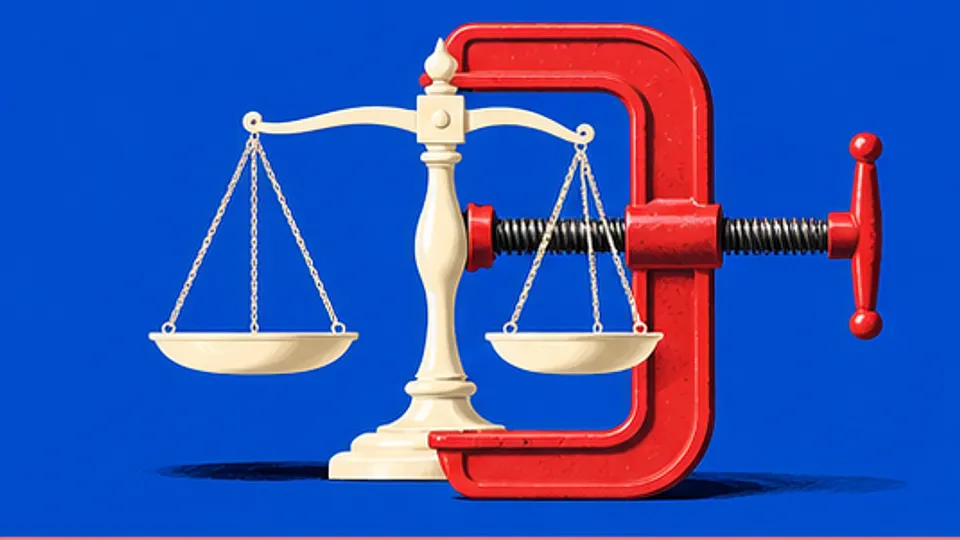
South Korea’s constitutional order has, this week, narrowed down to a fight about one appointment that has not happened. Chief Justice Cho Hee-dae has been summoned as a witness to the National Assembly’s audit of the Supreme Court, scheduled for October 6. On Sunday, the Chosun Ilbo reported, he submitted a written refusal to Seo Young-kyo, the chair of the Legislation and Judiciary Committee. The ruling Democratic Party responded by telling him to show up or quit.
“Appear at the parliamentary audit and explain yourself before the people,” Democratic Party spokesperson Lee Yong-woo said at a briefing at the National Assembly. “If you have no intention of doing so, step down from that seat immediately.” A person who “abandons his constitutional duty and refuses even the legitimate demand of the National Assembly,” Lee said, “has no qualification to serve as the head of the judiciary.”
The question the assembly wants to ask about is not a judgment but a non-judgment. Lee said the witness questioning concerns “the unconstitutional state caused by the long-term failure to exercise the power to recommend Supreme Court justices” -- that is, judicial administration, not any particular trial. Here the mechanics matter. In South Korea the president formally appoints Supreme Court justices, but may only appoint someone the chief justice has recommended. Whoever controls the recommendation, then, decides who can be a justice at all. When that power goes unexercised, a vacancy simply sits there, and the two elected branches can do nothing about it except complain. Loudly, as it turns out.
The failing-to-recommend in question has been building for months. The Korea Times reported that the presidential office last month asked Cho to re-recommend a candidate for the top court, and that Cho said he could not comply because the request did not specify concrete reasons or constitutional grounds. According to the Korea Herald, Cho had said he planned to clarify his position at the parliamentary audit -- before deciding this weekend not to attend it.
Lee pressed the inconsistency. “The people are asking whether the Court Administration Office issued an opinion in favor of re-recommendation, and whether the chief justice ignored it and ordered that a refusal stance be established,” he said. He cited Article 2 of the Act on Testimony and Appraisal Before the National Assembly, which provides that anyone asked to appear as a witness must comply notwithstanding other laws: “The chief justice is no exception.”
He has insisted that his power to recommend outranks the appointment power of a president elected by the people, and now he says that even the audit power of the National Assembly, the people’s representative body, does not reach him. That is an imperial judge cloaked in the independence of the judiciary -- a frontal rejection of the checks and balances the constitution provides.
Cho’s refusal letter makes the symmetrical argument. It would be inappropriate, he wrote, to disclose specifics of sensitive, ongoing personnel matters involving a candidate and consultations touching the president’s constitutional authority. Because a criminal complaint has been filed over his exercise of the recommendation power, he added, “the possibility that investigative procedures will proceed cannot be ruled out.” Making a chief justice testify about a recommendation power that is his constitutionally independent prerogative, he argued, offends the separation of powers and the independence of the judiciary -- and the National Assembly Act pointedly does not impose an attendance duty on the chief justice.
So each side reads the same constitution and finds, in it, the other’s overreach: the assembly’s audit power against the court’s independence, the elected branches’ demand for accountability against an unelected official’s claim that accountability is precisely what independence protects him from. This is what happens when a constitution hands one person a veto over who may join the court and then declines to say who, if anyone, can make him use it. The October 6 audit will proceed either way. Whether the most important seat at it is occupied is, at this point, its own constitutional question.