

It was 20 October 2025, after football practice at Kenwood High School in Baltimore County, Maryland. Four boys, all sixteen, stood outside waiting for their rides, sharing a bag of Cool Ranch Doritos. Practice was over and the rides had not yet come, so they waited, the way schoolboys everywhere wait.
A school camera was watching, and behind the camera sat software. As Ashley Belanger reported for Ars Technica, the system, called Omnilert, flagged one of the boys, Taki Allen, as a possible gunman. He was holding the chips.
The machine was wrong, and the people watching it saw the mistake almost at once. Within two minutes, Baltimore County Public Schools officials reviewing the footage recognised the bag and canceled the alert. The cancellation went to other school officials and to the Baltimore County Police Department: no response needed.
That should have been the end of it.
The text message
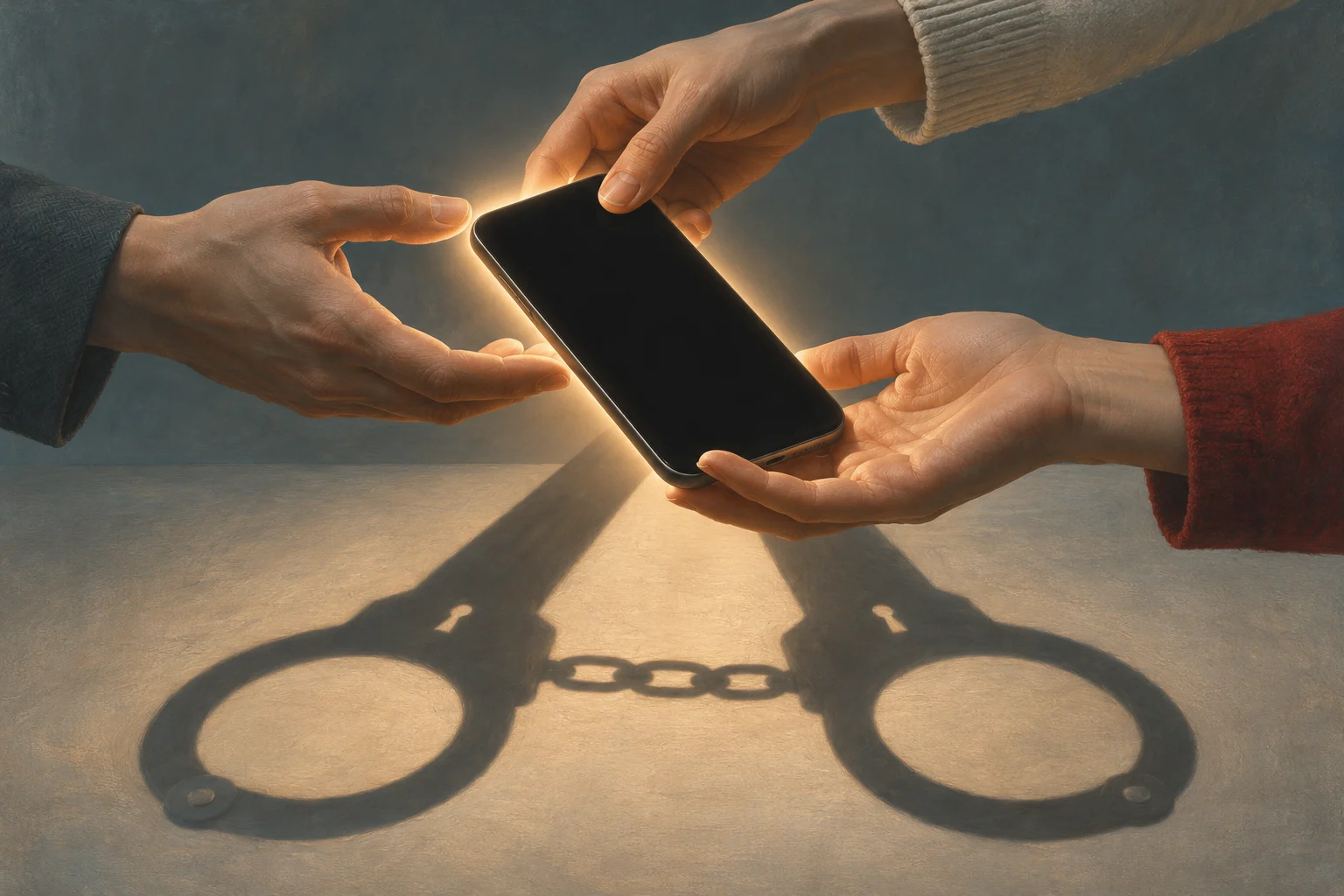
It was not, because of a phone. The principal of Kenwood, Catherine “Kate” Smith, saw the alert and missed the cancellation. Maryland’s Office of the Inspector General for Education found that about 15 minutes later she texted a school resource officer to send police, admitting in the same text that the object was “maybe not” a gun. The inspectors also reported that she had apparently never been trained on Omnilert. She had opened the alert in a text-message window, and the inspectors suggested that anyone whose first move was to enlarge the image or check the footage could easily miss the cancellation that came next. The students’ complaint, as Maryland Matters reported, says she sent a screenshot of Allen to the resource officer, who passed it to the police. Richard Henry, the inspector general, put the episode down to “human error” in reading video and still images on a cell phone.
A reflection, nothing more: modern authority seldom makes its errors in one great act. They pass from hand to hand, one screen to the next, and at every step it gets harder to say who decided anything.
On the concrete
At least six patrol cars arrived with their lights flashing. Some officers got out with their guns drawn. The boys froze and did as they were told.
No one told the students what they were suspected of. Officers separated the students, ordered them to their knees on the concrete, handcuffed them, and searched their persons and property.
That is the complaint’s account. It alleges that none of the officers had looked at the camera footage before they responded, and that none of those who knew about the cancellation stepped in. When the other boys asked why they were being searched, they were reportedly told they were guilty “by association.”
There was no gun. Only then did the boys learn that a machine had called the police on them. One officer allegedly muttered “stupid AI cameras” and “fucking Omnilerts”, and another told them “AI is not the best.” On letting them go, one officer allegedly said: “Hey, thanks for not running away, that would have been a real problem.” Walking off, another told them to “be careful with your chip bags.”
The joke, it seems, belonged to the men holding the handcuffs.
Ninety-nine in a hundred
Baltimore County was one of Omnilert’s earliest customers, and its officials have called the system “the largest deployment of AI visual gun detection.” Omnilert advertises “near-zero false positives”. The complaint argues that this claim depends on human review the company does not effectively require. The inspector general’s report found that more than 99 percent of alerts in the county’s schools were false positives that needed no police response. NBC News reported that the finding covers November 2023 to November 2025, and that the report said the system never flagged the chip bag itself. It reacted to the boy’s hand movement, “including its position and angle.” The inspectors found no bias. One of the students’ lawyers, Engel, told WMAR-2: “In Baltimore County alone there are 12 false positives a day. It is a dangerous tool, it is a deadly tool.”

A machine that is wrong ninety-nine times in a hundred demands one thing of the people between it and the police: that they look, every single time. At Kenwood someone did look. A text message undid it.
The inspectors made recommendations. They called for training twice a year; right after the incident, an internal Omnilert training link had gone out to staff. They told the schools’ Department of School Safety to review its protocol and cut the number of people who get gun alerts. They told officials to use the Omnilert app rather than text messages. Without such changes, they warned, “the loss of alert notification controls could place not only BCPS staff and students at risk but could also place responding law enforcement in a potentially tragic situation.”
A year later
For the boys, that is not enough. On 17 November 2026, Allen, Yui-Osa Ogbeide, Devon Thompson Jr. and Keith Winfield III filed a 31-page complaint in Baltimore County Circuit Court. They are represented by the Lawyers’ Committee for Civil Rights Under Law, working with Willkie Farr & Gallagher and Engel Law Group. They are suing Omnilert, the school system, individual school officials, the police department and the officers who responded, alleging negligence, false arrest, false imprisonment and unreasonable search and seizure. “BCPS’s failures amounted to deliberate indifference to the constitutional rights of its students,” the complaint says. They want a court to bar the use of Omnilert until school staff and police are properly trained.

“Overreliance on artificial intelligence technology mixed with inept communication and coordination among key officials is a toxic mix,” said Damon Hewitt, the Lawyers’ Committee’s president. “We need a reckoning on how AI is being used, especially concerning public safety and kids.”
The school system declined to comment and pointed instead to the statement it sent parents after the incident. That statement promised “ongoing counseling and emotional support” but did not directly apologise. Allen, the only one of the four still at the school, says the principal never apologised either, and that she joked about the incident with other officials in texts full of cry-laughing emojis. Blake Mitchell, Omnilert’s vice president of marketing, said the company was reviewing the complaint. “What these four students went through on October 20, 2025 should not have happened, and we are truly sorry for the fear they and their families experienced,” he said. The company has said before that its system worked as designed.
The boys say what remains are the deep red marks the handcuffs left on their wrists, the fear, the humiliation, and a rumour that keeps following them that there really was a gun. Allen no longer feels safe waiting outside after school and often pays for a private car home. Winfield lived very close to the school, yet after practice he would call his mother several times to make sure she was coming.
“The police told my son this could have been a real problem,” said Frieda Winfield. “No child in Baltimore County should face this kind of danger while waiting outside his own school for a ride home from his mother.”