
Grand is a village in the Vosges, in northeastern France, with a few hundred inhabitants. That is the present. The past was larger. Under the Romans the settlement spread across more than 70 hectares. It had monumental public buildings, an amphitheatre about 148 metres long that could hold more than 17,000 spectators, and a sanctuary of Apollo Grannus, a healing god whose cult drew pilgrims in search of help and, apparently, of sacred or curative water. The village today sits inside a town it can no longer fill.
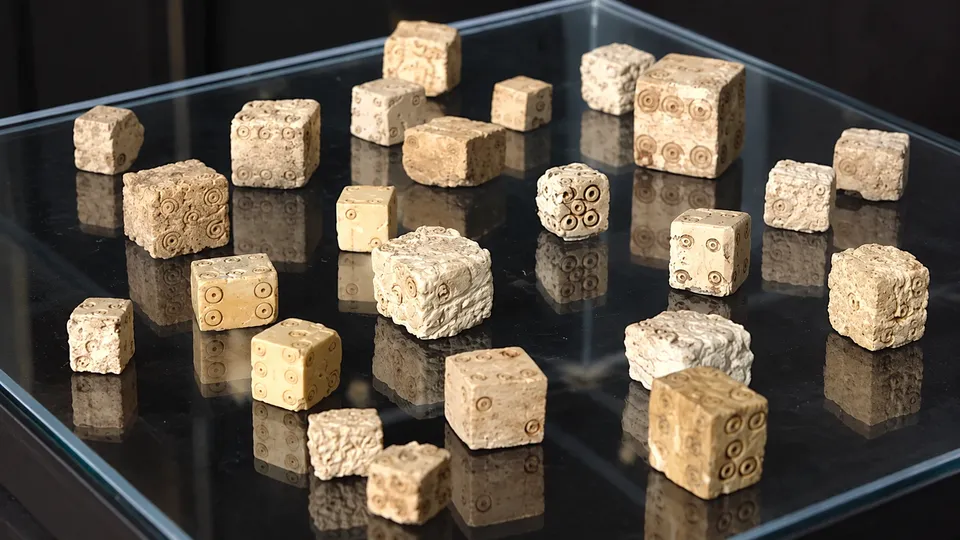
From the ground beside the old basilica, where a mosaic of more than 220 square metres still lies, archaeologists have now lifted more than a thousand dice made of bone.
The room by the road
The work began in 2022, [as Arkeonews reported](<https://arkeonews.net/an-ancient-las-vegas-more-than-1000-bone-dice-unearthed-at-a-roman-town/>), with a modest aim: to find again, and reassess, structures that excavators had dug in the 1960s. In the 2023 and 2024 seasons the team exposed a small building, roughly 4.5 by 3.8 metres, standing beside a road that ran east to west. It opened to the east. Its plaster was painted red above a yellow base. A room for one purpose, perhaps two. Not a palace.
The dig is run by the Conseil départemental des Vosges with support from the French Ministry of Culture, and this summer it was led by Thierry Dechezleprêtre, chief curator at the musée d’Archéologie nationale in Saint-Germain-en-Laye, working with about fifteen archaeology students, [according to Vosges Télévision](<https://www.vosgestelevision.tv/Fil-info/Grand-une-campagne-fouilles-explore-mystere-un-jcCuardyke.html>).
Around the walls the soil held the ordinary leftovers of human traffic: shoe nails, pottery fragments, animal bones, fibulae, bronze coins, needles with eyes. And dice. In July 2026 the count stood above 500, and [France 3 Grand Est](<https://france3-regions.franceinfo.fr/grand-est/vosges/la-plus-importante-collection-de-des-a-jouer-de-l-antiquite-mise-au-jour-lors-de-fouilles-archeologiques-dans-les-vosges-3389842.html>) was already calling it the largest collection of gaming dice from antiquity found so far. Before the month was out [ICI, the former France Bleu, reported](<https://www.ici.fr/emissions/l-info-d-ici-ici-lorraine-meurthe-et-moselle-et-vosges/photos-plus-d-un-millier-de-des-decouverts-sur-le-site-gallo-romain-de-grand-dans-les-vosges-6199973>) that the total had passed a thousand. The broadcaster dated the dice to the second century AD and gave their size as anything from half a centimetre to just over one.
The sevens
They were made carefully. Each face carries small concentric circles, called ocelli, cut with a fine metal tool. In some cases the grooves may have been filled with wax and charcoal so the marks would stand out dark against the pale bone. The numbers follow the arrangement archaeologists call the “Sevens”: opposite faces always add up to seven. Anyone who has played a board game in the past two thousand years has held the same object.
A die on a Roman site is nothing special. They turn up across the empire in houses, military camps, public buildings and amphitheatres. Soldiers threw them, idlers threw them, and emperors are remembered for throwing them. One die is ordinary. A thousand of them in a few square metres of ground is a question.
Three in the foundations
Three of the dice came from the building’s foundations. People do not drop things into a foundation trench on their way down the road. Whoever laid those footings either did not care what fell in with the rubble, or cared a great deal. The excavators treat the find as one of the strongest signs that the dice and the building belong together, and that the room had some special function.
Which function, nobody yet knows. The team has three explanations and has not chosen between them. The first is a workshop, where craftsmen cut bone into cubes and drilled the circles. The second is a gaming room, a place where luck was bought and lost. The third is ritual. Roman dice were not only toys: they were also used in divination, in appeals to the gods, in the business of asking heaven a question and letting the bone fall.
Water
There is water here too, which makes the puzzle harder. The team followed a narrow conduit for about 20 metres north of the building. Iron collars, found where they lay, probably once joined wooden pipes. At the end of the line a rectangular pit may have held a wooden basin. Water mattered across the town. Digs between 2010 and 2016 uncovered a wide gallery, decorated with marble and painted plaster, that may have belonged to a bath complex. An underground channel may have carried water from a spring beneath today’s church towards those baths.
The temple of Apollo Grannus is still missing. Scholars have been looking for its exact site since the nineteenth century, [Sciencepost noted](<https://sciencepost.fr/les-archeologues-cherchaient-un-temple-introuvable-depuis-le-xixe-siecle-a-grand-ils-sont-tombes-sur-pres-de-500-des-antiques/>), and it has not turned up. So the god of healing has hidden his house, and in its place the town has offered a decorated room, a pipe, a basin, some coins and a small fortune in dice.
The casino that may not have been
The comparison with Las Vegas came quickly, and it is easy to see why: a great arena for gladiators and wild animals, monumental buildings, pilgrims arriving with money and hope, and now the dice. But nothing dug up so far shows that Grand was a gambling town. The dice may turn out to be stock from a workshop that was never sold. They may be offerings. They may be both at once, from a world where the line between a game and a prayer was not sharply drawn.
It is worth pausing on that. Pilgrims came to Grand because they were sick, or afraid, or wanted something they could not get by their own effort. Every regime, Roman or otherwise, has understood the economy of that wanting: the arena for the crowd, the god for the desperate, and somewhere between them a small room where a man could put a coin down and wait for the bone to stop rolling.
The finds will stay in Grand. Nicolas Potier, a heritage curator and director of cultural sites for the Vosges departmental council, told ICI that the dice, the needles and the amphora fragments will be kept in the museum on the site, and he hopes they will raise the place’s profile and bring in more visitors. Pilgrims built the ancient town. The modern village is counting on tourists.