
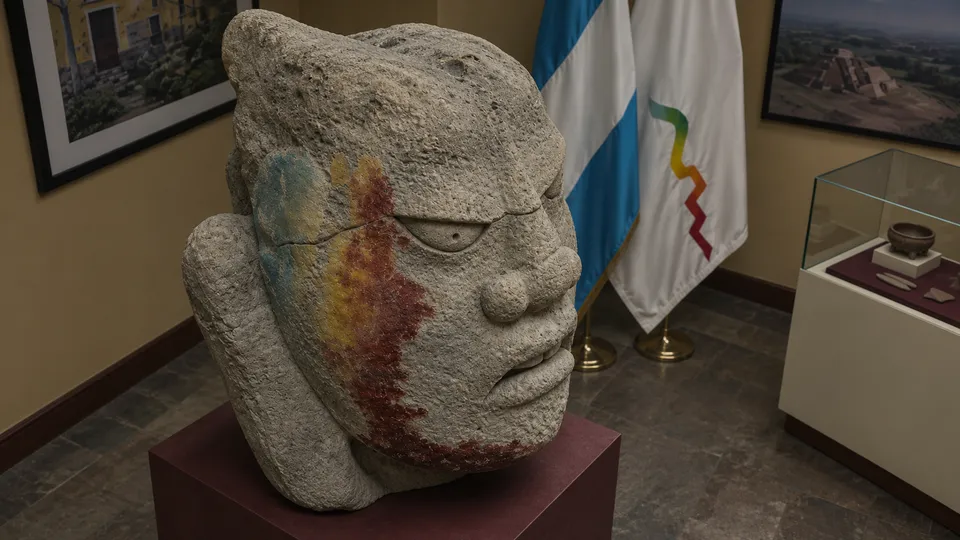
In the far north of Guatemala, in the Petén, the forest has grown back over a city that was once among the largest the Maya ever built. On November 18 the people who have spent decades uncovering it came before the press in Guatemala with faces: stucco faces of gods, of mythological beings, perhaps of rulers, modelled in plaster over stone and painted. More had come out of the ground during the 2026 season. Douglas Mauricio Martínez, a member of the excavation team, spoke of about three new sculptures, all needing restoration, as Arkeonews reported, drawing on Guatemala’s state news agency, AGN. Nobody has yet said whom they depict.
Nobody has settled the count either. Prensa Libre reported about 13 sculptures recovered this season. Mauricio told reporters there were some 40 complete pieces and parts of heads in all, and dated them to the Late Classic period, 600 to 900 AD, according to AFP.
The hole the thieves dug
This story starts with looters. In 2012 archaeologists were mapping the Casa del Coral group, a cluster of buildings on the eastern side of the city near the great La Danta complex, when they noticed fragments of stucco in a pit that thieves had already opened. They followed the fragments into a structure roughly 17 metres long, 10 metres wide and 5 metres high, and named it the Edificio de los Rostros, the Building of the Faces. Excavation there has since turned up more than 30 sculptures and many fragments.
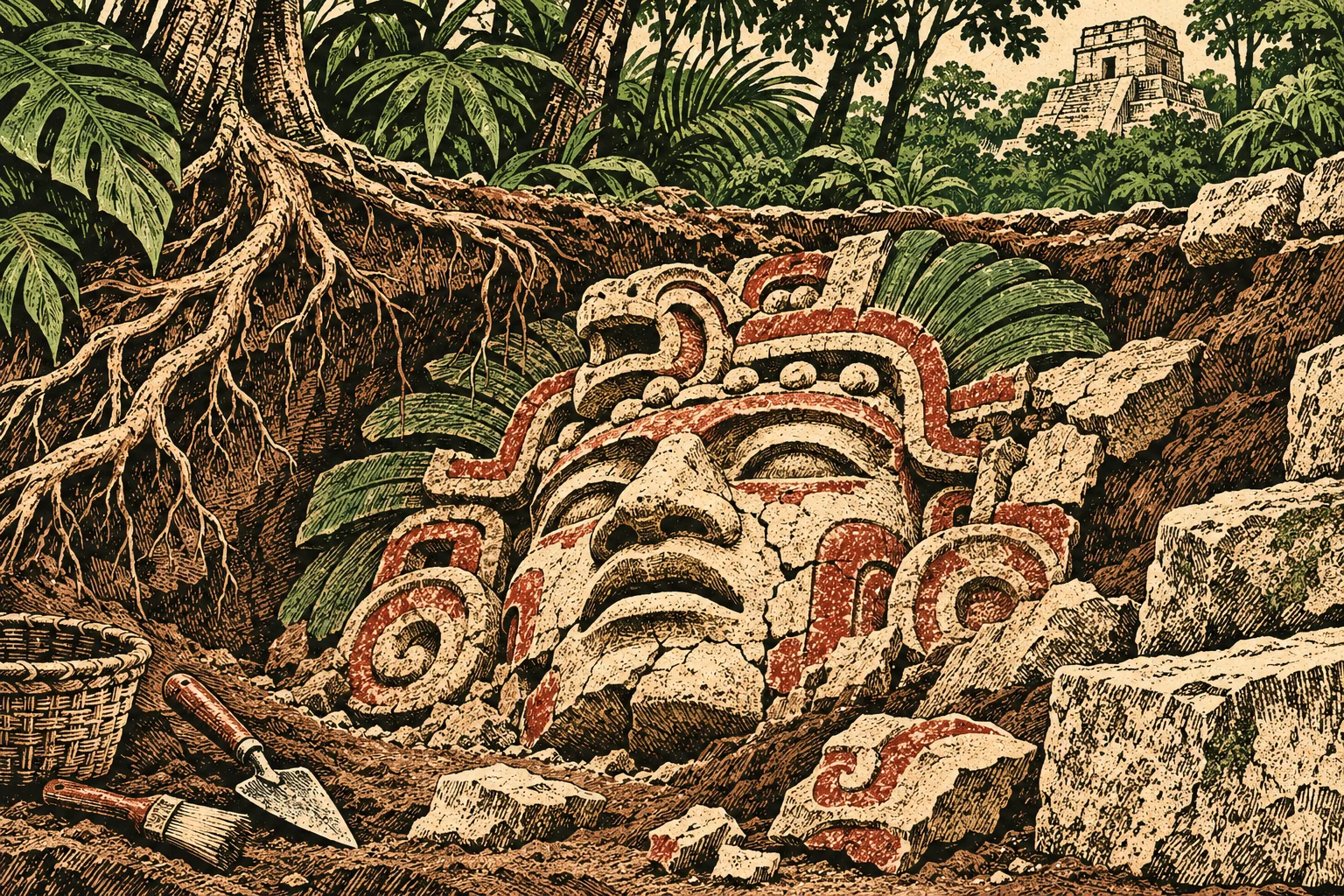
The faces were not where their makers had placed them.
They lay at the back of the building, not on its facade, tangled among fallen limestone blocks and architectural debris. The looters had shifted earth, stone and pieces of the building itself. The researchers believe the heads, built up in stucco over projecting stones, were once part of the building’s decoration. Where each one sat, and in what order, nobody can yet say for certain.
Here is a thought about this kind of theft, offered as reflection and nothing more. A looter takes an object, but he also destroys the sentence it belonged to. A face pulled out of its row becomes a word without grammar, and whoever comes after must guess at the meaning of the wall from the words the thief happened to leave behind.
The god who rows the dead
Even so, some of the faces have been named, provisionally. In a paper on the Casa del Coral heads, Mauricio, Richard Hansen and Stanley Guenter tied one figure to the Maya God of Death. Another may be the Paddler God, who carries the dead down to the underworld. Guatemala’s La Hora has told how the death god’s head was found.
Then there is La Princesa Azul, the Blue Princess, the subject of a 2022 study by Mauricio. The face is feminine and painted in Maya blue, and the water lilies on her headdress tie her to water. The researchers think she may have belonged to the ruling family.

If that reading holds, the building put gods, ancestors and the powerful side by side on a single facade, and the people who governed the city placed their own faces among the faces of death. The identifications remain open. A later article by José Manuel Mejía Sazo and Mauricio counts forty modelled heads and notes that this kind of art has not been found in the other buildings excavated at El Mirador.
Vessels for something poured
The building also held more than 35 ceramic vessels, among them the types called tecomate and bucul, which may have stored or offered liquids. The researchers suspect some held fermented drinks. Put that beside figures of death and the underworld and the outline of a ceremonial space appears, perhaps for rites to the ancestors or for the dead. The archaeologists say plainly that pots and faces alone cannot prove what the building was for, and they are still weighing other readings.
Plaster that turns to dust
Then comes the slow work of restoration. Lilian Vega de Zea, the project’s restorer, says most of the heads came out broken, wrapped in roots and extremely fragile. Stucco handled the wrong way crumbles to powder, so every piece is stabilised before anyone cleans it. Soil and roots are removed without harming the original surface, cracks are reinforced, and nothing more is done than the piece requires. At the press conference, Diario de Centro América reported, she said some heads had reached her completely disintegrated, and that a single restoration had taken her up to a year.
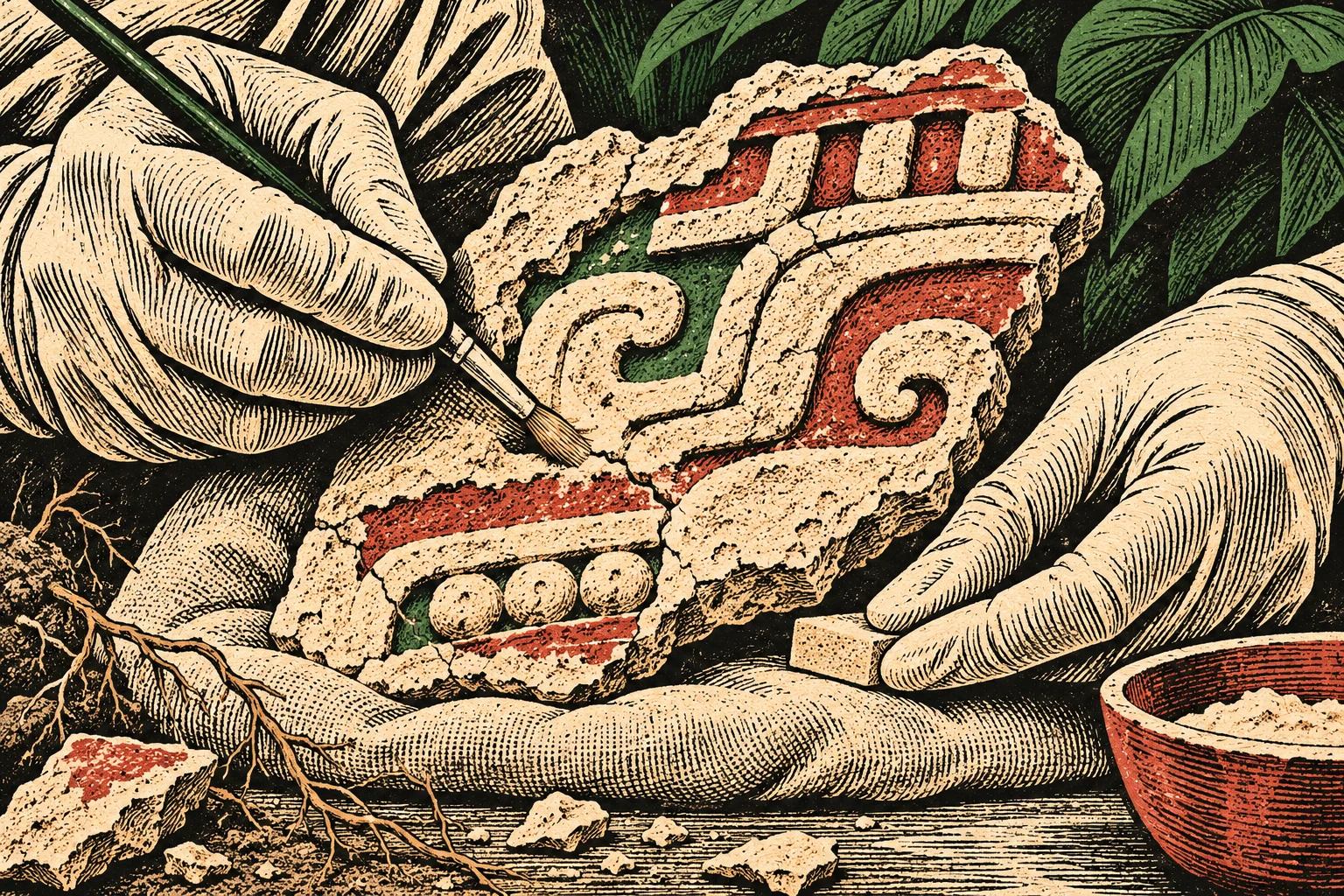
“It was an honour that these sculptures came into my hands. I feel satisfied to contribute to the culture of Guatemala.”
More than 20 heads have been restored so far. Some have gone to the National Museum of Archaeology and Ethnology in Guatemala City, and others are still being studied in laboratories. The new ones from 2026 will join that queue.
A city that ruled a basin
The conference was staged by the Guatemalan Tourism Institute together with the Mirador Basin Archaeological Project, and the state’s interest in the forest and its ruins is not purely scholarly. The government paper said Hansen, the project’s director, has worked at Tikal and El Mirador since 1978, and that since 2015 LiDAR, which maps the ground through the canopy with laser pulses, has helped identify more than 964 sites in the basin, dated by the paper to the Preclassic, 100 BC to 150 AD. AFP reported that the season also found more causeways and a settlement at one edge of the ancient roads south of El Mirador. The archaeologist Enrique Hernández said it would be studied to test the idea that the city “had the capacity to control the whole region”.
Those causeways belong to the Preclassic city. The faces, if AFP’s Late Classic dating is right, belong to centuries afterwards, to people who still decorated a building east of La Danta with gods of death and a woman in blue, long after the basin’s greatest age had ended. Three more of their faces, or thirteen, are now waiting for Vega de Zea’s hands.