
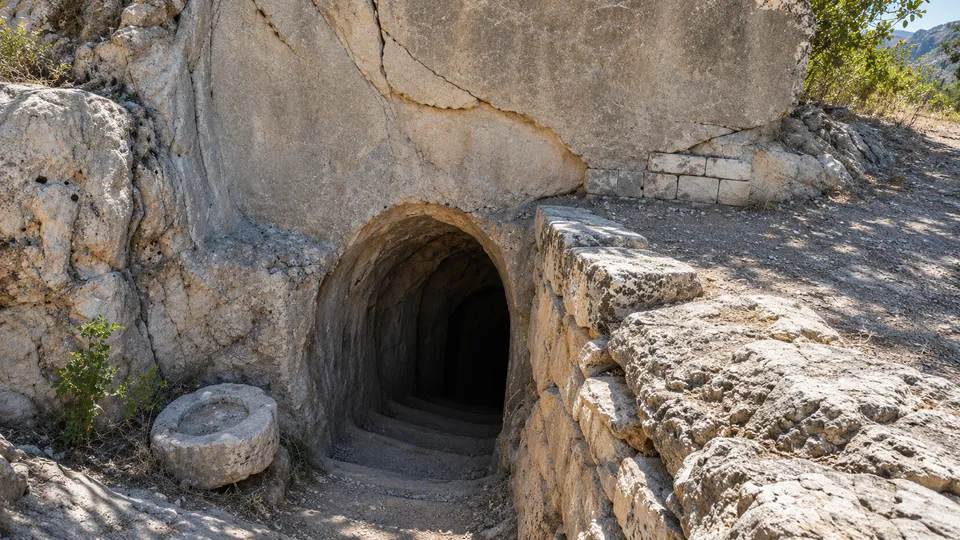
In 1974 the anthropologist Maurice Bloch needed an image for ritual, and he chose a tunnel. The kings of Commagene had cut one into a hillside roughly two thousand years before he wrote the sentence.
Ritual is a kind of tunnel into which one plunges, and where, since there is no possibility of turning either to right or left, the only thing to do is to follow.
Lennart Wouter Kruijer, an archaeologist at Leiden University, opens his new study with those words and then reads them literally, Leman Altuntaş reports for Arkeonews. The paper, “Descent into a trap: Pilgrim affordances of the rock-cut staircase tunnel at Arsameia on the Nymphaios”, appeared in the Journal of Roman Archaeology on 19 November. It is about a stepped passage 158.1 metres long. For decades it was taken to be a way of getting to water and nothing more. Kruijer argues that it also told the people who entered it how to move, what to feel and where to look.
The road up from the river
Arsameia sits on a rocky hill near Mount Nemrut in southeastern Türkiye, about 26 kilometres from the town of Kahta in Adıyaman Province. It looks down on the river the ancients called the Nymphaios, now the Kahta River, and across it to Eski Kahta Castle. Here Antiochus I, who ruled Commagene from 70 to 38 BC, according to Livius, built a tomb-sanctuary for his father, Mithridates I Kallinikos, and made the hill a centre of the royal cult.
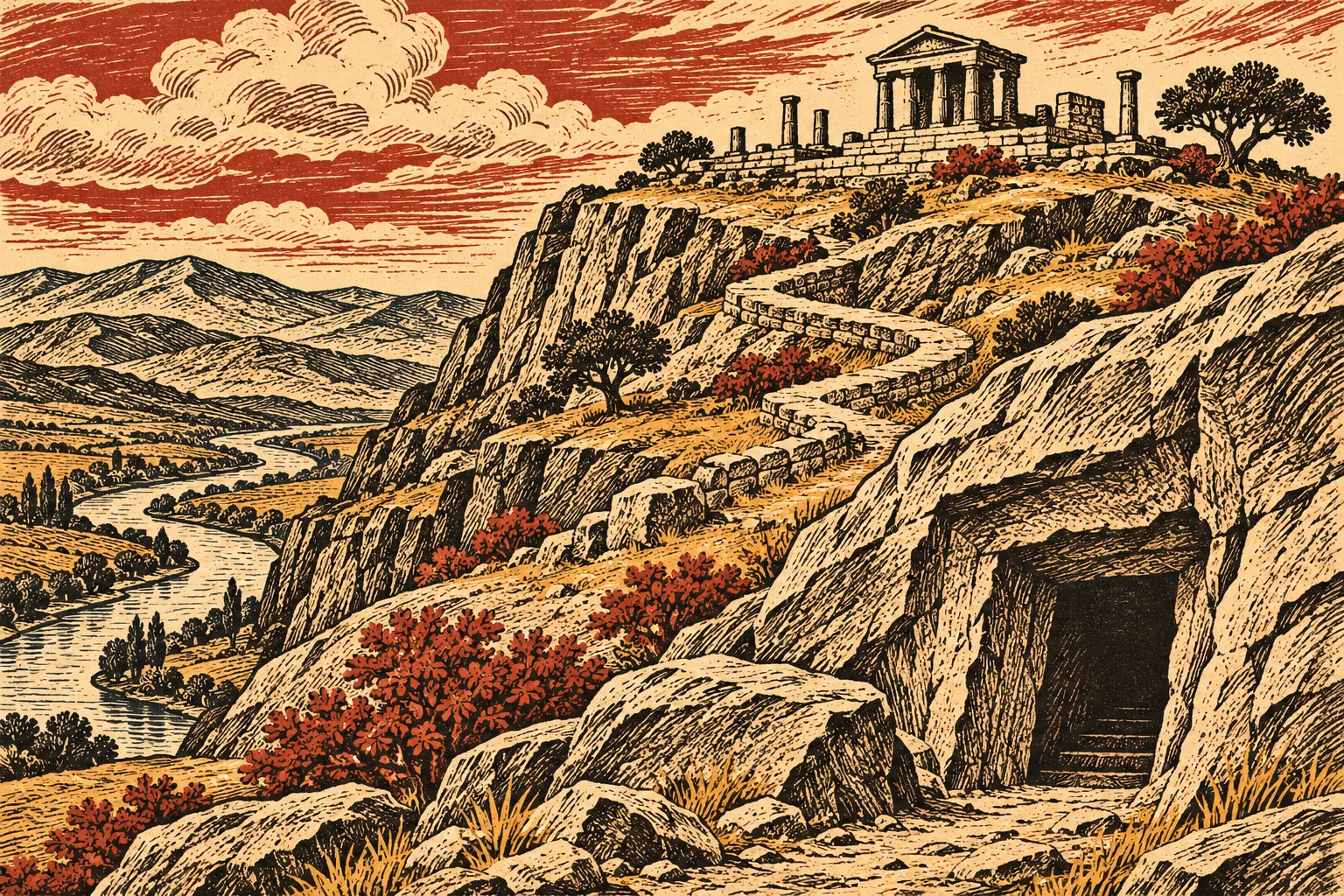
Nobody who came was left to wander. A monumental road wound up from the valley past reliefs of kings shaking hands with gods, places of worship and offering, rock-cut structures and inscriptions. One stop was a stepped passage about 10 metres long, thought to lead to the burial chamber of Mithridates. Then came the tunnel mouth, about two metres high and 1.5 metres wide, beneath a large Greek text known as the Great Cult Inscription. It runs to five columns and gives the titles of Antiochus, Mithridates and Queen Laodice. In it Antiochus set the rules for his sanctuary: how local and foreign visitors were to be received, and the monthly festivals for his own birthday and his father’s. Nearby, a relief shows the king clasping the hand of Artagnes-Herakles, the god identified with the Greek hero. Arkeonews names that king as Antiochus I, but some descriptions of the site give the handshake to Mithridates.
Kruijer sees the whole route as a guide that worked in stages. The tunnel continued it, and it made the visitor wait longer before reaching the statues of king and gods at the summit.
Down
The steps go straight down into the rock. As the study reconstructs it, the light fades quickly, the air gets colder, and the sounds of the outside world give way to echoes. The steps are uneven, so each foot has to be placed with care and the body leans further forward as it goes. This is what Kruijer means by a “trap”. He does not mean a device for catching people. He means a sacred space’s power to direct the bodies and attention of those inside it.
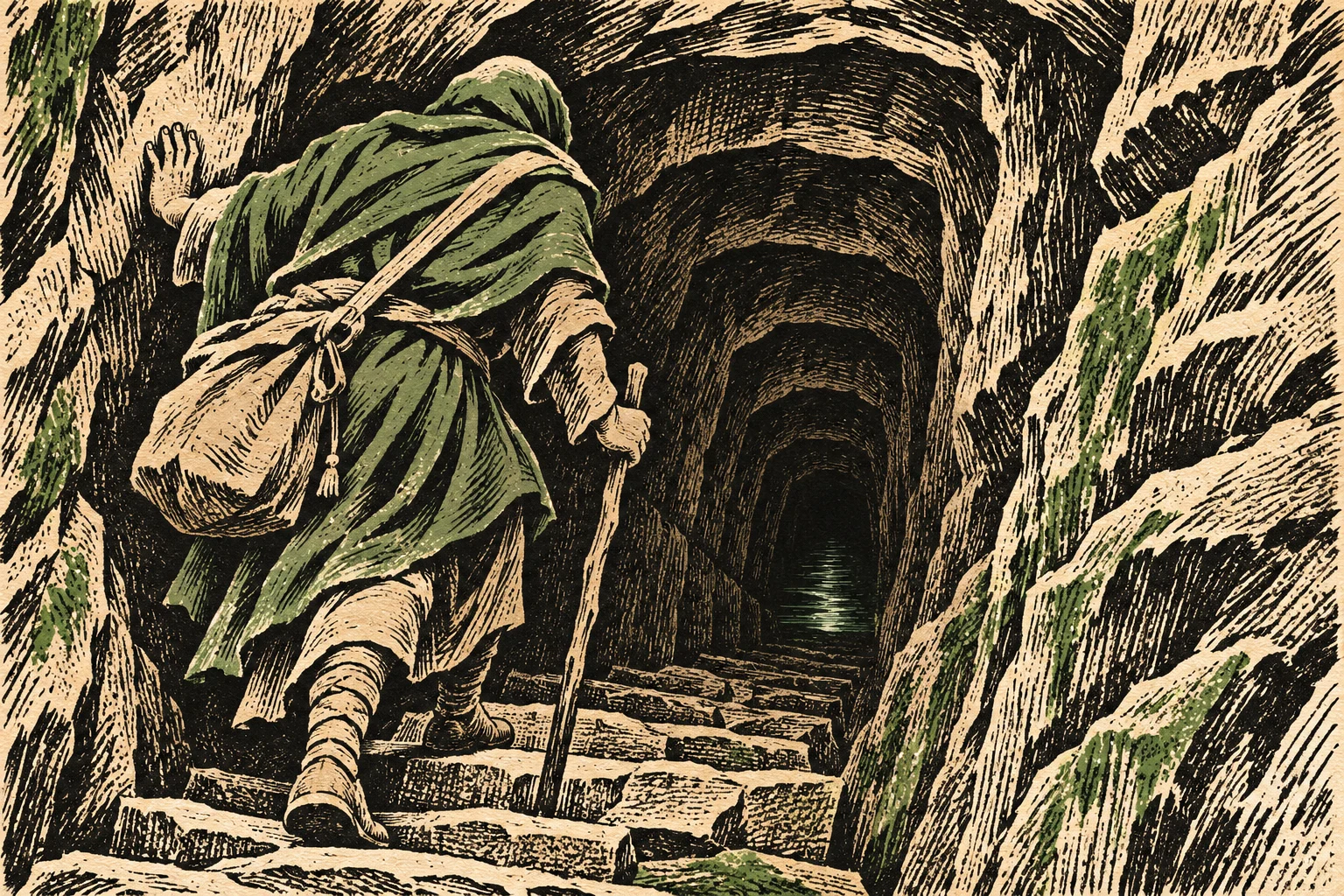
The record bears him out on that. In the 1950s Friedrich Karl Dörner, who led the excavations at Arsameia, noted that his workers grew more and more uneasy the deeper they went into the dark. When Kruijer went down himself in the spring of 2019, he reported a similar anxiety and, along with it, a wish to keep going.
Fear and the urge to go on. It is tempting to think that rulers have understood this pairing for as long as there have been rulers, and that a king who carves a descent into his sanctuary is writing it in stone.
The study puts the tunnel beside the royal tomb that visitors passed just before it. Both have stepped passages going underground and both sit near royal reliefs, which suggests pilgrims may have linked the two with death and what comes after. Heracles at the entrance points the same way, since in myth he went down into the underworld. Kruijer is careful about what he can show. His research does not prove that any underworld ritual took place in the tunnel. No ancient text says how it was used, and he does not identify it as a shrine of Mithras. The argument rests on the layout of the site, on mythology, and on the conditions a visitor would probably have met.
Water at the bottom
After 158.1 metres the tunnel simply ends. It has no exit. At about 141 and 150 metres from the entrance there are two circular hollows, each about 2.5 metres across and 40 to 50 centimetres deep. At the end lies groundwater, and its level changes with the seasons. After rain it can rise and partly flood the passage. In summer it can drop well back.
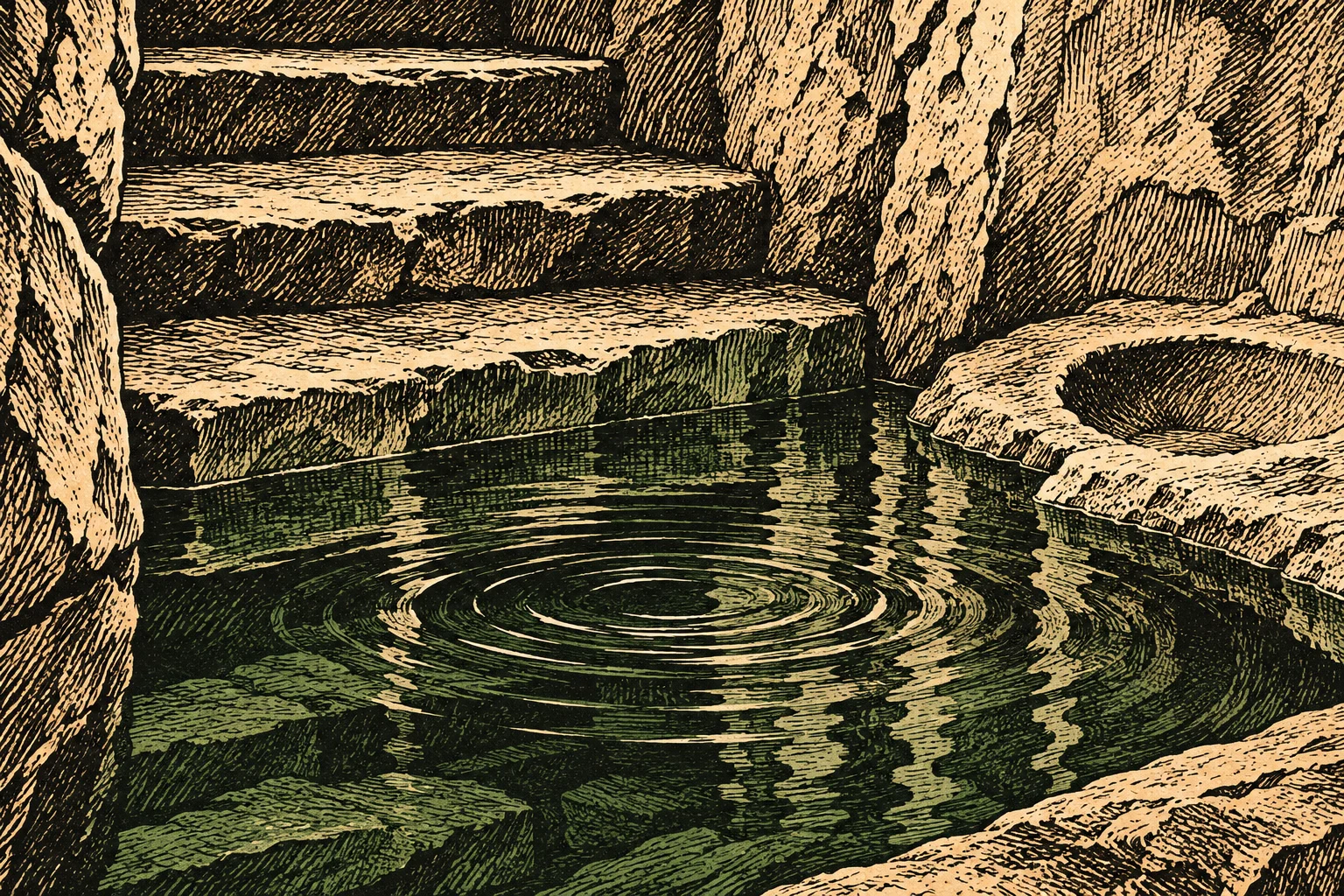
That water supports the old view. The feasts on the hill needed water, and so did the visitors. Kruijer does not reject that view. He argues that the water mattered for more than practical reasons. The Great Cult Inscription connects Arsameia’s springs and natural resources to the identity of the sanctuary and names its waters alongside divine attributes. It also forbids anyone to carry the drinking vessels used at the feasts out of the sacred area.
The cups were not to leave the hill. In this telling, fetching, carrying and pouring the water ceremonially kept people bound to the land around them, and the changing water level shaped what could be done in the sanctuary at any given time. Others have suggested that the two hollows were used for ritual bathing. Nobody has proven it.
Ninety tunnels
Arsameia is not the only such tunnel. Many rock-cut stepped tunnels have been found in Anatolia, a large share of them in the old regions of Pontus, Paphlagonia and Galatia. A survey published in 1967 examined 51 of them. Later work in Pontus documented 39 more at 30 different locations. Most were long read as military works, dug so that a besieged fortress could still reach water, and some of them do reach groundwater and connect to fortified settlements.
They are not all alike, though. Some are notable mainly for their size. Others lie near religious reliefs, cult niches and statues. Kruijer warns against giving every staircase tunnel in the country the same meaning.
At Arsameia a king had his rules carved over a hole in the rock that leads only down. The water at the bottom still rises after rain and falls back in summer, as it did when Antiochus set out his festivals.