
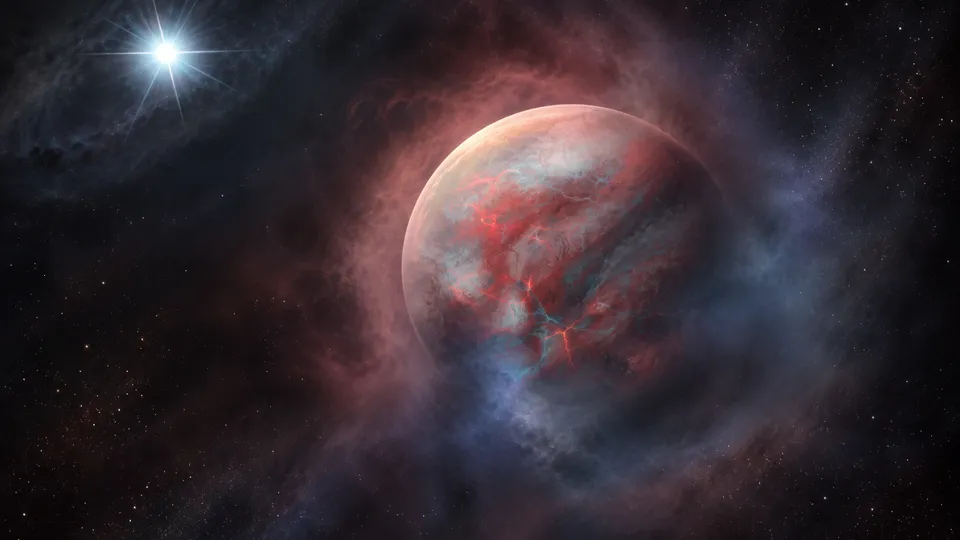
Astronomers said on Monday that they had found a possible planet made from the remains of a dying star, the first candidate of its kind spotted orbiting a white dwarf.
The white dwarf, HS 0209+0832, is about 270 light-years from Earth, the study’s authors told CNN. Their [paper in Nature Astronomy](<https://www.nature.com/articles/s41550-026-02983-7>) calls the object a planet candidate. It’s probably a gas giant about the size of Jupiter, orbiting roughly 3.7 million miles from the star, well inside Mercury’s distance from the sun, according to a [release from the European Space Agency’s Hubble team](<https://esahubble.org/news/heic2613/>).
When a star like the sun dies, it swells into a red giant, throws off its outer layers and leaves behind a small, dense, hot core: the white dwarf. Planets on wide enough orbits can survive that, and astronomers have found a handful of them. No one had recorded a second-generation planet, one formed afterward out of the dead star’s leftovers.
The evidence is niobium, an element heavier than iron that coats the white dwarf’s surface. “It’s the first time that this element is found in a white dwarf, and this implies that the planetary material is made from the ashes of the star as it died,” Jamie Williams, the lead author and a doctoral student in physics at the University of Warwick in England, [told CNN](<https://www.cnn.com/2026/10/05/science/second-generation-planet-discovery-white-dwarf>).
Heavy elements in a white dwarf sink quickly, leaving hydrogen and helium on top. So the niobium had to come from outside. “We think these elements fell onto the white dwarf’s surface because the white dwarf is very hot and emitting loads of extreme ultraviolet radiation, which is stripping the atmosphere of a nearby planet,” Mr. Williams said.
Ordinary fusion doesn’t make elements heavier than iron, but dying stars do. “The presence of niobium is a signpost of these ‘death’ throes,” Nicholas Stone, a co-author at the University of Wisconsin-Madison, said in the release.
The clue sat in old data. Hubble observed the star in 1999 and recorded about 100 chemical features nobody could identify, according to the release. Mr. Williams matched many of them to niobium using a newer chemical database, and records from NASA’s retired FUSE mission showed the same strong signal. Boris Gaensicke, a co-author at Warwick, said the element “had not been reported in any other white dwarf analysed to date.”
NASA’s TESS satellite, which watched the star for four months, picked up a faint dip in brightness repeating every 4.4 days. The researchers say that fits a giant planet in orbit.
“It’s not a confirmed planet,” Mr. Williams said. “It’s only a candidate for now.”
If it’s real, it may last. White dwarfs cool slowly, so their habitable zones barely move, and a planet that formed there “could form and then be in the habitable zone for tens of billions of years,” he said. “If the second-generation planet is there, I think it is likely to survive,” he said in the release.
How it formed is less clear. Mr. Williams said another object may have been near the star’s core, “maybe a star around 20% the mass of the sun, or a brown dwarf.” If that object fell in during the giant phase, it could have kept some gas and dust from scattering and spun it into a disk that later made a planet.
The first exoplanets ever found orbit a pulsar, a dead star left by a supernova, so they are probably second-generation, said David J. Wilson, a co-author and research associate at the University of Colorado Boulder. White dwarfs don’t explode, he said in an email, but they hold surviving planets, shattered ones and leftover gas. “So it’s a compelling idea that all that stuff might coalesce into new planets.”
Sarah Casewell, a lecturer at the University of Leicester who wasn’t involved, said in an email that most polluted white dwarfs carry material like the rocks in our solar system, while this one is “polluted by incredibly unusual material.” More than 95 percent of stars will become white dwarfs, she said. Susan Mullally, a mission scientist at the Space Telescope Science Institute, said in an email that if such planets are possible, “many more white dwarf stars will have planets than we may otherwise expect.”
The team plans to look again over the next year with Hubble and NASA’s Chandra X-ray Observatory, and has asked for time on the James Webb Space Telescope.
“The sun will eventually become a white dwarf,” Mr. Wilson said, “so we’re also looking at the future of the solar system here — maybe the Sun will get a new planet someday!”