
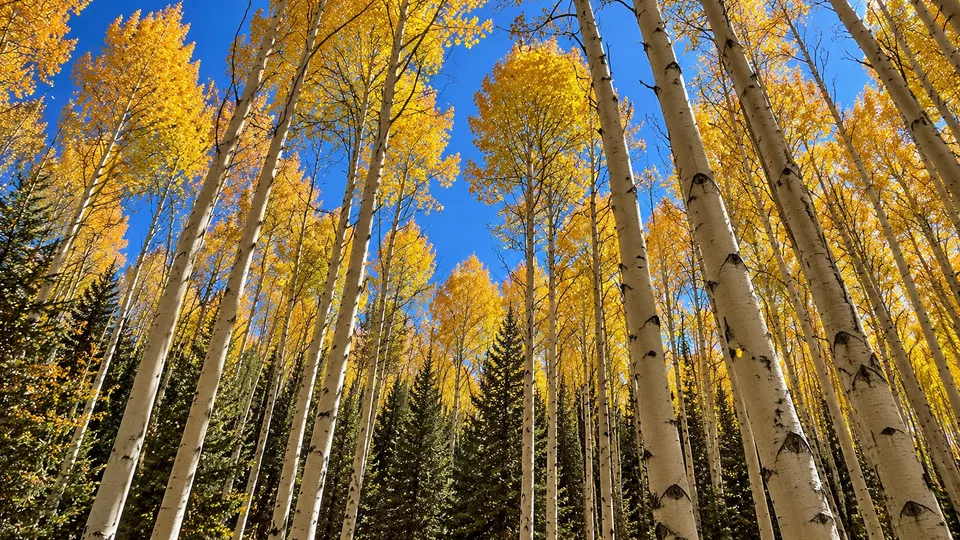
Drought gets written into trees. Slice one open and the bad years show up as narrow bands in the growth rings, a little wooden ledger of hard times. But quaking aspen may keep a second set of books. According to new research from University of Utah biologists, the trees carry a “functional memory” of past dry years — not in their rings, but in the chemistry of the leaves they produce long after the water comes back.
The finding comes from a three-year “common garden” experiment with quaking aspen (Populus tremuloides). The basic result: trees that had been put through experimentally induced drought produced leaves with higher levels of compounds called salicinoid phenolic glycosides in subsequent years. Those chemicals deter herbivores — the insects and animals that eat plants. At the same time, levels of another defense, condensed tannins, which help trees ward off microbes, went down. And the communities of fungi living on the leaves shifted along with the chemistry.
“We wanted to understand drought not simply as an acute stress, but as an event that may reshape how trees interact with their biotic environment long after soils have rewetted,” said Talia Karasov, an assistant professor of biology and co-author of the study, who specializes in plant-microbe interactions. The puzzle motivating the work: drought-year conditions alone do not explain all of the delayed mortality observed in forests. Something carries over. The team asked whether prior water limitation leaves a persistent signature in leaf chemistry — and whether that signature changes how trees deal with the creatures and microbes trying to eat them.
To see why the answer is interesting, imagine you are a tree. You are, financially speaking, a fixed income. Every gram of carbon you fix has to be allocated somewhere — wood, roots, seeds, or weapons. And aspen apparently spend astonishing sums on weapons. “In a dried leaf, the percentage of its mass that’s composed of these compounds that they make for fending off herbivores or microbes can be up to 20%,” Karasov said. “It’s incredible. So they’re putting so much of their resources into defending themselves.” A fifth of the product, by weight, is the security budget.
The security appears to work. The team found that increased phenolic glycoside levels were associated with reduced canopy damage, and prior research has shown that bumping those levels up even slightly can reduce herbivory by as much as 25%. “It can basically be the difference between a plant being totally defoliated or not because the insects don’t like these phenol glycosides,” Karasov said. And here is the genuinely odd part: the researchers found no evidence that the extra defense spending came at the expense of tree growth. The drought-experienced trees rearmed, heavily, for free — or at least for no cost the experiment could detect. Anyone who has run a budget will find that suspicious, in the best way.
A state tree in trouble
The reason anyone is spending grant money on aspen leaf chemistry is that the species needs the help. Quaking aspen are Utah’s state tree and the mountain West’s only dominant deciduous species, and they are in decline — squeezed by insects and pathogens, and by historic fire suppression and grazing by livestock and wildlife, which have let conifers move in and displace them. They grow in clonal stands in which every individual is genetically identical, which makes a pest outbreak less like a bad flu season and more like a family-wide genetic vulnerability. Their range also runs into parts of Canada, the Upper Midwest and New England. Reversing the decline matters for the ecological health of Western forests, but scientists still have gaps in their understanding of both the causes and the fixes.
The study shows that drought and leaf chemistry can filter the microbial communities living on leaves, but it does not yet establish whether all this ultimately helps or harms aspen recovery. What it does establish is that drought’s effects persist through subsequent growing seasons. “Defenses against pests and pathogens likely matter a lot for aspen to be able to survive droughts and also normal conditions,” said William Anderegg, the biology professor and forest ecologist who co-led the study. “And this study fills a key gap in understanding how drought and defense production change both during and after the initial droughts themselves.”
The common garden model — gathering plants from geographically divergent populations and growing them together under shared conditions — is what let the team isolate drought history as the variable. The plot sits at the university’s Biology Research Experimental Garden, near the mouth of Red Butte Canyon, where Anderegg’s lab planted rootstock in 2021 collected from mountain sites in five national forests in Utah and Colorado, at roughly 9,000 feet on south-facing slopes. From 2021 through 2023 the researchers manipulated how much water the trees received to replicate varying drought levels, then harvested leaves in late August for chemical analysis. Two other studies on aspen drought response have already come out of the garden, with more on the way.
The results appear in the journal New Phytologist, published Sept. 13 under the title Functional memory of drought affects leaf chemical defenses and microbial interactions in aspen. Karasov and Anderegg co-led the work with graduate student Aubrey Hawks, alongside a long list of student co-authors and Hsiao-Nung Chen of the chemistry department; funding came from the National Institutes of Health, the National Science Foundation and the USDA’s National Institute of Food and Agriculture, among others. The aspens, meanwhile, will go on remembering the dry years in a不上 language anyone teaches — a record kept in glycosides and tannins, filed away in leaves that fall every autumn. The archive burns through itself annually, and the trees keep writing it anyway.