
arXiv received 40,363 new submissions in September 2026, according to the preprint server’s own account of its moderation workload. That is nearly double September 2024’s 20,569 submissions and more than four times September 2016’s 9,869. The surge arrived at the same institution that, as of October 2026, is in the final stretch of a roughly four-year project to leave the Cornell University servers it has run on for most of its 35-year history.
arXiv proposed the migration, internally called arXiv-CE for Cloud Edition, in 2022 and has been executing it since 2023, as arXiv’s engineering blog described this week. The project’s stated goals are to improve service, secure the archive, and add features, while moving the code base off Cornell IT infrastructure. Cornell announced the funding behind it in October 2023: more than $10 million in combined gifts and grants from the Simons Foundation and the National Science Foundation, as Cornell’s news office reported at the time. That money paid for five new engineering positions. This week’s post adds Simons Foundation International and Schmidt Sciences to the list of funders, without disclosing new dollar amounts.
What arXiv-CE has shipped
Three pieces of the migration are done. arXiv’s browse function, the part of the site that serves abstract pages and listings, finished moving to the cloud in August 2023. Submission 1.5, released in September 2025, cut the delay between when authors submit a paper and when it is announced. And as of August 2026, arXiv’s entire collection is available in HTML: 4.6 million article versions, with 99% of the papers submitted as LaTeX now readable as HTML rather than only PDF, up from the partial, opt-in HTML support arXiv had offered since December 2023. That matters for accessibility specifically: screen readers can parse HTML; they generally cannot parse PDF math notation.

What’s still pending
Two larger pieces remain: Submission 2.0, the next version of the pipeline authors use to upload papers, and a migration of arXiv’s underlying database. arXiv has flagged that both will likely require scheduled maintenance windows that disrupt submissions and announcements, and says it will announce outages in advance. Neither update carries a target date in arXiv’s own account.
arXiv also reports that from October 2025 to October 2026 it had zero outages and 99.96% availability, despite carrying more traffic than ever. Those are arXiv’s own figures; the post does not state how availability is measured, over what denominator, or by what monitoring tooling, and arXiv’s live status page shows only current state, not a historical incident log. Zero outages over a year with rising load is a real number worth noting, but it is not independently auditable from what arXiv has published.
A migration timed against a flood
The cloud project is finishing at an awkward moment. arXiv became an independent nonprofit on July 1, 2026, as it reported in July, ending its formal dependence on Cornell for operations just as submission volume kept climbing. Growth has not been even across categories: cs.AI submissions grew more than sixfold over the two years to September 2026, while other categories roughly doubled over the same span, arXiv said. September 2026’s 40,363 submissions generated nearly 9,000 support tickets for arXiv’s staff and volunteer moderators, by arXiv’s count. That pressure is what pushed arXiv, effective October 1, 2026, to cap each submitter at two submissions per calendar month across all categories, with no more than three active submissions at a time, a policy covered in detail in earlier reporting and in a look at how AI-written papers are reshaping arXiv’s moderation load.
| Submissions (submissions) | |
|---|---|
| Sep 2016 | 9,869 |
| Sep 2024 | 20,569 |
| Sep 2026 | 40,363 |
Source: arXiv
The chart shows the shape of the problem arXiv-CE is racing to catch up with: monthly submissions took eight years to double from roughly 10,000 to 20,000, then just two years to double again from 20,000 to 40,000, by arXiv’s own accounting. A migration budgeted and staffed around 2023-era traffic is being finished against a load that, by the time it’s done, may look nothing like what it was sized for.
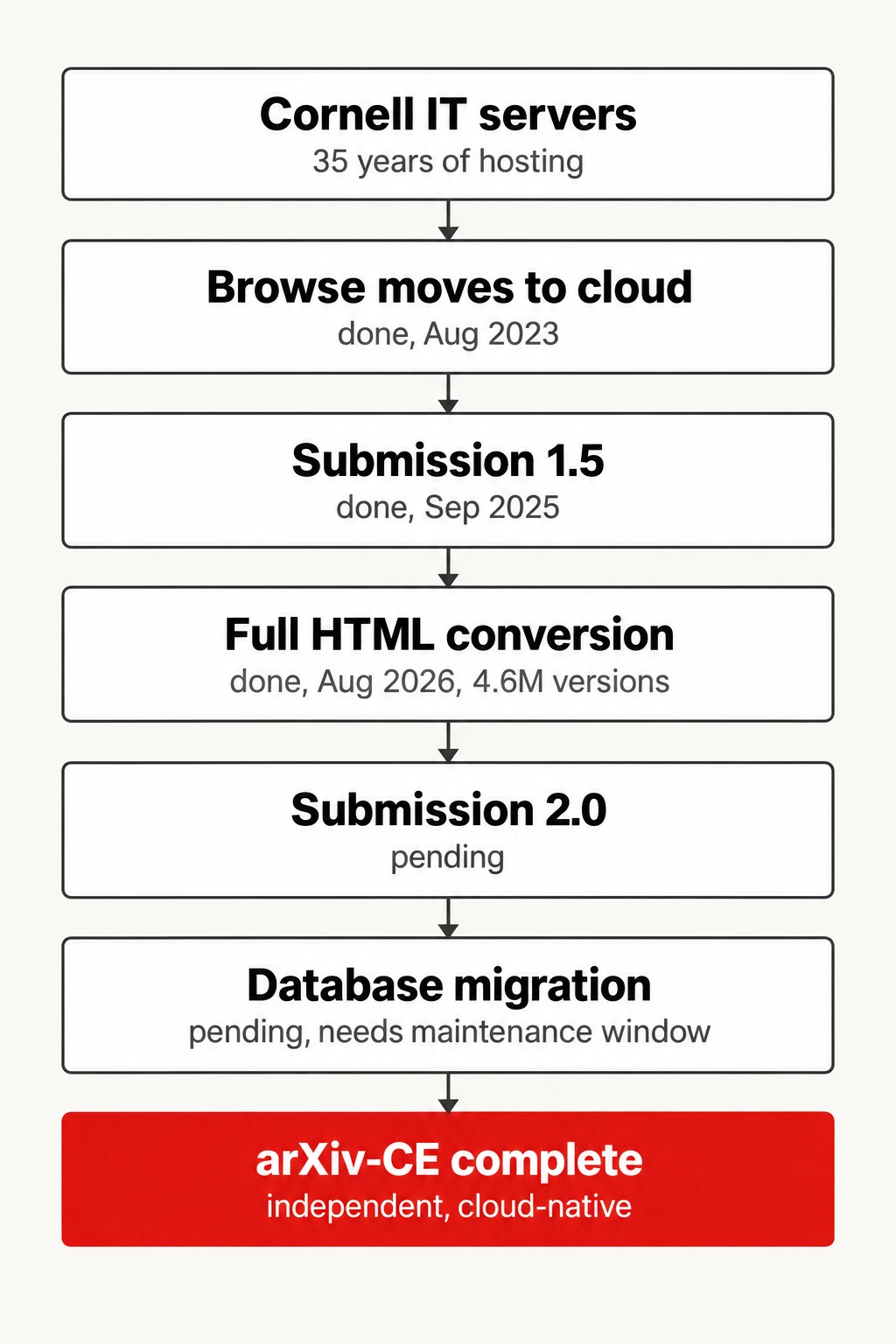
| From | To | How |
|---|---|---|
| Cornell IT servers (35 years of hosting) | Browse moves to cloud (done, Aug 2023) | |
| Browse moves to cloud (done, Aug 2023) | Submission 1.5 (done, Sep 2025) | |
| Submission 1.5 (done, Sep 2025) | Full HTML conversion (done, Aug 2026, 4.6M versions) | |
| Full HTML conversion (done, Aug 2026, 4.6M versions) | Submission 2.0 (pending) | |
| Submission 2.0 (pending) | Database migration (pending, needs maintenance window) | |
| Database migration (pending, needs maintenance window) | arXiv-CE complete (independent, cloud-native) |
Based on arXiv engineering blog
The riskiest box left on that chart is the database migration. Browse and HTML rendering are read paths; a database cutover touches every write, every new submission, every moderator action, for a service whose load just quadrupled over a decade and doubled in two years. arXiv has named an inaugural Engineering Director for the first time in its history, Jeff Sank, who started in April 2026 after more than 20 years in software and digital publishing, including a decade at NPR. “It’s an honor to lead and help such a vital scientific resource as we complete our final steps,” Sank said in the engineering blog post. Whether the 99.96% uptime figure survives that last cutover, and whether a two-submission-a-month cap holds as AI-assisted writing keeps pushing volume up, are the numbers to watch when arXiv next reports in.