
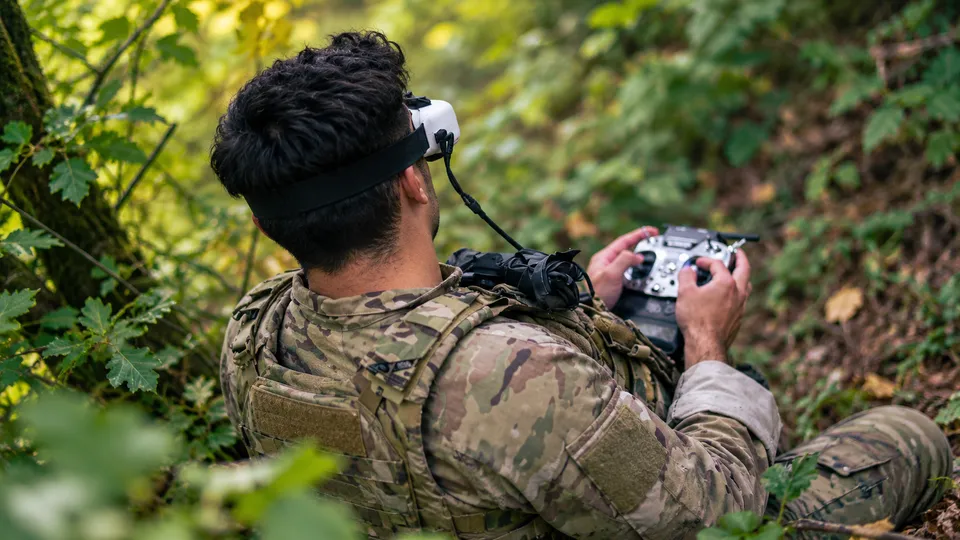
The Army graduated its first 10 robotics technicians on Friday at Fort Bragg, N.C., and its leaders say the specialty, which began in special operations, will spread to the rest of the service.
The 10 warrant officers finished a 19-week course at the John F. Kennedy Special Warfare Center and School and joined the Special Forces branch, according to an Army news release. The Army activated the job, designated 390A, on Oct. 1, a day before the ceremony. Their work goes beyond flying drones. They are meant to fold drones, ground robots, AI and other autonomous systems into operations, advise commanders and design, modify and repair custom hardware and software on short notice, Business Insider reported.
“We are scaling this across the Army,” Gen. Christopher LaNeve said last month at an Army conference.
Business Insider identified Gen. LaNeve as the acting Army chief of staff. The Army’s release calls him the vice chief of staff and says he first announced the specialty publicly on Sept. 16 at the Maneuver Warfighter Conference. “These technical experts will help command teams understand integration across the force,” he said there.
At the same event, Lt. Gen. Lawrence Ferguson, the head of Army Special Operations Command, said his command would give Army officials feedback in the coming weeks on taking the job beyond special operations, according to Business Insider. The course is a pilot for the whole Army, and the Special Operations Center of Excellence is involved to keep efforts from being duplicated. Officials told DefenseScoop that Friday’s graduation formally started the job and closed out the initial pilot.
Fourteen of the course’s 19 weeks went to technical training in computer networks, edge AI, computer-aided design, additive fabrication and radio frequency systems, the Army said. Two weeks covered mission planning. The last three were field exercises ending in a “Prototype Capstone,” in which students designed, 3D-printed and coded a solution in the field. Instructors can rewrite lesson plans as drones and AI change, according to Business Insider.
The technicians sit above a second new role, graduates of the Robotics Technology Integrators Course, who run the equipment. An Army document shared with Business Insider laid out the split.
To maintain battlefield overmatch, the Army requires a two-tiered structure: highly specialized technical architects (MOS 390A) who engineer and secure the systems, working in tandem with tactical employment specialists (RTIC) who operate them in the dirt.
The document compared the setup to motor racing. “If the Army Special Operations wants to build a Formula 1 racing team, the RTIC Graduate is our high-performance racing driver,” it said. The robotics technician is the crew chief. “They design the engine, write the telemetry software, rebuild the transmission when it breaks, and formulate the team’s strategy,” the document said.
The Army said lessons from recent conflicts made the need for the job clear. In Ukraine, new tools have gone obsolete quickly and soldiers have had to adapt them at the front, where both sides lean on drones and ground robots for supply runs.
Maj. Gen. Jason Slider, who commands the special warfare school, described the graduates in the Army’s release as “warrant officers who can turn robotics and autonomy into real combat capability.” Chief Warrant Officer 5 Jerry Brown of the 1st Special Forces Command said the work needed its own specialists: “it cannot be an additional task or an additional hat for someone on the ODA,” he said, referring to the 12-member Special Forces teams known as Operational Detachments Alpha. Lt. Gen. Steven M. Marks, the vice commander of U.S. Special Operations Command, gave the keynote at the ceremony.
Under the Army’s plan, the technicians will be the main technical advisers to brigade and task force commanders and will lead robotics detachments. The specialty arrives alongside a new multi-domain task force that is to field autonomous long-range fires, the release said.
Chief Warrant Officer 5 Gary Ostrander, the command chief warrant officer for the special warfare school, put it plainly in an Army release this summer. “There will no longer be a time when a formation does not employ robotics technology on the battlefield to gain an advantage over an adversary,” he said.