
Run water through an electrolyzer and it splits into hydrogen and oxygen gas. Burn that gas back together in a thruster and you get a specific impulse of roughly 400 seconds at the theoretical ceiling, by NASA’s own feasibility work on water-fed rockets published in the 1980s. That’s a worse propellant than the liquid hydrogen and liquid oxygen burned by Falcon 9’s upper stage, which runs closer to 450 seconds. But it ships as ordinary water, stores at room temperature instead of minus 183°C, and can in principle be dug out of lunar regolith instead of hauled up from Earth. That trade-off is the entire business plan of Argo Space, a four-year-old startup in Hermosa Beach, California.
The company was founded in late 2022 by three brothers, Robert, Ryan and Kirby Carlisle, who spent their SpaceX years launching, refurbishing and selling Falcon 9 flights rather than designing them. Ryan Carlisle ran launch engineering teams on Falcon and Starship and worked on an in-space refueling project under a 2020 NASA contract; Kirby refurbished flown Falcon 9 and Falcon Heavy boosters; Robert sold commercial and national-security launches. Their shared complaint, as TechCrunch reported when the company raised its $2 million seed round from Type One Ventures, Boost VC, Stellar Ventures and Earthrise Ventures in April 2023, was cryogenic propellant. “Cryogens are not fun to work with,” Ryan Carlisle told the outlet: the deep cold that liquid hydrogen and liquid oxygen need degrades seals and actuators, the exact failure mode Kirby had spent years fixing on returned boosters. Water needs none of that. “We based the company on water,” Robert Carlisle said in an interview with Ars Technica.
One tank, three jobs
Argo’s pitch is not just that water is a propellant. The same tank of water also cools the spacecraft’s thrusters and avionics, circulating as a coolant loop the way it would in a terrestrial power plant, and surrounds the payload as a radiation shield, since hydrogen-dense materials are good at stopping charged particles. Folding three jobs into one mass of water, rather than carrying separate coolant, shielding and propellant, raises what the company calls its propellant mass fraction: more of the spacecraft’s total mass is water that eventually gets burned for thrust, rather than hardware dedicated to a single function.
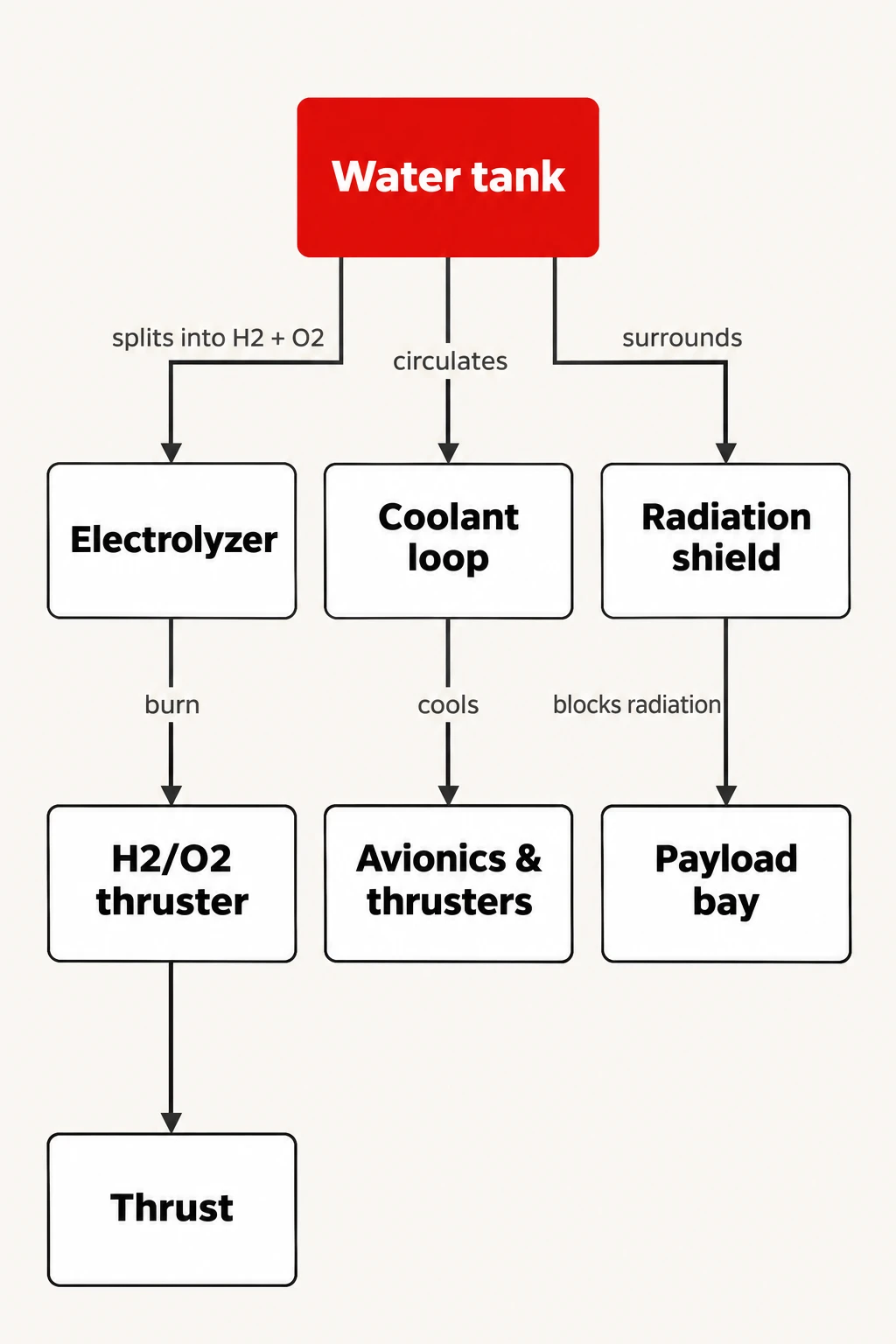
| From | To | How |
|---|---|---|
| Water tank | Electrolyzer | splits into H2 + O2 |
| Electrolyzer | H2/O2 thruster | burn |
| H2/O2 thruster | Thrust | |
| Water tank | Coolant loop | circulates |
| Coolant loop | Avionics & thrusters | cools |
| Water tank | Radiation shield | surrounds |
| Radiation shield | Payload bay | blocks radiation |
Based on Argo Space Corp.
Argo’s specification sheet for its Argonaut transfer vehicle lists up to 17 km/s of delta-v per tank, delta-v being the total velocity change a vehicle can produce by expelling propellant, the figure engineers use to size any mission. The sheet doesn’t say whether that’s one continuous burn or a sum across a tank’s life of on-orbit refuels. Taken as a single burn at the 400-second theoretical ceiling, the rocket equation says a mass ratio, initial mass divided by final mass, of about 76 is required: more than 98.7 percent of the vehicle’s starting mass would have to be propellant. At the more realistic 330 to 345 seconds NASA measured from actual gaseous oxygen/hydrogen thruster tests, the required ratio rises past 140. No flown upper stage gets close: Falcon 9’s second stage runs a mass ratio in the low teens. If 17 km/s is cumulative across many refuel cycles rather than one tank’s single burn, the number means something very different, and a lot more plausible.
A funding gap three orders removed
Argo has raised $9.9 million to $12 million total, depending on which funding tracker you trust, across the $2 million seed in 2023 and a $7.9 million Series A led by Crosslink Capital in October 2024, according to Tracxn’s count. It also holds a $1.9 million Tactical Funding Increase from SpaceWERX, the Space Force’s innovation arm, a non-dilutive award separate from its venture rounds.

Set that against the three companies building competing orbital transfer vehicles. Impulse Space, which moves payloads with chemical thrusters burning nitrous oxide/ethane and LOX/methane on its Mira and Helios vehicles, closed a $500 million Series D in June 2026 and a $308 million extension in September, the company announced, bringing its total raised across five rounds to roughly $1.27 billion at a $4.26 billion valuation. Starfish Space, whose electric-propulsion Otter vehicle docks with satellites that have no dedicated capture port, has raised over $150 million total after a Series B it announced in April 2026. D-Orbit, the Italian operator of the ION tug that has flown 19 missions and deployed more than 200 payloads since September 2020, has raised $223 million to $400 million depending on the tracker. Argo’s total sits at roughly 1 percent of Impulse’s.
Navigator’s one job
Argo’s first flight hardware, a spacecraft called Navigator, was supposed to answer whether any of this works in orbit. Defense contractor Anduril signed on in June 2025 as Navigator’s first customer, flying a suite of sensor and compute payloads built around Anduril’s edge-processing and infrared-imaging systems, with Argo CEO Robert Carlisle describing the mission’s goal as making “deltaV abundant.” Navigator launched on July 7, 2026, aboard SpaceX’s Transporter-17, a dedicated rideshare mission that carried 81 payloads to sun-synchronous orbit from Vandenberg Space Force Base.
Flight controllers made contact with Navigator after separation. Then one of its two rollout solar arrays failed to unfold. Controllers spent roughly half a day troubleshooting the mechanism and pulling telemetry on the spacecraft’s health, but the array stayed stuck, and Navigator stayed power-negative: it drew more power than its one working array could supply, and its battery drained with no way to recharge it. There was never enough energy left to run the one system the mission existed to test: the water thruster. Argo has not announced a recovery.

In the long run, this water-based transportation will give us a commercial incentive, a profit motive to go harvest it from the Moon’s shallower gravity well.
That line, from Robert Carlisle, describes the payoff Argo is still chasing after a demonstration flight that never got to demonstrate its core technology. The company is not slowing down to find out why the array jammed before moving on: in September 2026, Argo signed a definitive agreement with ispace-U.S. to fly the Lunar Connect relay satellite, named Alpine and the first node in ispace’s planned lunar communications constellation, to lunar orbit aboard Argo’s Argonaut vehicle, the companies announced. The mission, ispace’s Mission 2.5, could launch as early as 2027. Argo will be attempting a cislunar cargo run with water propulsion before it has demonstrated, in orbit, that the propulsion fires at all.
The open number is which comes first: a second Argo spacecraft actually igniting its thruster in orbit, or a paying customer’s satellite riding one to the Moon on the strength of a specification sheet. Water’s case rests on availability, not performance; Argo’s own numbers say the performance is already behind hydrogen-oxygen, let alone the storable hypergolics and electric thrusters its better-funded rivals fly today. Whether that gap closes, or whether 17 km/s per tank turns out to mean something far more modest once a spacecraft is actually burning it, is still untested.