
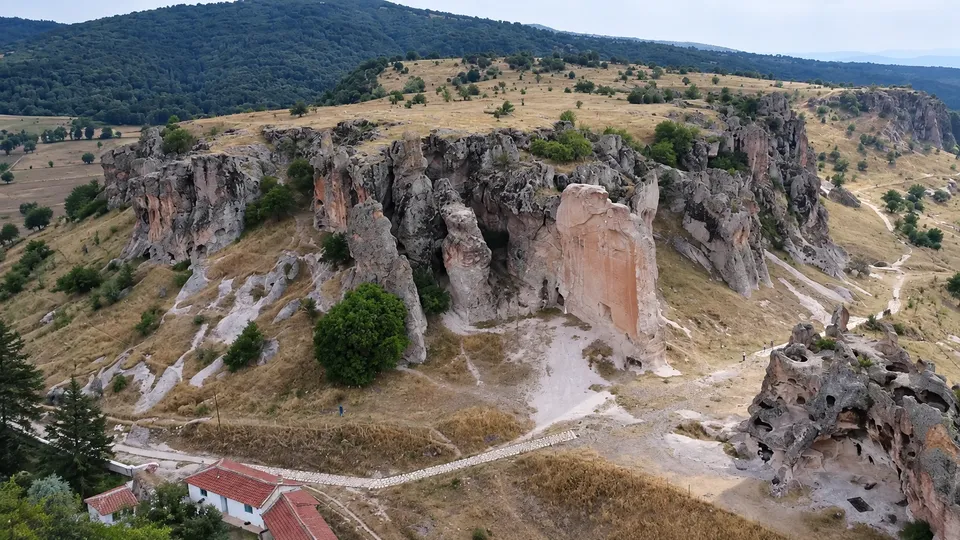
Archaeologists have uncovered a Phrygian fortification wall that still stands 2.6 meters high at Midas Castle in central Türkiye, the most substantial stretch of the ancient site’s defenses found so far, the excavation’s director said this week.
The wall came to light in a trial trench opened in a part of the site, known as Yazılıkaya, that archaeologists interpret as a watchtower. Its builders laid four courses of carefully worked stone blocks with raised, bossed faces, and the structure closes what was once an unguarded passage between rocky outcrops on the plateau, south of the city of Eskişehir. The excavation’s director, Yusuf Polat, a professor at Anadolu University, announced the find in a statement on X.
Until now the fortifications were known mostly from what the rock remembered. Earlier research documented grooves, stepped beds and sockets cut into the bedrock where masonry walls once stood, together with small wall fragments on the fortress’s southeastern side. The new section preserves that system on a far larger scale.
The plateau’s geology did most of the work. Steep volcanic tuff formations ring the settlement, forming a near-continuous barrier, and where the cliffs broke off, masons filled the gaps. The excavated wall, Mr. Polat said, does not merely stand beside the rocks but seals the passage between them. The result was an economical system: cliffs where cliffs sufficed, masonry where nature left an opening.
Pottery recovered from the trench dates to the eighth and seventh centuries B.C. Mr. Polat cautioned that the ceramics do not give the wall a construction date, but their context suggests that the enclosing and strengthening of the castle’s perimeter may have taken shape after the seventh century. Earlier surveys at the site found Phrygian pottery ranging from the ninth to sixth centuries B.C., with the strongest evidence from the eighth, and pointed to heavy activity in the Middle Phrygian period.
Excavations in 2024 had already targeted the defensive system and the nearby sanctuary of Agdistis. How the plateau was protected has become one of the central questions of the renewed dig.
The investment in walls fits what the place was. Mr. Polat describes Yazılıkaya-Midas as one of the most important sacred landscapes of Phrygian civilization, ringed by fortified sites that controlled the routes through the valley. Its best-known monument is the Midas Monument, a rock-cut façade nearly 17 meters across and high, covered in geometric decoration and carrying an Old Phrygian inscription that names Midas. Its form seems to reproduce, in stone, the front of a real building. Its date is still argued over: proposals run from the eighth to the sixth century B.C., and a 2023 study held that architectural parallels favor the first half of the sixth.
Across the plateau, archaeologists have mapped rock-cut altars, niches, cisterns, passages and ritual spaces tied to the worship of the Mother Goddess Matar. Recent work around Agdistis has begun to show how ritual life was organized around one of the site’s monumental rock-cut altars.
In the wider valley, several fortresses stood on high ground overlooking the ways in, and Mr. Polat’s research holds that they were no scatter of outposts but a system guarding access to some of Phrygia’s most celebrated religious monuments. Which is why a wall of four courses matters. The castle’s defenses no longer survive only as grooves and sockets cut into the bedrock. Part of the masonry that once completed them is standing there too.