
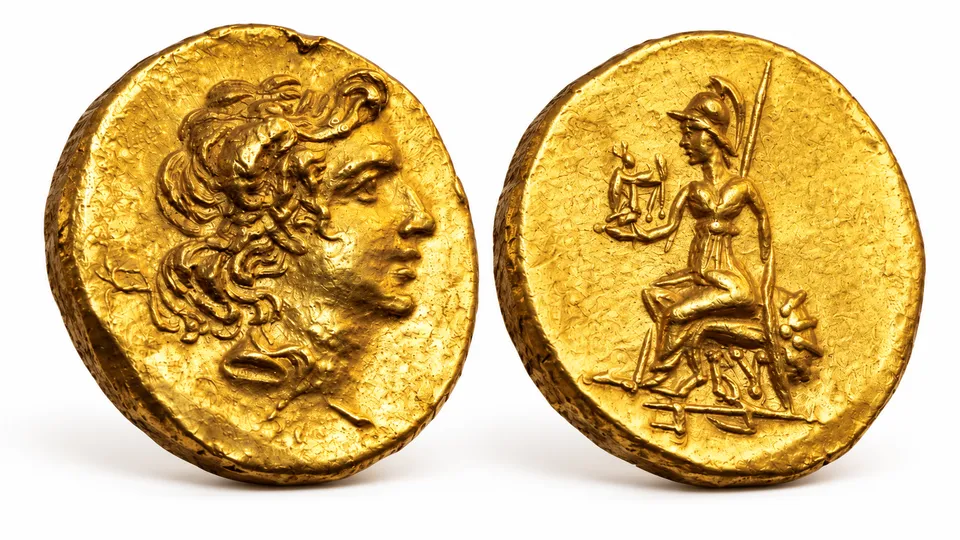
A young mounted warrior buried in southern Russia more than 2,000 years ago went into the ground with his horse, his weapons, a drinking cup scratched with a pentagram and a gold coin beneath his jaw, researchers reported on Wednesday.
The grave, known as Burial 52, comes from the Vinogradny 1 necropolis near the city of Krymsk in the Krasnodar region, a Maeotian cemetery in the foothills of the Western Caucasus, close to the eastern edge of the ancient Bosporan Kingdom. A new study by M. G. Abramzon, F. de Callataÿ, M. Y. Treister and N. F. Shevchenko counts 155 graves there, dating mainly from the second half of the second century B.C. to the first half of the first. The settlement beneath had flourished centuries earlier, from the fifth to the third century B.C.
The warrior held the most privileged ground in the cemetery. At its center sat a circular sacred space about six meters across, partly covered in ash. A narrow rectangular shaft descended roughly two meters into the natural clay, with nine steps leading down toward the groundwater, and inside the shaft lay a single gold stater that the authors interpret as a votive offering.
Only two major complexes occupied that inner zone. The other, Burial 97, contained the complete skeletons of three horses and a young bull, along with remains of a cow, a dog and a pig, and part of an adult human pelvis. The authors read the assemblage as a commemorative and sacrificial deposit, one in which a human element also figured.
Burial 52’s occupant was a man of 25 to 30. An adult horse accompanied him, wearing iron bits and wheel-shaped cheekpieces, with a girth buckle surviving near one foreleg. In the grave were an iron spearhead, a javelin head, an arrowhead and a knife, plus remains of a sheep and a pig, provisions or offerings for the dead. The smaller goods included a gray-clay bowl, a handmade vessel and a glass alabastron.
Then there is the cup. On the body of a small two-handled kantharos, someone scratched a pentagram, which the authors describe as a widespread instrument of apotropaic magic, meant to turn away harm. Antiquity also tied the sign to astral beliefs, healing and health, and the Bosporan region offers parallels, some connected with military settings. Here the mark rode with a warrior into the earth, so its protection appears meant to extend past life.
The second striking object lay beneath the man’s lower jaw: a gold Lysimachus-type stater weighing 8.16 grams. Its obverse shows the deified Alexander the Great with the horn of Ammon, the reverse Athena seated with Nike in her hand. The placement points to a Charon’s obol, the payment Greek tradition held the dead owed for passage to the afterlife, the authors write.
The stater from the shaft makes a tidy parallel: one gold coin for the collective sacred space, one for a single warrior. Such staters rarely occur in the Bosporan area and are described as unique in a Maeotian context, and the researchers connect the late issues to the age of Mithridates Eupator, the Pontic king whose wars reached the northern Black Sea in this period.
Even the little alabastron traveled far. Its type belongs to the eastern Mediterranean, with comparable vessels in Cyprus, Syria, Italy and the northern Black Sea, and no example had previously been found in the Kuban region. Together with the coins, the cheekpieces and the kantharos, it fixes both the grave and the ritual complex in the first third of the first century B.C., the study concludes in the journal Russian Archaeology.