
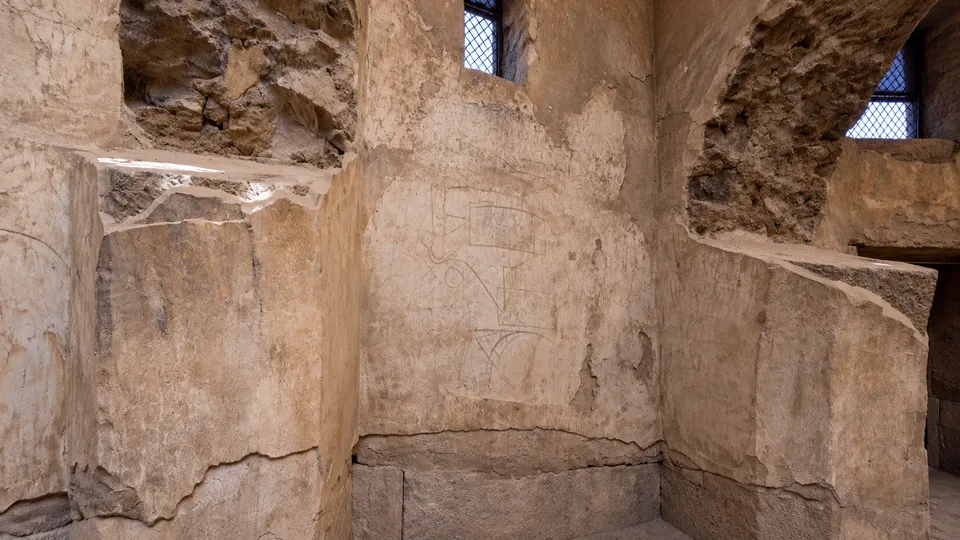
Archaeologists excavating the ancient city of Smyrna, in the center of modern İzmir in western Türkiye, have found wall paintings there for the first time, the excavation’s director said this week.
The team, led by Professor Akın Ersoy of İzmir Katip Çelebi University, also uncovered three rooms dated to the fifth and sixth centuries A.D., roughly 1,500 years ago. Two of the rooms have mosaic floors. The third is paved in marble.
Mr. Ersoy said his team had not previously encountered painted decoration of this kind in the newly investigated spaces near the city’s Agora and ancient theater. Researchers have not yet released details of the paintings’ colors, subjects or patterns, so their character remains unknown.
Smyrna was already known for its Roman graffiti, preserved on plastered walls and arch supports in the basement of the Agora’s basilica: drawings of gladiators, ships, birds and personal names, and scenes from everyday life. The paintings are a separate find, one that may help researchers determine how the decorated rooms were used.
The new rooms build on a mosaic floor the team began digging out during the previous excavation season. As the work expanded, three additional spaces emerged, showing that the earlier floor belonged to a larger building. Mr. Ersoy noted similarities with the famed Terrace Houses of Ephesus, though he believes the Smyrna rooms may have served a public purpose. That question is still open.
In January 2026, archaeologists presented a mosaic measuring about 3 by 4 meters along the Agora’s North Street, decorated with interlocking geometric panels and a central Solomon’s Knot, a design ancient builders often used as a symbol against misfortune and the evil eye. At the time, Mr. Ersoy said the building could not yet be identified as a private home or a public space.
The city itself is far older than any of this. Smyrna was reorganized as a major Hellenistic settlement after the era of Alexander the Great and flourished under Roman rule, and much of the Agora visible today was rebuilt after the earthquake of A.D. 178, with support from the emperor Marcus Aurelius. The new rooms are centuries later, from a time after the empire had split in two and Christianity had come to shape urban life. Mr. Ersoy considers the structures relevant to understanding how parts of the older Roman city took on new functions as its character changed. A 2026 study he wrote with colleagues in the journal Hoyuk traced the nearby theater’s transformations in the Roman period through its remains, inscriptions and ancient written sources.
Beneath the historic center, meanwhile, a Roman water channel, part of the city’s original supply network, still carries water nearly 2,000 years after it was built. Archaeologists have charted about 150 meters of its course toward the Agora, but they do not know where the water comes from. Mr. Ersoy believes it may connect to a spring near the Namazgah Bath and the Kursunlu Mosque, just south of the site; in Roman times, spring-fed channels supplied the city’s lower neighborhoods.
The dig will continue beyond the newly uncovered rooms before the team turns to the bath-gymnasium complex identified in earlier work. Finding where the water begins is also on the list.