
Archaeologists at Krevo Castle in western Belarus have found a fragment of medieval wall painting that shows a human palm, the first image of the human body in the history of research at the site, Belarusian scholars said on Friday.
The Institute of History of the National Academy of Sciences of Belarus announced the find in a Nov. 27 statement, as Arkeonews reported. The piece came out of the Prince’s Tower, the castle’s main tower. Nearly every painted fragment recovered there before it had carried geometric ornament. This one also shows traces of green pigment, which is rare in Krevo’s known murals.
The dig is led by Aleh Dziarnovich, whose name also appears in English as Oleg Dernovich. His team from the institute is working with specialists from the restoration organization Belrestauratsyya, and they are clearing debris from the tower’s lowest level, which has lain there “since the storming of the castle by the forces of Prince Švitrigaila in 1433,” according to the institute’s report as published by Nasha Niva.
A palm doesn’t go far toward a picture. The researchers said its measurements would let them reconstruct the size of the full figure in the original composition. They can’t yet say who the figure was, or whether it belonged to a religious scene or some other kind of painting.
The tower has turned up painted plaster before. Excavations there in 1988 and 2012 recovered about 4,000 wall painting fragments from the second half of the 14th century, according to a study by Mr. Dziarnovich and the art historian Giedrė Mickūnaitė. The paintings were done al secco, with paint applied to plaster that had already dried.
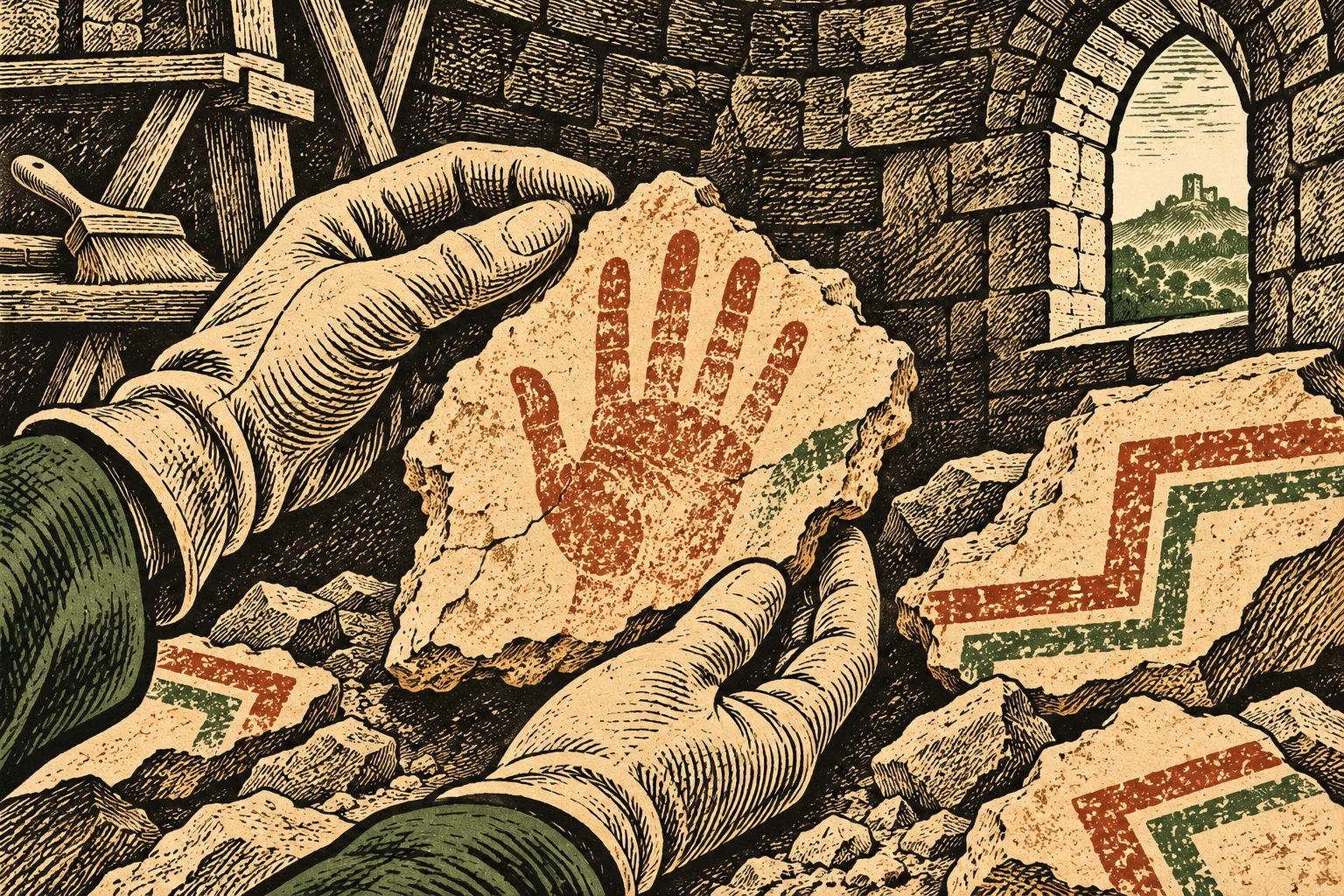
The painters worked mostly in what the institute calls earth tones, pigments they could get locally: red ochre, white and black. That’s why the green stands out.
One recurring design is the meander, a band of repeated right-angled lines that began in ancient Greek art and survived in Byzantine work. Researchers at the institute said the motif reached Krevo through the Byzantine tradition. The castle was a fortress, but rulers and nobles also lived in it, and its interiors were decorated.
Krevo, now in the Grodno region, was a political and military seat of the Grand Duchy of Lithuania in the 14th century. In 1382, Grand Duke Jogaila imprisoned his uncle Kestutis and cousin Vytautas there, according to a history of the castle. On Aug. 14, 1385, the Union of Krevo, negotiated between Jogaila and Polish nobles, set the terms for his conversion to Christianity, his marriage to Queen Jadwiga of Poland and his accession to the Polish throne. It was the start of a Polish-Lithuanian union that lasted for centuries.
The palm is the second find from the tower this month. On Nov. 18, Charter97 reported that the team had uncovered a set of steps it linked to Prince Kestutis.
The researchers plan to piece the fragments together to reconstruct the tower’s original decoration, and the hand gives them a human figure to work around for the first time.