
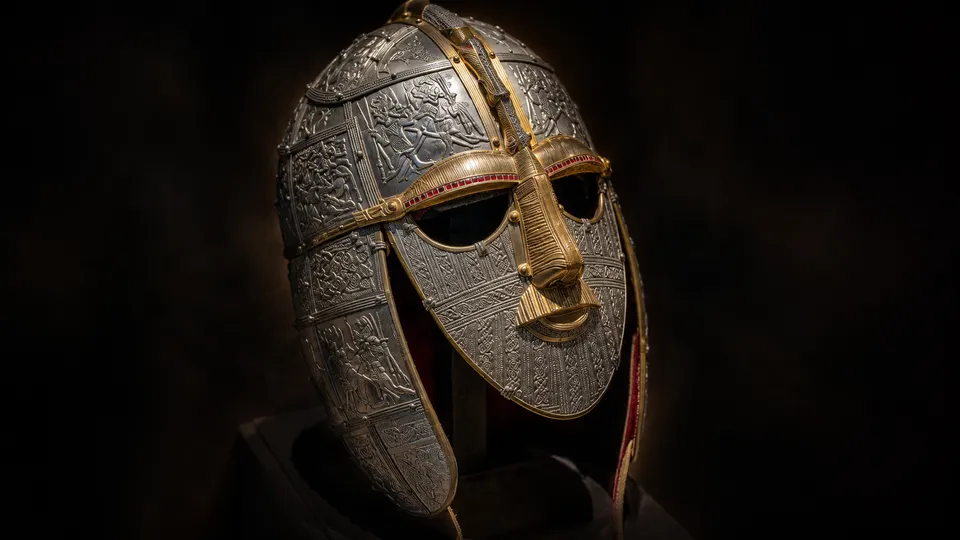
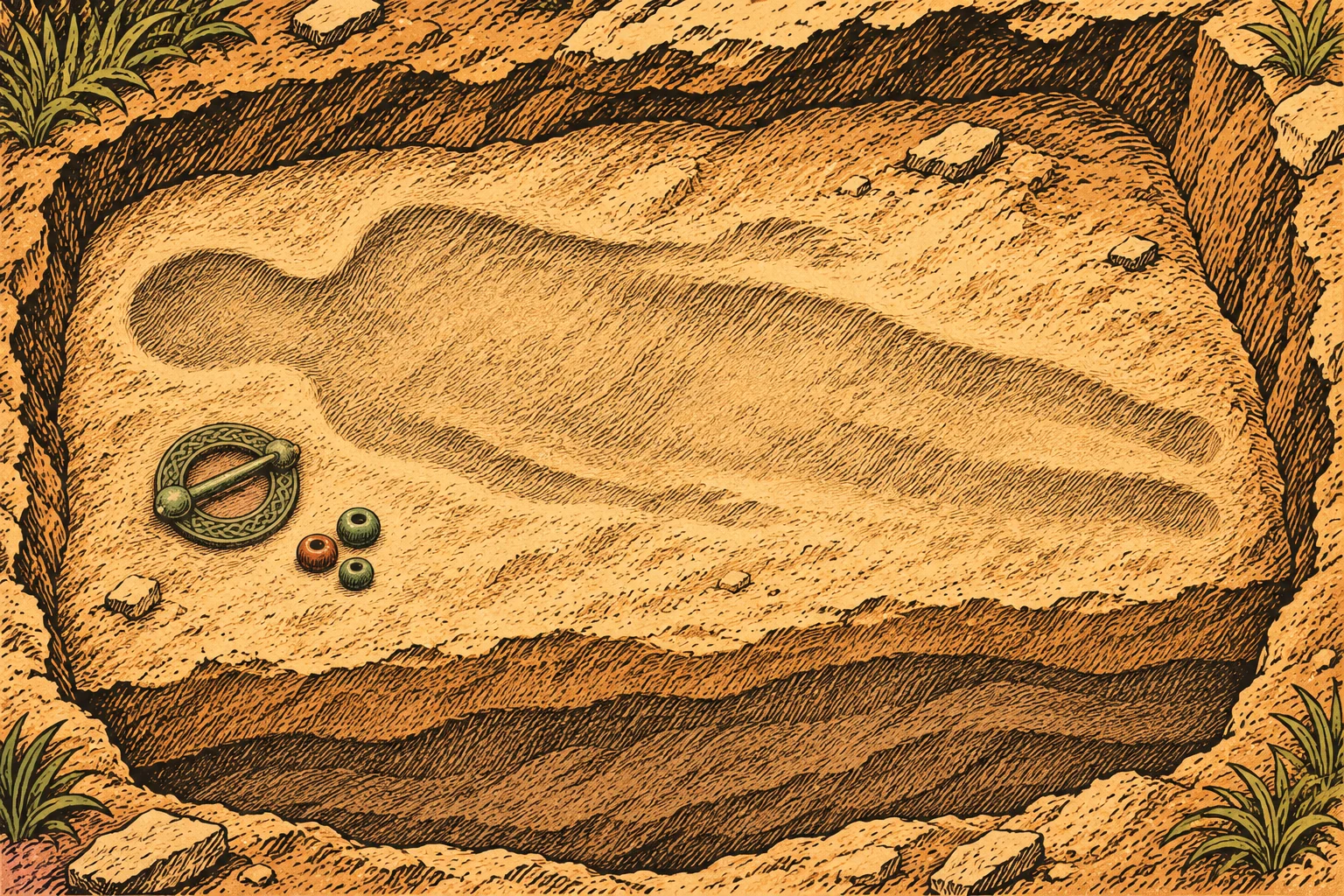
Archaeologists have found an Anglo-Saxon grave at Sutton Hoo in eastern England, where acidic soil left a person’s outline preserved in sand rather than a recognizable skeleton, in excavations announced this month.
The burial lay in Garden Field, a cemetery apart from the site’s celebrated royal mounds, and was excavated by Time Team in partnership with the National Trust. A brooch, knife, tweezers and beads accompanied the remains, Arkeonews reported. Preliminary findings indicate that another burial may lie below it.
Specialists call the preserved outline a sand body. Sutton Hoo’s acidic soil can dissolve bones over time, but the surrounding sand sometimes hardens around the space a body occupied and retains its shape. Similar remains were found during earlier work at the site, particularly in the 1980s.
That preservation comes with a loss: much of the skeletal evidence has disappeared, making the remains difficult to study. The objects can help researchers examine clothing, burial customs and personal possessions, but cannot by themselves establish who the person was or his or her social standing. Further examination will be needed to confirm the suspected second grave and determine how the two burials might be related.
Sutton Hoo’s reputation rests largely on the ship burial that Basil Brown uncovered in 1939. The 27-meter vessel held a chamber containing weapons, gold ornaments, silverware and other objects with connections far beyond early medieval England. The burial is often associated with Rædwald, a seventh-century king of East Anglia, though the occupant’s identity remains uncertain.
Garden Field offers a different record. Its Anglo-Saxon cemetery and evidence of earlier activity can help researchers study a broader part of East Anglian society than the royal burials represent. Less elaborate graves provide evidence about communities around the monuments, not only the people buried beneath them.
The excavation belongs to a two-year research collaboration between the National Trust and Time Team, the archaeological television project associated with Sir Tony Robinson. Archaeologists returned to Garden Field in the summer of 2025 for a second campaign, examining burials and additional cremation graves alongside fieldwork in the surrounding area. Earlier geophysical surveys had helped identify features underground without extensive digging.
Time Team has documented the work in a new series whose episodes began appearing publicly this month. The next archaeological task is to establish whether the feature beneath the sand body is another grave.