
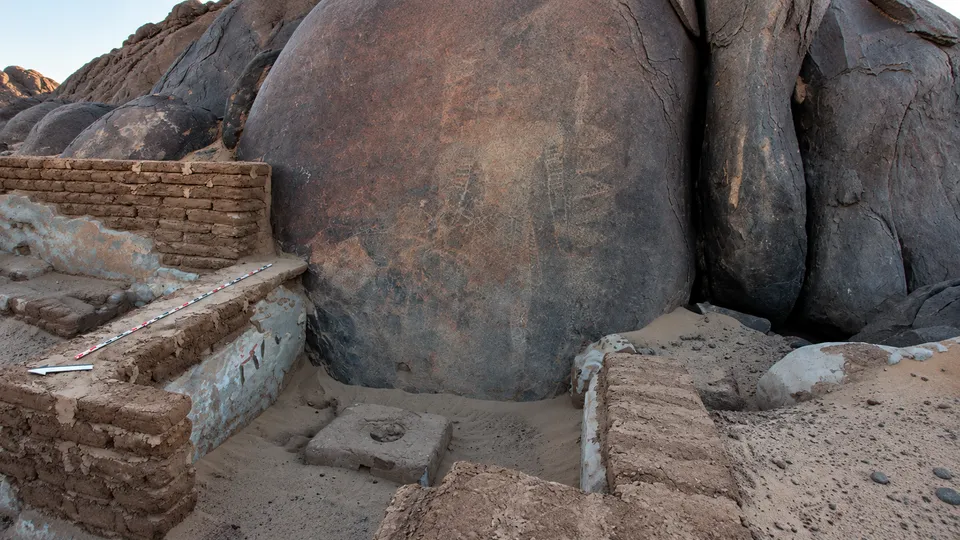
A life-size human figure carved into a granite boulder in northern Sudan may depict an ancient Nubian ruler, researchers said on Wednesday, and a Christian church was built around the same rock more than a thousand years later.
The figure anchors something much bigger. An international team surveying the Miseeda area of the Mahas region, around the Third Cataract of the Nile, documented nearly 300 archaeological sites and laid out a history running from prehistoric settlement to medieval Christianity and the folklore people still tell now. The study, led by J. A. Ciesielska with colleagues, appears in the journal Antiquity.
The carving, at a site the team labels MAS.021, dominates the face of its boulder. The researchers think it may show a ruler of the Kerma or Kushite cultural sphere, though its date remains uncertain. They compare it to a monumental carving of the Meroitic king Sherkarer at Gebel Qeili, read as an assertion of royal authority near the kingdom’s edge, and suggest the Miseeda figure may have marked a comparable frontier. More precise dating must come first, they said.
The rock around it carries older and newer marks. The team recorded large images of a lion, an elephant and possibly a rhinoceros, with smaller cattle figures nearby, plus carvings of Christian crosses, ships and human figures whose ages are unclear. Community after community returned to the same stones and left its own signs.
Around the seventh century, Christians built a church at the site, folding the ancient carved rock into the new sacred ground rather than erasing it. Several carvings from that period bear crosses, and some appear to direct attention toward the church itself. Pottery at the site ties Miseeda to the early Christian kingdoms of Nubia, with wares associated with Nobadia and early Makuria.
The wider map shows the busiest periods in the Mesolithic, the Late Neolithic and Pre-Kerma phases, and again in the Christian era. Material from the Classic Kerma through Kushite periods runs thinner, though the monumental petroglyph is among its most visible traces. The ceramics blend northern and southern Nubian traditions. The team reads Mahas not as a backwater but as a frontier where people, technologies and customs met and changed.
To pull the strands together, the project combined archaeological survey, rock-art analysis, ethnographic research and geographic information systems.
The ethnography reaches into living memory. Local tradition still ties the ruins to stories of gold, spirits, miraculous places and curses. People once regarded the church and the nearby Diffi Allirki fortress as both wondrous and dangerous, making pilgrimages and ritual offerings there. The church’s sacred standing has faded since, and today it also answers to names that include Beit Kitchiner and Beit Sheitan, the latter meaning House of the Devil.
The granite outcrop has now worn at least three reputations: royal emblem, holy place, devil’s house. The figure carved into it never moved through any of them.