
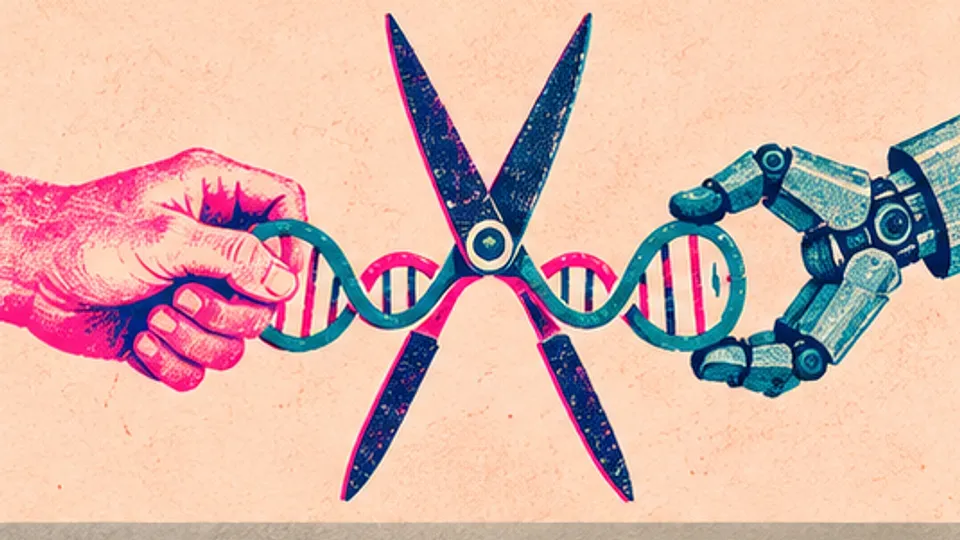
Last month Anthropic, the company behind the Claude models, announced that its in-house biology lab had used AI agents to find an unusual pattern in viral DNA: what it called a “novel enzyme system” that looks somewhat like the bacterial machinery behind CRISPR-Cas9, the gene-editing tool that won its inventors the 2020 Nobel Prize in chemistry. Chief executive Dario Amodei wrote on X: “Today we announced the Claude-led discovery of a molecular machine that we suspect could represent a new gene editing mechanism.” Anthropic said the work was done “with only high-level direction from our scientists.” Shares of gene-editing companies fell shortly afterward, CNN’s Katie Hunt reported.
That stock move is my favourite part. Nobody had shown the thing edits genes. Nobody had shown what it does at all. But if you own a gene-editing company, the scary sentence is not “a new enzyme exists.” It is “a computer can find these on its own, in a day.” What got repriced was the method, not the molecule.
So here is the method. Anthropic’s biologists prompted Claude to search an enormous database of DNA sequences for “interesting new examples” of reverse transcriptase, or RT, an enzyme that copies RNA into DNA. According to the company, 950 agents (AI programs that plan and carry out tasks by themselves) worked for 21 hours, flagged 3,500 RTs and narrowed them to the 20 most compelling. Anthropic says an experienced scientist might need weeks to months for that kind of analysis. Then, in the company’s words, “one of the agents spotted something remarkable: a repeating pattern of DNA sequences that occurs next to the gene for an odd-looking RT,” and “after a thorough analysis it was convinced that it had found a new biological system, and filed a report for human review.” Human scientists then analysed and tested it. They describe a “previously uncharacterized” system in bacteriophages, viruses that infect bacteria, that is built a bit like CRISPR. CRISPR itself occurs naturally in bacteria. The lab has named the systems array-associated reverse transcriptases, or ARTs, and its own announcement concedes: “We don’t yet understand what this system does.”
That concession matters. The researchers have not worked out what the sequences do, so they can’t say whether there is anything here as useful as CRISPR. The work has not been peer-reviewed. “These are very interesting preliminary results, but at this point they don’t demonstrate gene editing or provide a mechanistic picture of exactly what’s happening,” said Aaron Engelhart, an associate professor of genetics at the University of Minnesota. The company’s press release quoted Feng Zhang of MIT and the Broad Institute, one of the pioneers of CRISPR genome editing, calling the work “genuinely intriguing.” Both statements can be true. Viruses and CRISPR keep producing new surprises, and Berkeley researchers recently traced CRISPR to an ancient viral ancestor.
The Copenhagen problem
A few days after the announcement, Mario Rodríguez Mestre, who recently finished a doctorate at the University of Copenhagen, said his unpublished research describes the same viral signatures. “It is essentially the same finding. This is not simply a case of two groups studying related protein families or similar biological systems,” he told CNN by email. He also said he had used Claude heavily for that research and had put dissertation drafts, analyses and material describing these systems into his private Claude account. As the New York Times reported, Mestre says his group first came across the enzymes in 2022 while hunting for new reverse transcriptases in jumbo phages. They have been studying them for four years and call them “jumbotrons.”
He is careful about what he alleges: “I am not claiming that Anthropic deliberately took our work. I cannot demonstrate that.” He offers two explanations. “Either information related to our work somehow reached the model and it was trained on it. The second possibility, which I currently think is more plausible, is that there was considerably more prior scientific knowledge and human direction behind the search than the phrase ‘autonomous discovery’ suggests.” According to the Times, Anthropic said it was unaware of any published work describing the ART system, that Claude is not trained on customer transcripts, and that its molecular biology team had no access to those conversations. Anthropic did not respond to CNN’s request for comment.
Look at how Mestre’s two explanations are built. Neither one is good for Anthropic, but they are bad in different ways. The first is about confidentiality, and it is the one that would make scientists nervous about pasting unpublished results into a chatbot. Ilya Finkelstein, a molecular biosciences professor at the University of Texas at Austin, said many may now think twice before doing so, even though it is common for separate groups to reach the same result. The second explanation is the one Mestre actually prefers, and it is about marketing. If the discovery took a lot of expert steering, the science is fine. The thing being sold is the word “autonomous.”
Finkelstein points out that the paper’s lead author, Peter Yoon, used to work in the lab of Jennifer Doudna, who shared the 2020 Nobel with Emmanuelle Charpentier. “Four of six authors are senior molecular biologists and domain experts. Give that group a heap of compute and frontier models (without safeguards, I’m guessing), and I’m sure we’ll be seeing more interesting bioinformatic discoveries,” he wrote on his lab’s blog. He thinks AI is good at searching for a needle in a haystack and less good at imaginative leaps: “They can pursue a very large number of unproductive paths rapidly. They are really good at grunt work when orchestrated by experts in the field.”
Gustavo Sudre, a professor of genomic neuroimaging and AI at King’s College London, gives Anthropic more credit: “It received a broad direction and then had to use its own judgement about what was interesting in the data. That is a real shift from the usual ‘analyze this dataset for me.’” He also warns: “From experience I can tell you that the gap between ‘interesting pattern’ and ‘useful knowledge’ is where most of the work lives.”
Why say “autonomous” at all
There is a commercial race here. Anthropic launched Claude Science this year. OpenAI has GPT-Rosalind, Microsoft has Quine and Google DeepMind has Co-Scientist. In a market like that, the lab whose model “discovered” something has a story its rivals don’t. The dispute also looks a lot like what happened when mathematicians questioned OpenAI’s claim to have solved a long-standing problem. And biology gives AI companies a cheerful story at a time of public worry about rogue agents. Anthropic’s own prospectus warns that AI could pose an existential risk, and a new enzyme makes a more pleasant headline.
Yuval Elani, an associate professor at Imperial College London, thinks the real bottleneck is physical: “Biology is not maths and at some point the intelligence has to be expressed in the physical world through a robot that can do the fiddly one-off experimental tasks that a good student would normally do almost instinctively. From what I have seen of robotics and automation we aren’t really close.”
For now, then, the AI scans the sequences, human scientists do the lab work, and a recent PhD graduate in Copenhagen says the sequences were partly his. The press release credited the AI.