
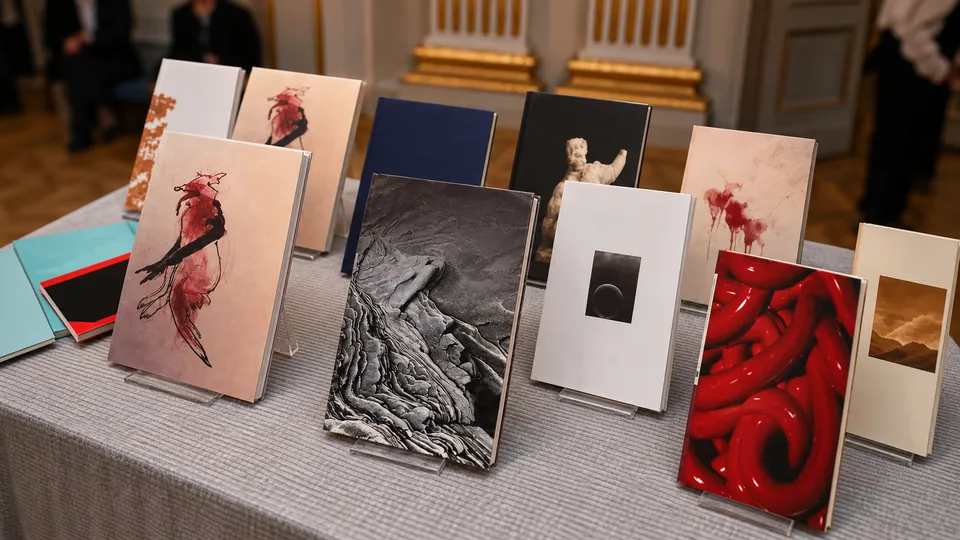
Stockholm, Thursday, 8 October 2026. The Swedish Academy has a set ritual. The permanent secretary steps out, says a name, and somewhere in the world a telephone rings. This year Ingrid Carlberg made the call and found the laureate neither in Toronto, where she was born, nor in any of the North American universities where she taught classics. She was in Iceland, and, as Carlberg put it, she was “listening to the wind.” “She was very taken by surprise,” Carlberg said, according to the Associated Press.
The prize went to Anne Carson, 76, poet, essayist and translator, for what the academy’s official announcement calls “her bold and inventive oeuvre that, in playful dialogue with the classical tradition, has created new forms for contemporary literature.” As CBC News noted, only two Canadian-born writers had won it before her: Saul Bellow in 1976 and Alice Munro in 2013. Bellow moved to the United States as a child and made his career there.
The philologist and the poet
Anders Olsson, who chairs the academy’s literature committee, gave his reading of the work in one sentence: “Almost all her literary production has centered upon the intersection between the philologist’s obsession with words and the poet’s desire for new meaning.” On the Nobel Prize website the academy went further, saying Carson herself has identified the etymology of words as the starting point for everything she writes.
She sets very old voices beside newer ones: the ancient Greeks next to John Keats, Virginia Woolf and Emily Bronte. Olsson said this “leads to playful and ironic works that move not only between classical and modern poetry but also between different genres and artforms.” The career started with a book of poetry, Canicula di Anna, in 1984. Two years later came Eros the Bittersweet, her first collection of essays, a study of the pleasure and pain of desire in ancient Greek literature, and it made her name in Canada and abroad.
The 1990s produced two books the academy singled out. It said Glass, Irony and God “demonstrates the potential of the long poem where genre boundaries are seen to blur.” Of Autobiography of Red: A Novel in Verse it said it “demonstrates her eminent ability to actualize the classical literary tradition.” More prizes followed. Men in the Off Hours won Canada’s Griffin Prize for poetry in 2001. In 2002 The Beauty of the Husband: A Fictional Essay in 29 Tangos made her the first woman to win Britain’s T.S. Eliot Prize. In 2020 Norma Jeane Baker of Troy, which runs the life of Marilyn Monroe alongside the Helen of Euripides’s play Helen, won a Governor General’s Award for poetry. The year after, PEN America gave her a career achievement award. Its judges called her a “visionary, sui generis writer” and announced the honour in the form of a poem.
Then there are the translations: If Not, Winter, built from fragments of Sappho, Sophocles’ Electra and Antigone, and Euripides’ Bakkhai. The academy said these “may be regarded as independent works in their own right.” Some of her work has been adapted for opera, including We Need to Talk and H of H Playbook. She once described her method to Eleanor Wachtel on CBC’s Writers & Company:
“Making a poem is making an object. I always thought of them more as drawings than as texts, but drawings that are also physically enterable through the fact of language.”
A box for a brother
Not everything comes from the archive. Nox, published in 2010, is about her brother Michael, his decades-long absence and then his death. Olsson called it “a creation as sculptural as it is literary, an epitaph in the form of a box containing an accordion-fold-out of pictures, letters and other written texts dedicated to her dead brother.” Inside is her translation of an elegy by the Roman poet Catullus for his own brother, so one grief is answered by another two thousand years older.
The hand
In 2024 Carson wrote in the London Review of Books that she had been diagnosed with Parkinson’s disease. The detail she chose to write about was small and exact: “a symptom particularly mortifying to me was that my handwriting disintegrated.” “Hard to describe or explain the shame of bad handwriting,” she wrote. “Bad handwriting is ugly. Also it is inauthentic. In the sense it is not you.” The magazine also quoted her on what the diagnosis means over time: “It is hard to live within the word ‘degenerative’, which means that, however I strive, I do not win.” The Irish Times cites another line from the essay: “I scrub out whole paragraphs in shame.”
The same year she published Wrong Norma, a wide-ranging collection of pieces that had appeared in places such as The Paris Review and The New Yorker, illustrated with her own drawings. This is a writer who thinks of poems as drawings, and whose disease has gone after her hand. Only weeks ago, the Goncourt withdrew a prize-winning debut amid claims that a machine had written it. Set against that, Stockholm has rewarded someone who writes about her own handwriting as proof of who she is, and about the shame of losing it.
Ceremony and money
Carson and her husband, Robert Currie, were granted Icelandic citizenship in 2022. When the prize was announced, the Associated Press tried to reach her and her literary agent, Nicole Aragi, without immediate success. Whatever she thinks of it so far went into the one telephone call.
The prize carries 12 million Swedish kronor. The AP put that at about $1.2 million and CBC at $1.7 million Canadian, which is the same sum in two currencies. The laureates receive their prizes on 10 December, the anniversary of the death of Alfred Nobel. He was a chemist and businessman whose will left most of his estate to fund “prizes to those who, during the preceding year, have conferred the greatest benefit to humankind.”
The literature prize closes a week that began in the laboratories. The medicine prize went to three scientists whose work produced a tool that uses light to help explain how the brain works. Physics went to a Belgian scientist for tracking a rare group of neutrinos at the South Pole. Chemistry honoured two scientists who sorted out mirror-image molecules, work that has since gone into countless drugs. The peace prize is announced on Friday and the economics prize on Monday. Past laureates include Kipling, Hemingway, Camus, Toni Morrison and V.S. Naipaul, and also Winston Churchill and Bob Dylan, which shows how loosely the academy has sometimes read the word literature.