
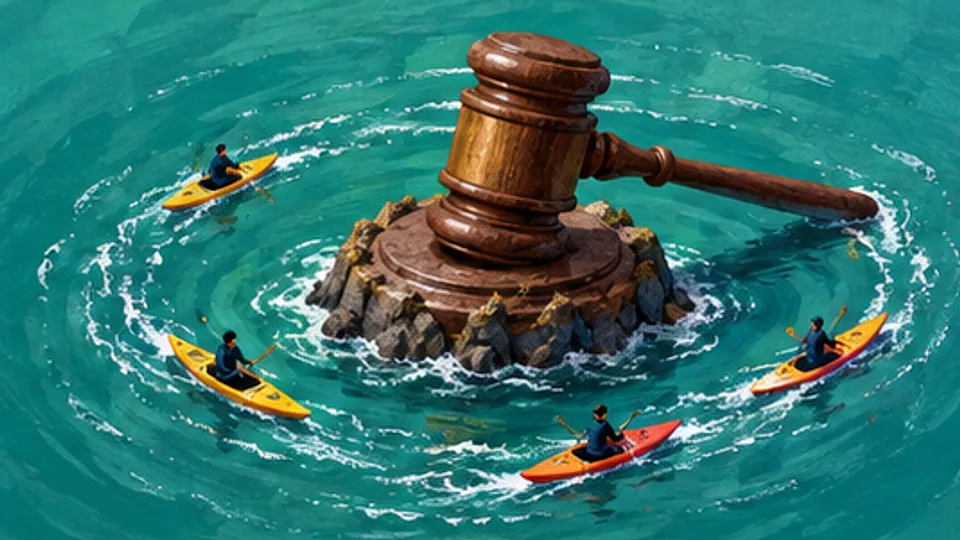
Chief Justice John G. Roberts Jr. has summered on a small island off the Maine coast for two decades, but the protests that have followed his court’s decisions have now followed him there, the Boston Globe reported on Friday, with neighbors forming kayak flotillas in front of his home and some longtime friends pulling away.
The demonstrators, who call themselves “kayak-tivists,” hold waterproof signs facing the gray-shingled house Chief Justice Roberts bought on Hupper Island in 2006, the year after he joined the court. A local newspaper columnist has urged residents to confront him, even to give him the finger. Friends who would never join the protesters told the Globe they had drawn back socially over their distress at his decisions, above all the court’s 2024 ruling granting President Trump broad immunity from prosecution. Residents say he is now ringed by far more security than in the past.
The island, an hour and a half north of Portland, has no ferry or bridge and no municipal trash pickup. Friends remember the chief justice leaping up from a dockside chat and exclaiming, “I’ve got to get to the dump!” Kevin Lipson, a former law partner who has vacationed in the area for 40 years, found the house, negotiated the deal and folded the Roberts family into what he called an unusually cohesive community of summer people, lobstermen and a local kayak outfitter. Years ago, he recalled in an interview with the Globe, the two men hitchhiked back to town in the bed of a stranger’s pickup.
That world has narrowed. This year, on an outing to Monhegan Island, people recognized Chief Justice Roberts as he walked past a brewery and chanted, “You should be ashamed,” according to Mr. Lipson. He now hesitates before introducing his friend to strangers. Chief Justice Roberts declined to comment to the Globe.
The first visible break came after the Supreme Court ended the federal right to abortion in 2022, when Becca Shaw Glaser, a gardener and columnist in nearby Rockport, wrote in the now-defunct Free Press that her neighbors should confront the chief justice wherever they found him. “Yell, boo, whisper, weep audibly, give him the thumbs down or the finger, hand him a note, refuse to serve him,” she wrote. “May you never feel welcome here again.”
Chief Justice Roberts’s position in the abortion case had in fact lost: he argued, alone, for preserving the right to abortion before 15 weeks. But he voted with the majority, and Ms. Shaw Glaser held him responsible as the court’s leader. Letters to the editor split. “Our children and grandchildren will learn nothing from this type of printed vitriol other than a complete disrespect for public servants at any level,” one person wrote. Mr. Lipson, debating the protests on Facebook, answered with a different verdict. “John is a credit to the community,” he wrote. “Civility should be our guiding principle.”
For years an unspoken rule held on the peninsula: no one raised the court with him. If a stranger asked what he did, he said he was a judge and left it there. Local pride ran so deep that a boat service pointed out his house to passengers, until friends asked it to stop. “From what I see, the barrier runs both ways,” said Mary Anne Mason, a friend and former law partner who lives in Port Clyde. “It’s harder for him to feel comfortable approaching people — and vice versa.”