
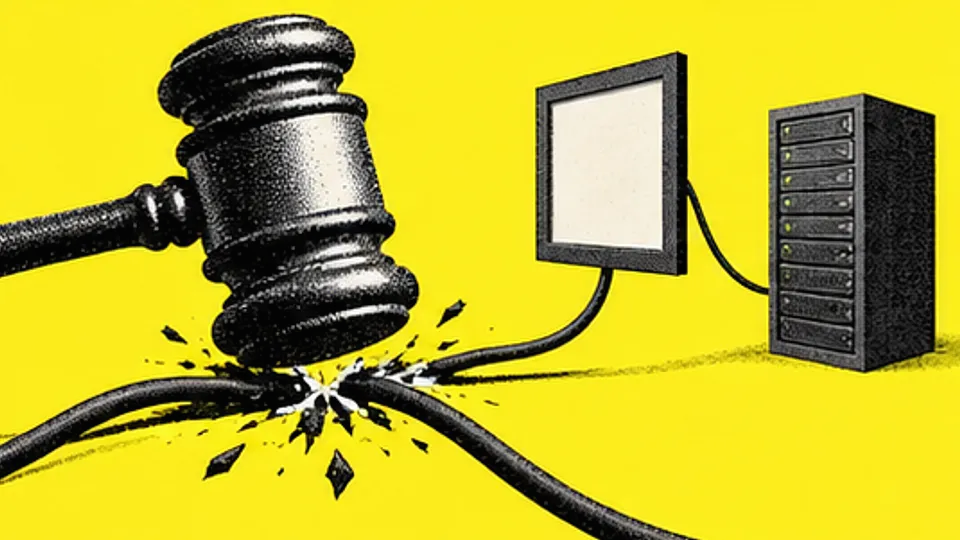
Eric Goldman, a law professor who specialises in the internet, has a ritual for each new opinion from America’s Fifth Circuit Court of Appeals: watch with mounting dread, because the result will probably be terrible and the reasoning worse. Emmerich Newspapers v. Particle Media, decided on August 27th, did not change his viewing habits. It is, he writes, dense, tendentious and tangent-filled. It is also the first federal appeals-court ruling to reject the “server test”, the shield that has protected embedded content for nearly two decades.
Embedding is the plumbing of the modern web. On NewsBreak, the app run by Particle Media, users see a thumbnail of a third-party article; clicking opens an empty frame inside NewsBreak’s page, which fills according to instructions sent by the original publisher’s server. The result is the publisher’s live page, viewed through someone else’s window. Emmerich Newspapers, whose articles appeared this way, sued for infringement of its right to display its works publicly.
Under the Ninth Circuit’s server test—laid down in Perfect 10 v. Amazon in 2007 and reaffirmed in Hunley v. Instagram in 2023—direct liability for displaying a work requires a copy fixed on a server the defendant possesses or controls. A mere linker stores nothing, so it displays nothing. Applying that logic, the district court dismissed the case, as one account of the ruling notes.
The Fifth Circuit panel took a different road to a similar destination. Parsing the statute’s language—Section 106(5) grants the right “to display the copyrighted work publicly”—it rearticulated the right as “to show a fixed work by transmitting it to the public”. That shift of emphasis, the court said, leaves the server test “on weak statutory footing”: the test fixates on where a copy is fixed, rather than on who transmits it. Yet the panel conceded the two tests usually coincide, since “a website cannot transmit a work that it does not have.”
The opinion does flirt with a worrying idea: that an embedded page might itself count as “fixed”, because it is “not necessarily so fleeting” that it could not last more than a transitory duration—the court even suggested that one site embedding another’s embedded photo proves the first page stable enough to be fixed. Mr Goldman replies that the statute itself contemplates a work being fixed by someone other than the transmitter, simultaneously with its transmission. If anyone fixed the copy, it was the user or the host, not the linker—which should strengthen the server test, not weaken it.
Think of Particle as a switchboard operator... Particle cannot connect a user to Emmerich’s content without Emmerich’s transmittal of the content. Just as the critical act in having a telephone conversation is someone picking up the other end, we find that the critical act in the linking process is the transmittal of content
From the switchboard the court derived a bright-line-sounding rule: if no user can see content without the content owner transmitting it, then no liability attaches to the linking site—“one cannot transmit content it does not have.” Practitioners noted that the outcome favoured NewsBreak even as the doctrine shifted; Loeb & Loeb’s analysis stresses that the embedder did not “transmit” content residing on the copyright owner’s server, while Reed Smith describes a “significant doctrinal shift” beneath a result-friendly surface.
Then came the hedges. “Our decision should not be understood to mean that embedding will always be permissible,” the court wrote, resting its reasoning on two principles: the copy came from an authorised source, and that source could have refused the request. Mr Goldman reads this as something close to an implied licence granted by uploading—and notes it drifts toward trespass-to-chattels territory, where blocking embeds lets a site control its chattels regardless of copyright. The court also offered fair use as “a viable pathway” against infringing links, which is backwards: fair use is a defence, reached only after an infringement the court had just said never happened. And it gestured at anti-circumvention law for content behind registration walls—an invitation, to Mr Goldman’s alarm, to the rampant abuse of that law as an anti-scraping tool.
Does this create a circuit split? Mr Goldman’s answer begins “Sort of…?” and runs out of road. One early commentary jokes of “a lot of obituaries for the server test this week.” The Electronic Frontier Foundation, which had warned of “staggering new potential liability” for the internet’s most basic functions, kept its odium; the embedders kept their victory. What publishers gained is less clear: those who serve content openly to any browser that asks will still struggle to sue those who link to it. What everyone gained is uncertainty. In copyright law, that is usually grounds for appeal.