
The American Cancer Society’s new definition of a worrying PSA reading is 3.0 nanograms per milliliter, for any man under 70. Most US clinical labs have flagged results below that as normal since 1986, when a study of 472 healthy men set 4.0 ng/mL as the cutoff, as Tech Times reported in its look at the mismatch. The gap between those two numbers is small on paper and not small in practice: it reclassifies every man whose PSA has landed between 3.0 and 4.0 on a routine blood draw, from clear to worth a second look. James Eastham of Memorial Sloan Kettering, who sat on the guideline panel, put it bluntly to Tech Times: “It really should be under 3.”
That threshold change is one piece of a bigger reversal the cancer society announced on Thursday, November 12, in a guideline published in CA: A Cancer Journal for Clinicians, its flagship research journal. It is the group’s first major revision of prostate screening advice since 2010, when the guidance was to let men age 50 and up “consider” PSA testing after talking it over with a doctor, as both Ars Technica and CBS News noted in their coverage of the update. The 2026 version drops the hedge: men at average risk should get a PSA test every two years starting at 50 and continuing through 69, full stop.

What the algorithm says now
Risk tier sets the clock. Black men, who the cancer society says have 67% higher prostate cancer incidence and nearly double the mortality rate of white men, should start annual PSA testing at 45, according to the society’s press release. So should any man with a father, brother or son diagnosed before 65, or with two or more close relatives diagnosed at any age. A man with one relative diagnosed at 65 or older starts at 45 too, but can test every two years instead of annually. Screening after 70 becomes a case-by-case call through age 74 and is actively discouraged from 75 on, regardless of risk tier, for anyone unlikely to live another decade. The society estimates 333,830 American men will be diagnosed with prostate cancer in 2026 and 36,320 will die of it, making it the second-leading cause of cancer death among US men.
By catching aggressive cancers with a simple PSA blood test, you open the door to highly effective treatments that protect your future. Meanwhile, lower-risk findings can be safely managed through careful, active surveillance.
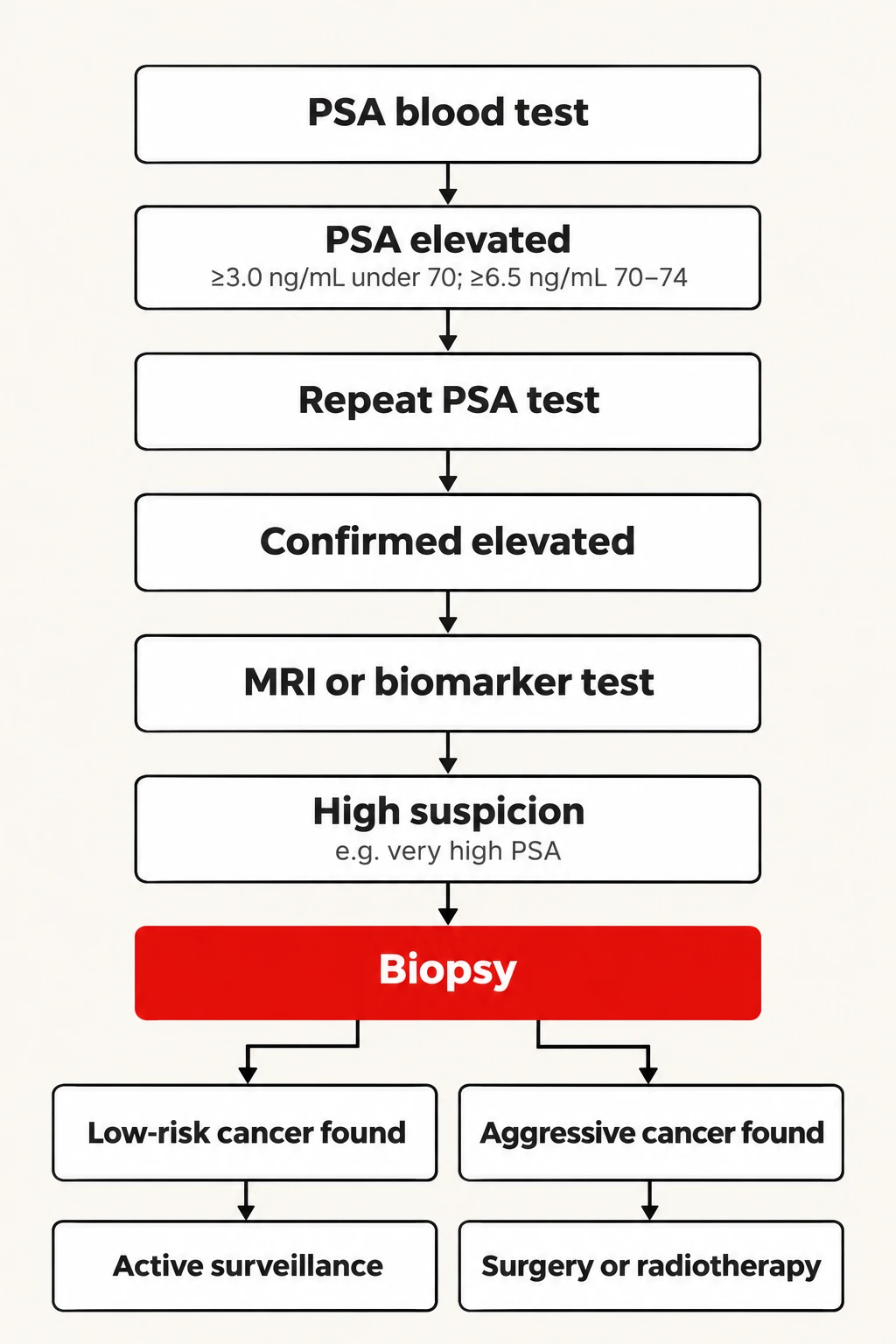
The quote, from the society’s interim chief patient officer Shanthi Sivendran, names the two failure modes the old guidance was accused of: missing cancers that kill, and treating ones that would not have. The new guideline tries to fix both by adding steps between a positive PSA test and a scalpel.
| From | To | How |
|---|---|---|
| PSA blood test | PSA elevated (≥3.0 ng/mL under 70; ≥6.5 ng/mL 70–74) | |
| PSA elevated (≥3.0 ng/mL under 70; ≥6.5 ng/mL 70–74) | Repeat PSA test | |
| Repeat PSA test | Confirmed elevated | |
| Confirmed elevated | MRI or biomarker test | |
| MRI or biomarker test | High suspicion (e.g. very high PSA) | |
| High suspicion (e.g. very high PSA) | Biopsy | |
| Biopsy | Low-risk cancer found | |
| Biopsy | Aggressive cancer found | |
| Low-risk cancer found | Active surveillance | |
| Aggressive cancer found | Surgery or radiotherapy |
Based on American Cancer Society
A single high PSA no longer sends a man to a biopsy. It sends him to a second PSA test, then, if that is still elevated, to an MRI or a validated biomarker test. Only a high-suspicion result from that step triggers a biopsy, and a biopsy that comes back low-risk defaults to active surveillance, meaning scans and repeat PSA tests on a schedule, not immediate surgery or radiation. Ash Tewari, who runs urology at Mount Sinai’s Icahn School of Medicine and was not on the guideline panel, told CBS News the change removes the guesswork for primary care doctors who are less versed in the specialty: “This has taken ambiguity out of it. They are basically saying, ‘Do it.’” CBS medical correspondent Céline Gounder made the underlying math explicit: “It takes about 10 years from when you diagnose prostate cancer to until somebody may need surgery, and we do much more watching and waiting, so it makes sense now you can be a little more aggressive with the PSA.”
Two trials, one reversal
The 2010 guidance cited “mixed” trial evidence on whether PSA screening saves lives, per Gizmodo’s reporting on the update. That evidence came almost entirely from two trials that reached opposite conclusions, and the gap between them is a matter of contamination, not biology.
| Trial | Participants | PSA threshold | Follow-up | Mortality result |
|---|---|---|---|---|
| ERSPC (Europe) | 182,160 men, 8 countries (core ages 55–69: 72,890 screened vs. 89,351 control) | 2.5–4.0 ng/mL, varied by site | Up to 23 years | 13% lower mortality (rate ratio 0.87, 95% CI 0.80–0.95) |
| PLCO (US) | 76,683 men (38,340 screened vs. 38,343 usual care) | 4.0 ng/mL | Up to 17 years | No significant difference (rate ratio 0.93, 95% CI 0.81–1.08) |
Source: Systematic review commissioned for the ACS guideline
The American trial, PLCO, found nothing because its control arm wasn’t actually unscreened: 74% of men assigned to “usual care” got at least one PSA test on their own, according to the systematic review the cancer society commissioned to write the new guideline. That contamination erases the comparison the trial was designed to make. The European trial, ERSPC, kept a cleaner control arm and, after 23 years, still shows a statistically significant mortality reduction in its core 55-to-69 age group. Individual ERSPC sites vary: the Netherlands and Sweden show the benefit most clearly, Finland only after adjusting for age, and the review’s own strength-of-evidence rating for the overall mortality benefit is “low certainty.” That is thinner evidence than the cancer society’s confident new phrasing suggests, and thinner than a rate ratio with a tight confidence interval implies on its own.
The overtreatment side of the ledger has firmer, more recent numbers. A Veterans Affairs cohort study published in JAMA in August 2026 found that active surveillance became the initial approach for 93% of veterans with low-risk prostate cancer in 2024, up from 27% in 2005, across 73,042 men, as Urology Times reported. For favorable intermediate-risk disease the rate rose to 61%, from 14%. The VA is an integrated system with unusually consistent practice, and Urology Times noted its rate runs ahead of what’s reported in US community-based practice, without putting a number on the gap — which leaves open how much of that progress has reached men outside VA care.
The clearest evidence that watchful waiting doesn’t cost lives over the medium term comes from a different trial: the UK’s ProtecT, which tracked 1,643 men with already-diagnosed localized prostate cancer, randomly assigned to active monitoring, prostatectomy or radiotherapy. After 15 years, prostate-cancer-specific death occurred in 3.1% of the monitoring group, 2.2% of the surgery group and 2.9% of the radiotherapy group — differences the trial’s authors, writing in the New England Journal of Medicine, called not statistically significant (P=0.53). More than a third of ProtecT’s patients had intermediate- or high-risk disease at diagnosis, so it isn’t a direct test of the cancer society’s low-risk-only surveillance policy, but it is the strongest data behind the claim that deferring treatment doesn’t trade years for comfort.
A guideline without a coverage mandate
The federal body that actually sets US insurance coverage rules hasn’t moved. The US Preventive Services Task Force’s prostate screening recommendation is still the version it issued in 2018: a Grade C for men 55 to 69, meaning screening should be an individual decision rather than a default, and a Grade D against screening at 70 and up. Under the Affordable Care Act, insurers must cover only Grade A and B preventive services at no cost to patients. A Grade C recommendation carries no such mandate.
The task force’s update has been pending for some time. In May 2026, the American Cancer Society Cancer Action Network joined 59 other patient and provider groups in a letter to Health and Human Services Secretary Robert F. Kennedy Jr., pressing the department to protect the task force’s independence after it dismissed the body’s leadership, and urging it to finish the prostate cancer revision. No new USPSTF recommendation has followed. Medicare is a separate case: Part B has covered an annual PSA test and digital rectal exam for men 50 and older under its own statute since the 1990s, independent of the task force’s grading, so that population is unaffected by the gap. Everyone covered by an ACA marketplace plan or an employer plan that follows the task force’s letter grades is not.
The cancer society’s new default arrives with no legal lever forcing insurers to pay for it without a copay, for men younger than the task force’s 55-year floor or on a two-year cycle the task force has never endorsed. Whether that gap closes before it hardens into two tiers of access depends on a revision that, as of this guideline’s publication, still has no announced release date.