
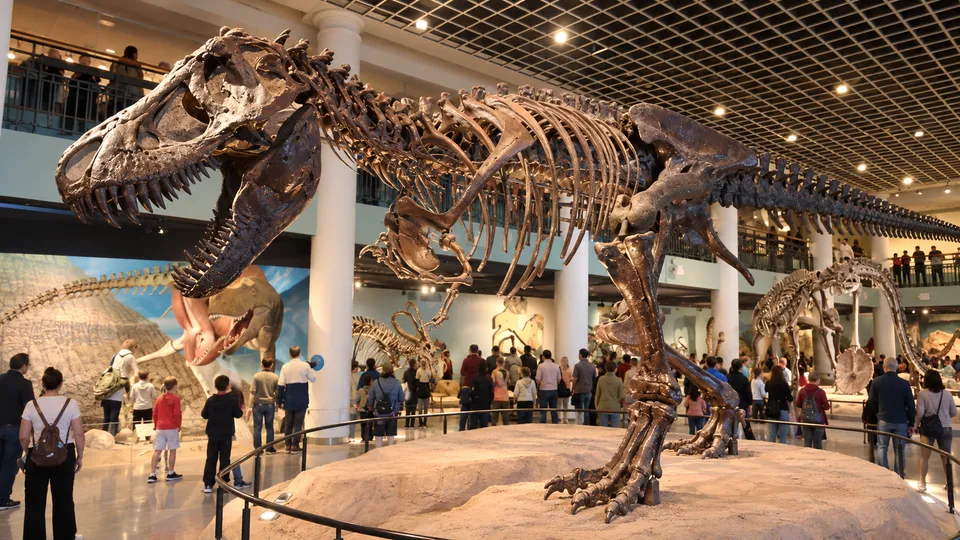
The Academy of Natural Sciences in Philadelphia, the oldest natural history museum in the Americas, closed to the public on Wednesday, two years short of the 200th anniversary of its opening and one month after the announcement that it would shut.
Crowds packed the place in its final weeks. Every weekend for the past month, the sidewalk outside felt at once like a festival, a funeral and a science fair, NPR reported, with lines to get in, activists circulating “Save the Academy” petitions and an educator showing visitors a giant salamander skull. Revenue in the last few weeks ran more than 20 times higher than last September.
Alexandria McCormick, who visited on the final Friday with her husband and six children, said she had come multiple times a year as a child herself. “It makes me really sad to think that my children might not also grow up having these experiences and being inspired to love nature this way,” she told NPR. Another visitor, Zoe Abrams, looked at the lines and said, “This is busier than Grand Central. Could have saved things.”
The museum announced on Sept. 1 that it would close on Sept. 30. Drexel University, which took over financial responsibility for the Academy in 2011, said on its website that costs had risen and attendance had declined since the pandemic.
Founded in 1812 and opened to the public in 1828, the Academy was the first museum in the world to display a dinosaur skeleton, in 1868. It holds more than 19 million specimens, including Thomas Jefferson’s fossil collection, plant samples gathered by Lewis and Clark and an archive of 73,000 holotypes, the preserved reference specimens scientists use to define and name species.
Drexel has said it will preserve access to the collection for students and researchers. What that means for the general public is unclear.
Isa Betancourt, who worked in the Academy’s entomology department from 2011 to 2021, flew back from Arizona, where she now lives, to help organize the campaign to save the museum, which drew rallies, marches and an online petition with more than 114,000 signatures. “If this museum can slip away like that, what’s stopping other museums from going the same way?” she said.
Supporters faulted Drexel for joining none of the rescue efforts and for refusing to say what it would cost to keep the doors open. “It’s like the leadership didn’t even try to keep it open,” Ms. Betancourt said. In a statement, Drexel said it “remains deeply committed to protecting the Academy of Natural Sciences’ extraordinary legacy.”
Less than a week before the closing, the William Penn Foundation offered a year of bridge funding to buy time to work out a permanent solution. Drexel said it was exploring the possibility but would need a plan for long-term sustainability before considering reopening.
The Academy tied its finances to Drexel’s in 2011, becoming a subsidiary of the university while keeping its own board and nonprofit status. Announcing the deal, the Academy’s president boasted of “a rock-solid balance sheet with a $51 million endowment.” But Drexel, like many universities, has struggled with declining enrollment and reported a budget shortfall in 2024. Last year the museum laid off staff and cut its hours; it later canceled its 2026 summer camp. Earlier this year, The Philadelphia Inquirer reported that Drexel and the Academy were renegotiating their relationship, with the university seeking a full merger that would give it the building, the endowment and the collections.
The closing lands at a hard moment for museums generally. A 2025 survey of American Alliance of Museums members found that a third had government grants or contracts canceled and more than two-thirds were affected by executive orders, said Natanya Kashan, a spokeswoman for the alliance. “The financial pressures are not only in federal funding,” she said. “They’re also in philanthropy, in corporate donations, in individual giving.”
Philadelphia has rescued failing cultural institutions before, including the Barnes Foundation and the Please Touch Museum. But those campaigns ran before the museums closed.
Amid speculation that Drexel intends to sell the Academy’s 150-year-old building, the City Council has proposed zoning changes to make a sale or conversion harder. It also plans special public hearings on how the Academy reached this point, with legislation that gives the council subpoena power over the university. “We need to know how this came to be,” said Councilmember Nina Ahmad. “What were the levers that created this decision, and how do we undo that decision?”