
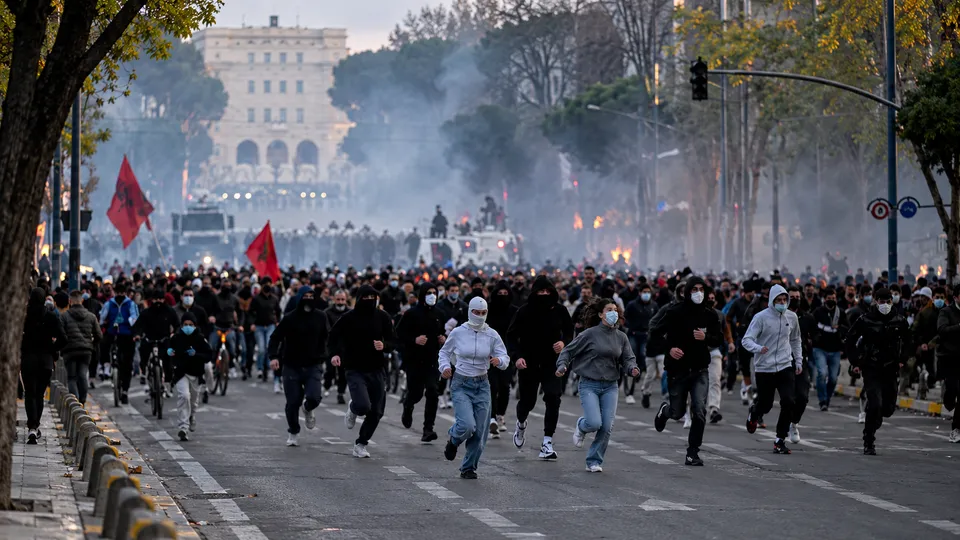
On Friday, 16 October, for the fourth day running, riot police stood in front of the education ministry in Tirana and the young of Albania came at them. As Al Jazeera reported, drawing on AFP and Reuters, thousands of them marched through the capital against government corruption and the state of the universities. They wanted one more thing as well: the resignation of Prime Minister Edi Rama, whose Socialist Party won its fourth consecutive election last year.
The prime minister replied in a Facebook video.
“These are foreign hands that do not wish for Albania to be at peace,” he said, according to Euronews. Then he went further: “All of this is the work of the very same hand, the hand that has gripped the Albanian opposition by the throat, the hand that has burned and destroyed Albania more than once.” Whose hand it was, he did not say.
Al Jazeera’s account puts him in a building damaged by fire. “This is not a student phenomenon,” he said there, and: “These flames are not student flames.” He accused the opposition of inciting the violence and called the unrest a deliberate attempt to wreck Albania’s long effort to join the European Union, while also calling for calm.

A reflection, and only that: when a government finds its own children in the street, it tends to go looking for a hand somewhere behind them. A hand can be blamed. Children have to be answered.
Four days at the ministry
It began on Tuesday, 13 October, though Al Jazeera had earlier counted from Monday, when fierce protests broke out in Tirana. On Tuesday, Balkan Insight reported, protesters threw bricks and concrete blocks at the education ministry, smashed its windows, pulled down its perimeter fence and set billboards alight. Police answered with tear gas and water cannon and made 23 arrests. Molotov cocktails, firecrackers and stones flew at officers behind their shields. That first evening was covered here at the time.
On Wednesday the ministry itself caught fire, and at least 16 more protesters were arrested. Deputy Prime Minister Albana Kociu wrote on Facebook: “Protesting is a legitimate right, but it cannot be used as an excuse for violence, city destruction or ugly fighting in the middle of the road.” The same day, the European Union’s delegation in Albania said it was concerned by “the violent escalation at the protest in Tirana” and asked the authorities for a proportionate response.
By Friday the city’s rubbish bins were burning across the roads. Some protesters smashed windows and damaged traffic lights. Stones went one way; tear gas and water cannon came back the other.
What the young say
A high-school student, who gave only her first name, laid the escalation at the government’s door: “The government’s indifference and arrogance since the beginning of our movement have been unbearable and have made the situation worse.”
Ledia, 18, told AFP: “We are not criminals. We simply want a better life for our parents and ourselves. We do not want to leave Albania.”
Student organisers listed their grievances: conditions in the universities, the cost of higher education, financial support for students, and whether there will be any work for them after they graduate. Along the way the demands grew to include electoral reform and Rama’s immediate departure. Afrim Krasniqi, a political researcher in Tirana, told Al Jazeera that the students had protested peacefully for nearly three months, “yet their demands were largely ignored, while the government often responded with discrediting campaigns rather than genuine dialogue”.
Beyond the capital
The movement has not stayed in Tirana. Students have been boycotting classes in other cities too. The broadcaster Top Channel, as cited by ProtoThema, reported secondary-school pupils and university students walking out in seven of them: Lezhë, Shkodër, Burrel, Laç, Elbasan, Korçë and Vlorë. In Shkodër, Socialist Party offices were attacked. In Lezhë, a schoolgirl was injured.
The coast and the mandate
This week came after months of anti-government protest, which the Jerusalem Post dates to May and calls the most violent outburst yet. One cause has been a luxury tourism project linked to Ivanka Trump and her husband, Jared Kushner, built on a stretch of Albania’s coastline that was sold for a resort. For many Albanians it has come to stand for alleged corruption and inequality. The government denies any corruption.
Rama has said he is ready to talk about the rising cost of education. He will not talk about leaving. Resigning, he said, “would be a betrayal of the Albanians who gave me a strong mandate to complete negotiations on European Union membership”. His government is aiming for membership by 2028. The next parliamentary elections are not due until 2029.
That leaves three years between now and the vote, measured against an eighteen-year-old who says she does not want to emigrate. Albania has seen Europe’s student unrest close up this autumn: in France, school blockades have drawn mass detentions. Rama, though, is asking his students to wait for Brussels.