
The Africa Space Expo, which closed last week in Abidjan, Ivory Coast, was not built around rockets and astronauts. Its organisers staged a market instead: a place where start-ups, project labs and investors could trade in what satellites do — watching crops, tracking coastlines, securing waters, connecting the unconnected. The stated aim was to move ideas from demonstration to deployment.
There was paper to show for it. Ivory Coast signed the Artemis Accords, becoming the 75th signatory of the agreement on space exploration and development, and Angola signed a letter of intent on space cooperation with the United Arab Emirates. But the expo left a plainer question hanging over the deal-making, Al Jazeera reports: can Africa stop merely using space technology and start building more of it?
Ghana shows both the reach of the ambition and the width of the gap. The country’s space and nuclear ambitions date to the first years of independence. In 1961 President Kwame Nkrumah’s government began a nuclear reactor project in Accra; two years later parliament created the Ghana Atomic Energy Commission to pursue the peaceful uses of nuclear energy. The reactor died with Nkrumah’s overthrow in 1966. The commission survived, and it is now the parent body of the Ghana Space Science and Technology Institute, the GSSTI.
Joseph Tandoh, the institute’s director, traces the modern programme to a partnership with South Africa. “Ghana became a partner through South Africa,” he told Al Jazeera. “Through that project, we were able to reconstruct the old satellite antenna at Kuntunse into a radio telescope.” The dish — a redundant 32-metre (105-foot) antenna — is now a working radio telescope, launched in August 2017. Ghana was the first of South Africa’s eight African partners in the Square Kilometre Array project to complete such a conversion.
The framework has followed. Cabinet approved a national space policy in 2022, and it was launched in 2024. In 2025 the government approved the establishment of a Ghana Space Agency, beginning the creation of a dedicated national institution. The scaffolding exists. What it will build is another matter.
Some of it is being built already. With VITO, the Flemish Institute for Technological Research in Belgium, the GSSTI ran a project called GEOMAIZE, using satellite data to monitor crop health and to classify crops. Predicting yields proved harder: most Ghanaian farmers sow small, mixed plots, and satellite soil-moisture data are too coarse to tell one small farm from the next. A follow-up project, supported by the French embassy and international research partners, is now working to sharpen the estimates. The institute also uses satellite data to track forest loss linked to mining, works with partners in Nigeria on a digital twin simulating coastal erosion at Keta and Agavedzi, and has drawn technical training from Japan. French support on space legislation produced a draft law now being reviewed by the attorney general.
We always say that Ghana Space Science and Technology Institute becoming an agency is to position Ghana in a way that we will not only be users of the technology but we will also contribute to designing, developing and building our own tools
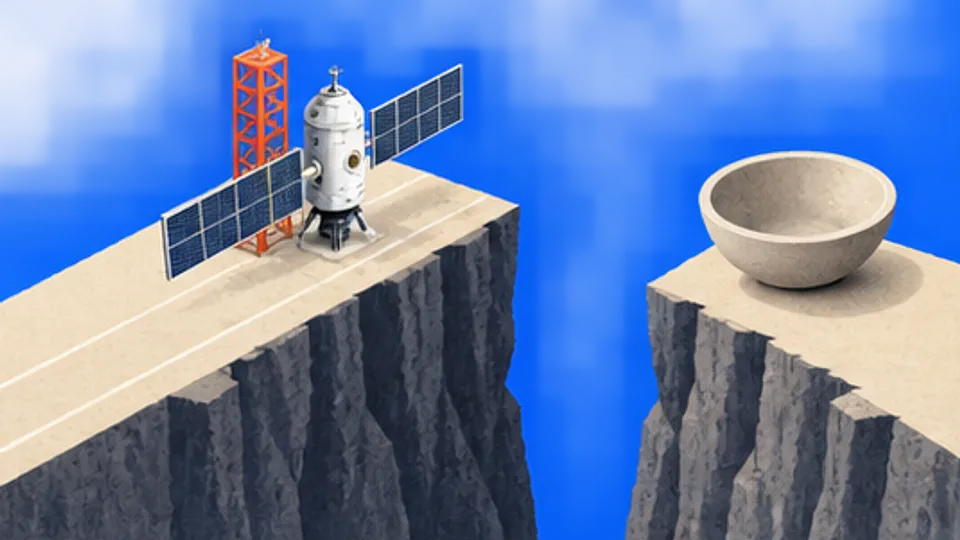
The wall is money
Victor Tagborloh founded Galaxy Aerospace Ghana in 2020. Two years later his team launched a high-altitude balloon into near space, photographing Ghana’s geography with clearance from national security and airport authorities. The company has designed mini-rockets for the GSSTI, trained young people in space robotics and artificial intelligence, and pushed for the introduction of Starlink in Ghana in 2024. Six years after its founding, it has yet to secure an investor. Its plans are large: a space university on 33,000 hectares (82,000 acres) it says it has secured at Apam in the Central Region, and a ground station to improve the monitoring of floods, mining and coastal erosion. The curriculum is ready, Tagborloh says, and the land is there; the capital is not. He argues that Ghana’s position near the equator could cut the fuel needed to reach orbit — an advantage several African countries share. Galaxy, it told Al Jazeera, was unable to take part in this year’s expo.
Bright Atsu Sogbey, president of the Africa Development Council and a senior research engineer at the Atomic Energy Commission, says private companies cannot carry this alone. “Borrowed technology cannot be sustainable,” he told Al Jazeera. “The state must be in the driver’s seat, using the natural resources we have to ensure that, in partnership with the private sector, we can have laboratories and manufacturing hubs for the space industry.” South Africa, Egypt and Nigeria already have space laboratories and have manufactured test satellites; Ghana lacks the state-backed labs and factories to make its own components. “Enough of the talk shop,” Sogbey said. “The next expo should see African satellites assembled on this continent and launching capability for African satellites.”
Others put the starting point further back. Daniel Aboagye, an engineer who runs African Progressive Research and Innovations, wants space science brought into schools: “We cannot continue to be consumers of technology we do not understand.” Kwadwo Dwomo II, whose company COMCENT Ghana builds agritech systems that run on satellite data, also wants more government investment. Around them sits a small cluster of Ghanaian firms — Galaxy Aerospace, Xavier Space Solutions, Ayeji Aerospace — working in satellite technology, Earth observation and geospatial services.
The continental machinery exists: an African Space Agency headquartered in Egypt, meant to give cooperation a common frame, and an expo designed to wire investors to African researchers and start-ups. Tandoh’s own order of business is modest and clear — first a hub that processes satellite data for ministries across government, then Ghanaian-built tools, then, in time, Ghanaian satellites. “Space cuts across all the ministries,” he said. “We should be able to build and validate our own tools first.”
Tagborloh is less patient. “We shouldn’t wait for tomorrow,” he told Al Jazeera. “Whatever decision we have to take, especially for human resource capital in the space industry, it has to be now.” Ghana has a policy, a telescope, trained engineers and a stretch of equatorial land waiting for a university. “We have the team, the knowledge, the research and the technical know-how,” Tagborloh said. “We just need funds.” After a week of signatures in Abidjan, that sentence stands for a whole continent.