

The African Union’s new credit rating agency says it will publish its first verdicts on African governments before the end of March. It is stepping into a dispute in which the best estimates of the big agencies’ bias against the continent run from nothing to one notch.
Those estimates look contradictory, but mostly they answer different questions. One set asks whether Moody’s, S&P Global Ratings and Fitch Ratings grade African governments below what their finances warrant. Moody’s own default data, an International Monetary Fund working paper and a 2025 study of S&P’s ratings find little or no sign of it, while a German model finds half a notch to a full notch. The other set asks whether investors charge African governments more than their ratings imply. There the answer is yes: 46 to 88 basis points in calm markets, by I.M.F. estimates, and more than 120 basis points in a global shock.
That split decides what the Africa Credit Rating Agency, or AfCRA, can do about an external debt-service bill the union says reached $163 billion in 2024, up from $61 billion in 2010. An agency can correct a rating. The better-documented penalty sits in the price investors set after the rating is published. And the record so far, from Europe’s long experience with a challenger agency to Afreximbank’s break with Fitch in January, shows how little a new or dissenting rating moves that price.

What AfCRA is
AfCRA opened in Port Louis, Mauritius, on Oct. 7, on the sidelines of the second Annual African Conference on Credit Ratings, according to the African Union. African leaders first endorsed the idea in 2017, Al Jazeera reported. The union dates the formal decision to a 2018 Assembly vote, followed by a declaration from finance ministers in Nairobi in July 2023. The African Peer Review Mechanism, the A.U. body that oversaw the build, held a March 2024 retreat in Lusaka, Zambia to finalize the design. Then the start kept slipping. As recently as March, a paper published by the German think tank SWP expected first ratings by June.
The union describes the agency as private-sector-led and self-financing, and it bars governments from holding shares. The ownership behind that description is narrow. Reuters reported this month, as summarized by EnterpriseAM, that AfCRA is held by Plus 94 Research, the South African firm the union named as its technical adviser. Sifiso Falala, the agency’s interim chief executive, co-founded Plus 94. AfCRA plans a share sale of about $15 million that would give African investors two-thirds of the equity. It has also bought 51 percent of Sovereign Africa Ratings, another South African firm that Mr. Falala founded and still leads.
Its sovereign ratings will be solicited. Governments ask for them, pay for them and give analysts access to officials and data. Moody’s, S&P and Fitch work the same way.
Coverage is the least contested part of the case. The union says the Big Three rate 32 of Africa’s 55 states and leave 23 unrated. Tatiana Lysenko of the Finance for Development Lab, a Paris research group, gave a slightly different count as of Oct. 13 in an analysis published after the launch: 26 states rated by at least two of the three agencies, nine by one and 20 by none. S&P rates 25 African governments, she wrote, with a median grade of B- and 14 of them in the B band. Only Botswana and Morocco hold investment grade from S&P. Mauritius holds it from Moody’s alone.

The 2020 downgrades
In 1994, South Africa was the only sub-Saharan government rated by a major agency, Ms. Lysenko wrote in a September 2025 working paper. By the end of 2024 there were 31. Chad was the latest.
The grievance behind AfCRA hardened in 2020. Of the 32 African countries rated by at least one of the three agencies, 18 were downgraded that year, the economist Hippolyte Fofack wrote in Project Syndicate in August 2021. They came during Africa’s first recession in a quarter-century. In African Business, he called the cuts procyclical and said they hit more than 56 percent of rated African countries, against a global average of 31.8 percent.
Some cuts were threatened over debt relief itself. In April 2020 the Group of 20 offered poor countries a pause on payments to official creditors. On May 7, Moody’s put Ethiopia’s B2 rating on review for downgrade, citing the group’s view that private creditors should take part on comparable terms. Reviews of Cameroon and Ivory Coast followed. In August, Moody’s confirmed all three ratings, saying the risks were already reflected in them. The union had asked the agencies to freeze downgrades during the pandemic.
Then came defaults. Zambia spent five years in default before S&P lifted it to CCC+ in November 2025, and Ghana exchanged its Eurobonds in October 2024. Since then the cycle has turned. Upgrades outnumbered downgrades in both halves of 2025, according to the peer review mechanism’s end-year review. Ivory Coast, Ghana, Egypt, Kenya, Morocco, the Seychelles, South Africa, Tunisia and Zambia were among the countries upgraded.
Counting the cost
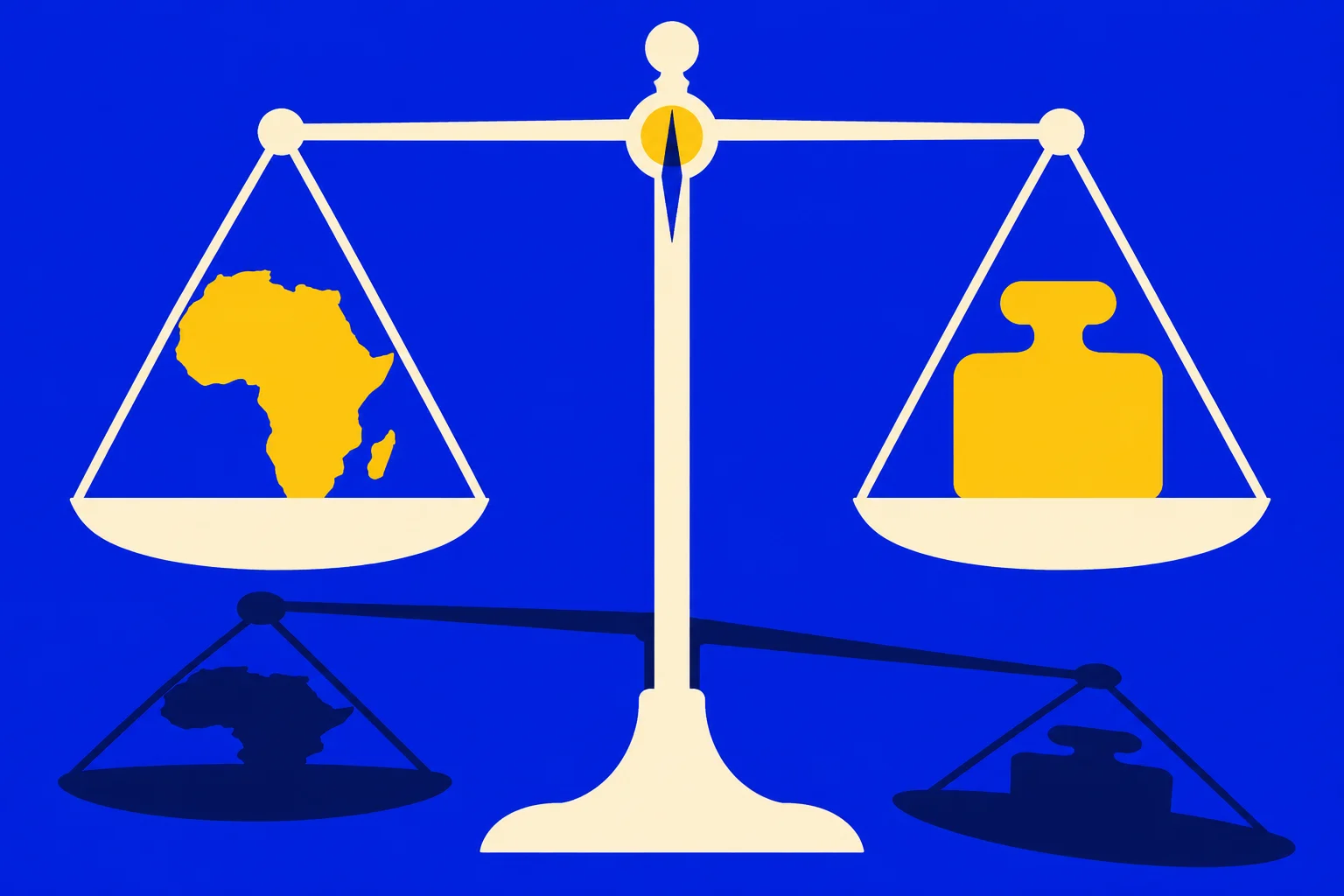
The most quoted price tag for bias comes from an April 2023 study by the United Nations Development Program, which said African countries could save up to $74.5 billion if ratings were based on less subjective assessments. The study compared the agencies’ grades with scores built only from macroeconomic and financial indicators, then put a price on the gap. In a 2024 essay for Brookings, five authors, two of them from the program’s Africa bureau, split the cost into over $24 billion in excess interest and more than $46 billion in forgone lending, accrued over the life of various bonds. Another Brookings article put the number of countries at 16.
Since then, the figure has been retold as a yearly cost. Ahunna Eziakonwa, the U.N. special adviser on Africa, and Marie-Antoinette Rose-Quatre, chief executive of the peer review mechanism, described it as an annual cost in an Oct. 5 op-ed in Africa Renewal. Mr. Falala told Reuters that African borrowers pay about $75 billion a year more in interest than borrowers elsewhere, Nairametrics reported. Jon Offei-Ansah, writing in Africa Briefing, cautioned that the number is not a proven annual loss and that no new agency could simply recover it.
The difference is large. As a yearly sum, $74.5 billion would equal about 46 percent of the union’s $163 billion debt-service figure for 2024. As a total spread over the life of bonds issued by 16 countries, it is a far smaller share of any one year’s bill. Neither the U.N. press release nor the Brookings summaries convert it into an annual figure.
What the default record shows
Mr. Falala’s argument starts from a fact about the rating scale. He told Al Jazeera:
A significant number of African countries carry speculative-grade ratings despite having no history of sovereign default.
Moody’s answered with a count. Marie Diron, Moody’s director of sovereign, multinational and sub-sovereign ratings, spoke at a June 16 seminar held by Chatham House and the Konrad Adenauer Foundation. She said the firm had studied four decades of sovereign defaults worldwide. A B-rated government had an estimated one-year default probability of about 5 percent whether it was African or not, she said, and Moody’s found what she called a “perfect alignment” between African sovereigns and the rest.
A speculative grade is a forecast of default, not a judgment on a country’s past, and a forecast is tested by what happens next. Ms. Diron set out that test, according to Peter Fabricius, who wrote up the seminar for the Institute for Security Studies:
If our ratings were biased, you would expect to see, for a given rating level, that the probability of default for an African sovereign is lower than for a sovereign elsewhere in the world.
Moody’s has not published that regional breakdown in full, so it could not be independently verified. Two other studies reach the same result by different routes. Ms. Lysenko’s paper, using S&P data, found “no statistical evidence of differentiated treatment of SSA sovereigns by S&P” once income, institutions and other credit factors were accounted for. An I.M.F. working paper published in July 2025 by Adrian Alter and five colleagues found “limited evidence of credit rating agencies’ bias against the region” after controlling for fundamentals. A Reuters investigation in 2024 found no evidence of systemic bias in the agencies’ sovereign ratings of Africa.
The dissent comes from a study the Konrad Adenauer Foundation and the RWI-Leibniz Institute for Economic Research published in April and presented at the same seminar. Its model found that the Big Three underrate African governments by 0.5 to 1 notch on average, a gap that held up in the authors’ statistical tests. Much of it traced to the weight the agencies give to income per head. Most African countries “would need to raise their per-capita income to the level of Mauritius,” the authors wrote, to gain one notch with everything else unchanged. Income per head in Mauritius was $10,552 in 2023. In Congo it was $511.

The two camps are closer than their headlines suggest. The Moody’s and S&P tests ask whether the agencies apply their models to Africa the way they apply them elsewhere. Ms. Lysenko’s paper states the limit: such tests check consistency, not whether the chosen variables and weights reflect relative default probabilities. The German study goes after the weights. If income were overweighted, poorer countries would default less often than their grades predicted. The Moody’s figures Ms. Diron presented show no such gap for Africa.
Ms. Eziakonwa and Ms. Rose-Quatre wrote the opposite in their op-ed: “Africa’s actual default rate is far lower than what its credit ratings imply.” Mr. Offei-Ansah cited one supporting statistic from African Development Bank research: cumulative defaults of 1.9 percent on African infrastructure loans, against 6.6 percent in North America. He also warned that those are project loans, not sovereign bonds. Ann Rutledge, in a December 2024 column for Forbes, disputed the Reuters finding and pointed to academic work showing that Africa overpays for credit. Neither offered a sovereign default comparison by rating grade to set against Moody’s.
The price above the rating
The basis-point figures measure something else. In June 2023, the I.M.F. economists William Gbohoui, Rasmané Ouedraogo and Yirbehogre Modeste Somé studied 1,592 fixed-coupon sovereign bonds issued by 89 countries from 2003 to 2021. Sub-Saharan governments paid higher coupons at issue even after controlling for their ratings, they found. The 130-basis-point figure often attached to the paper is a raw average: from 2014 to 2021, sub-Saharan coupons ran 1.3 percentage points above those of other developing and emerging economies, before any controls. Over 2004 to 2021 the raw gap was 2.1 points. The premium shrank when the authors added structural factors, among them shallow financial sectors, opaque budgets, large informal economies and weak regulation.

The fund’s April 2024 regional outlook controlled for the rating, global conditions and bond features. It put the premium on sovereign Eurobonds at 53 to 88 basis points, with a midpoint of 70, widening to 120 in global shocks. For bonds sold by sub-Saharan state-owned enterprises and private companies, the premium disappeared. The July 2025 paper put it at 46 basis points at issue, with a standard deviation of 16, and above 120 in shocks.
So the range from zero to 130 covers three different measurements. Zero describes the ratings. The 46 to 88 basis points describe what investors charge on top of the ratings. The 130 is the raw gap before anything is controlled for. A premium paid above the rating means investors are gloomier than the agencies. David Lubin, a senior research fellow at Chatham House, made that point in a November 2025 essay. Moody’s evidence makes an anti-African bias hard to argue, he wrote, while the I.M.F. has shown that sub-Saharan borrowers pay higher spreads than similarly rated countries elsewhere.
Abdussalam Muazu, an associate chartered economist at the Institute of Chartered Economists of Nigeria, offered one explanation for that gap in comments to Al Jazeera:
African governments and companies often pay more to borrow than their ratings suggest, partly because investors know too little about them and price in the uncertainty.
If the premium pays for missing information, better data could shrink it, and a local agency with analysts on the ground might supply some of that data. A higher grade on its own would not. Hene Aku, writing in October on the Substack The BlankPage, argued that “an observed spread bundles together benchmark rates, sovereign credit risk, issue-specific liquidity, and issuer challenges,” and that none of those amounts to a surcharge for geography. The post’s subtitle was four words long: “There is no bias.”
The Afreximbank test
The one live case of an African institution rejecting a rating involves Afreximbank, the Cairo-based trade lender. On June 4, 2025, Fitch cut it to BBB-, one notch above junk, after estimating its nonperforming loans at 7.1 percent. The bank’s own figure was 2.44 percent. The gap came from Fitch’s decision to count loans to Ghana, South Sudan and Zambia as nonperforming. In a June 6, 2025, statement, the peer review mechanism said “no formal default has occurred and none of the sovereigns have repudiated the obligation” and asked Fitch to re-examine its criteria.

In December 2025, Afreximbank and Ghana agreed in principle to restructure a $750 million loan as part of Ghana’s debt workout. On Jan. 23, the bank ended its relationship with Fitch, saying the rating “no longer reflects a good understanding of the Bank’s Establishment Agreement, its mission and its mandate.” Five days later Fitch cut the bank to BB+, below investment grade, and then withdrew its ratings for what it called commercial reasons, Graphic Online reported. Fitch said the Ghana deal suggested the bank lacked the preferred-creditor status multilateral lenders usually enjoy. The I.M.F. said the deal met the comparability requirements of Ghana’s official creditor framework.
On the narrow point in dispute, the record went Fitch’s way: the Ghana loan was restructured. Afreximbank still holds investment grades from Moody’s at Baa2, Japan Credit Rating Agency at A-, GCR at A and China Chengxin International at AAA. But Fitch’s last published grade for the bank is junk.
Afreximbank welcomed AfCRA’s launch in an Oct. 26 post on X. The post quoted its senior executive vice president, Denys Denya, on the need for methods that understand African institutions’ legal frameworks and operating models.
Credit ratings influence who can access capital, at what cost and on what terms. Their credibility depends on rigorous analysis and a full understanding of the institutions being assessed.
Looking back at the launch of the Africa Credit Rating Agency (AfCRA) in Port Louis,…
The European precedent
Europe tried this first. The German study noted that Europeans had seen the Big Three as biased against Europe and as missing European specifics. It also noted that Scope, the Berlin-based challenger built on that complaint, “has not yet succeeded in lowering the credit cost of European issuers.” Scope spent years trying to get its ratings accepted in the European Central Bank’s collateral framework and won acceptance in November 2023.
Two years later, Scope’s share of E.U. rating revenue fell to 1.23 percent from 1.83 percent, according to the European Securities and Markets Authority’s December 2025 calculation, which is based on 2024 revenue. S&P held 50.42 percent, Moody’s 29.63 percent and Fitch 11.82 percent. In the SWP paper, Benedikt Erforth of the German Institute of Development and Sustainability wrote that Japan Credit Rating Agency and DBRS Morningstar each took many years to win international recognition.
Mr. Lubin, who chaired the June seminar, described the investor’s problem there, by Mr. Fabricius’s account. A fund manager choosing between bonds from Congo and the Philippines needs a rating that covers both, and an Africa-only agency can rank African borrowers only against one another. He asked whether AfCRA amounted to Africa “marking its own homework.”
Daniel Cash, a law scholar at Aston University who has advised the peer review mechanism, argued in a July 4 post on his Substack that the agency’s fate turns less on its models than on its institutions. He pointed to committee design, insulation for analysts and whether a jurisdiction as small as Mauritius can supply enough legal and supervisory backing. He concluded:
What is abundantly clear is that institutional courage requires institutional shelter.
Dayo Obisan, a financial market professional, told Al Jazeera that the case for an African agency “centres on richer local data, contextual insight, wider coverage and support for domestic markets.” Dr. Erforth reached a similar view. The agency’s best contribution, he wrote, would come “not by contradicting the Big Three, but by filling data gaps they overlook.”
What comes next
Mr. Falala told Reuters that the agency would begin research in Togo, Kenya, the Seychelles, Burundi and Mauritius, and that it would lean less on figures from the I.M.F. and other international institutions. “We will be in a position, by March, before the end of March, to have released results,” he said. Talks with 15 governments are not 15 contracts, and AfCRA has not said which countries have commissioned ratings or which will come first.
Ms. Lysenko wrote that sovereign ratings are expected to make up around 70 percent of AfCRA’s business in the medium term. If it gives fiscal and external positions more weight than income and institutions, its ranking of African governments could differ from the one the Big Three imply, she wrote, which would leave some governments lower relative to their neighbors than they stand today. Mohamed Abdelmeguid, a former senior economist at BNP Paribas, told EnterpriseAM that “we shouldn’t expect risk premia to be influenced by AfCRA ratings at this stage.”
Claver Gatete, executive secretary of the U.N. Economic Commission for Africa, put the condition in one line, in remarks delivered on his behalf by Hanan Morsy and reported by Africa Briefing: “A rating agency that cannot downgrade will not be believed when it upgrades.”
AfCRA’s first sovereign ratings are due by the end of March.