
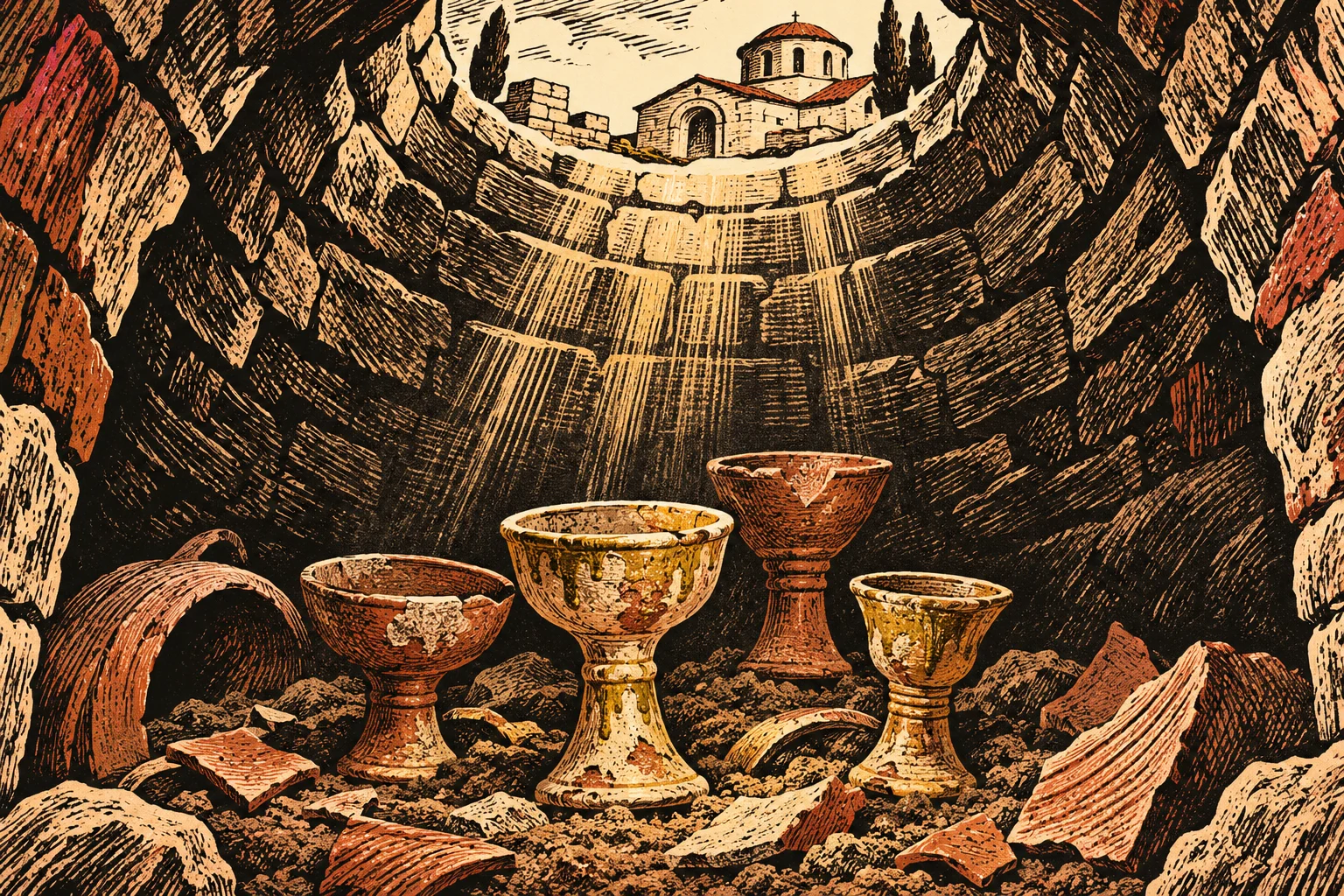
Nineteen clay chalices came out of an eight-meter well at Vatopedi Monastery on Mount Athos, part of a haul of more than 100 ceramic vessels pulled from the bottom during excavations in 2000 and 2001. The monastery’s own tradition says monks dropped sacred objects down the Well of the Virgin Mary to keep them from pirates. A 2026 master’s thesis by Stavros Zachariadis at the Aristotle University of Thessaloniki, reported by arkeonews.net, argues the well did something closer to the opposite: it was a long-term, deliberate repository, not a one-time hiding spot.
The vessels are Eucharistic cups — the ceramic ware used to hold communion wine, a cheaper substitute for gold or silver chalices. Some are plain. Others carry crosses engraved into the wet clay before firing, or Greek inscriptions: «ΠΟΤΗΡΙΟΝ ΙΕΡΟΝ» (‘Sacred Chalice’), «IC XC NIKA» (‘Jesus Christ Conquers’), and on one piece, a reference to the holy sanctuary set inside decorative Solomon’s knots. The well also held plates, bowls, jugs, a silver plaque of the Virgin Mary in the Hodegetria pose, and a small vessel depicting Saint Demetrius and Saint Theodora of Thessaloniki.
The old date, and the new one
The previous reading grouped all 19 chalices into the 15th and 16th centuries, treated as a single, roughly contemporary batch. Zachariadis’s thesis spreads them out: the oldest vessel in the well assemblage dates to around the mid-12th century, the newest to the 19th, and he proposes the well was in continuous use as a sacred dump from the 13th century through the 19th. The dating method is stylistic — comparing shape, glaze and decoration against ceramics with known findspots — not lab analysis. One yellow-glazed chalice resembles 13th- and 14th-century Thessaloniki pottery. Others match Late Byzantine wares from Thrace. Two chalices with green bands and patchy coloring line up with 15th-century ceramics from Lemnos. No archaeometric testing — the chemical or petrographic fingerprinting that would pin a sherd to a specific clay source — has been run on these pieces, so the new chronology, like the old one, rests on comparison rather than measurement.
| Chalice group | Proposed origin | Proposed date |
|---|---|---|
| Yellow-glazed chalice | Thessaloniki workshops | 13th–14th century |
| Chalices matching Late Byzantine wares | Thrace | Late Byzantine period |
| Green-banded, patch-glazed chalices | Lemnos | 15th century |
| Full 19-piece set (prior reading) | Not specified | 15th–16th century, now superseded |
Source: Stavros Zachariadis thesis, Aristotle University of Thessaloniki, via arkeonews.net
Why a well, not a midden
The thesis’s central claim is about function, not just dates. A chalice that breaks, or gets swapped for a metal one, is still a vessel that touched the Eucharist. Byzantine and post-Byzantine monastic practice, as Zachariadis reconstructs it, didn’t let that status lapse just because the object stopped being useful — so it couldn’t go out with ordinary refuse. Comparable ceramic chalices turn up elsewhere on Mount Athos, in Thessaloniki, and in burial contexts at Nicaea (modern İznik), a parallel tradition of treating communion vessels as grave goods examined in a Cambridge study of ceramic chalices found in Byzantine graves — the chalice as an object buried with the dead, not thrown away. At Vatopedi, with its many dependent churches and chapels, Zachariadis floats two explanations for why so many ceramic cups existed at all: the monastery commissioned them as the budget option, or worshippers donated them as offerings. The thesis treats both as plausible and doesn’t pick one.
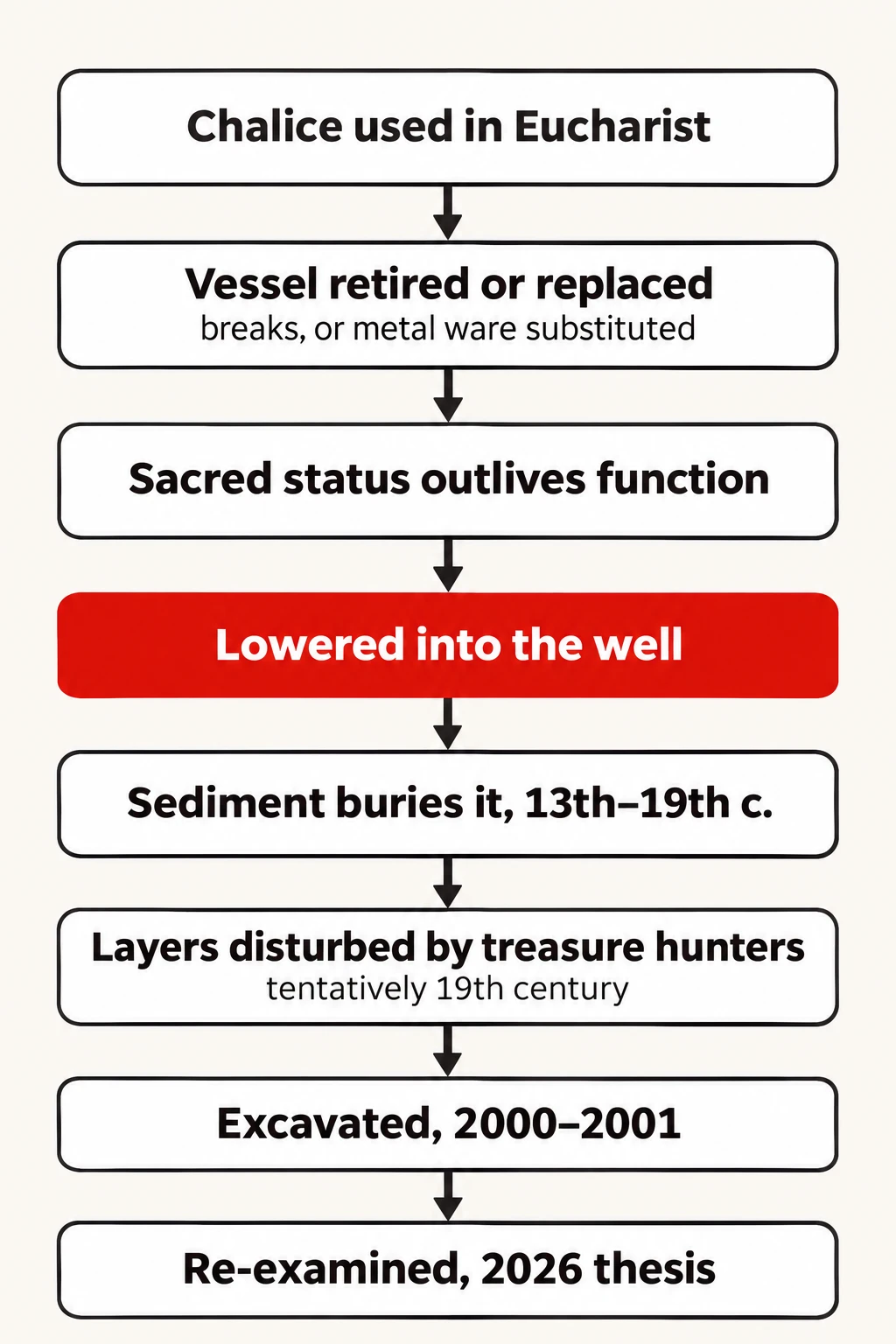
| From | To | How |
|---|---|---|
| Chalice used in Eucharist | Vessel retired or replaced (breaks, or metal ware substituted) | |
| Vessel retired or replaced (breaks, or metal ware substituted) | Sacred status outlives function | |
| Sacred status outlives function | Lowered into the well | |
| Lowered into the well | Sediment buries it, 13th–19th c. | |
| Sediment buries it, 13th–19th c. | Layers disturbed by treasure hunters (tentatively 19th century) | |
| Layers disturbed by treasure hunters (tentatively 19th century) | Excavated, 2000–2001 | |
| Excavated, 2000–2001 | Re-examined, 2026 thesis |
That disturbance matters for how confident anyone can be about individual dates. Someone dug through the well’s fill looking for treasure, mixing layers that would otherwise have kept vessels of similar age together. The thesis moves the likely date of that disturbance from the late 18th century to the 19th, possibly after the Greek Revolution of 1821 — itself a revision, and one the thesis calls tentative. With the stratigraphy scrambled, Zachariadis can’t rule out that chalices of very different ages ended up mixed in the same pocket of fill; gradual deposition over centuries is his preferred reading, but it isn’t the only one the evidence permits.
A count that doesn’t match, and nobody has reconciled it
An earlier account of the same well gives a different number and a different story. Pemptousia, reporting on conservation work by the archaeologist Eleni Stoumpou-Katsamouri, describes 21 clay chalices recovered from the same excavation and says they were discarded in a single episode around the start of the 18th century, when the monastery switched to metal vessels. That is two more chalices than Zachariadis counts, and a flatly different mechanism: one discard event in a narrow window, versus a seven-century accumulation. Neither account has run the clay through a lab. Until someone does — petrographic sourcing, at minimum, to match fabric to findspot — the 19-versus-21 count and the single-event-versus-gradual-practice question both stay open, resting on how two researchers, a decade and a dating method apart, read the same glaze and the same stratigraphy.
The vessels’ origins point at a wider network regardless of which chronology holds: workshops in Thessaloniki, Serres, Lemnos, İznik, Kütahya, Çanakkale and Didymoteicho, plus imported Italian maiolica, all represented in one monastery’s discarded tableware. None of those attributions has chemical confirmation either — they’re drawn from manufacturing technique and decorative style, the same comparative method used for the dating. A single archaeometric survey of the Vatopedi assemblage could settle both the date range and the supply map at once. Nobody has funded one yet.