
Climate change is usually a problem about paying. Cutting emissions costs money, the benefits go to everybody, so each country would quite like the other countries to do the cutting. Solar geoengineering is a stranger problem. Nobody is worried that it won’t get done. The worry is that somebody will do it, and whoever that is will be setting the thermostat for everyone else.
So what happens when you put the people who would have to manage that in a room and make them try? Karl Mathiesen reported for WIRED, in a piece republished by Ars Technica, on a simulation run last September at Queen Mary University of London. It was called Exploring Geopolitical Tipping Points and Climate Cooling Strategies, and it was organised by Danielle Young, an assistant professor in international relations at Leeds. About two dozen foreign-relations experts, scientists, military personnel and former government officials from around the world played national governments, climate NGOs, indigenous groups and tech companies. The setting was a hastily convened UN committee coordinating the world’s response to solar geoengineering, with meetings at three points in time: the present, September 2027 and September 2028. The organisers added new sunlight-reflecting technology at each step, and no player ever had the full picture.
The technology is solar radiation modification: reflect some sunlight back into space, for example by spraying sulphur dioxide or some manufactured particle into the atmosphere. That it would cool the planet is broadly accepted, because large volcanic eruptions do it naturally and can knock half a degree or more off for a while. The side effects are less clear and land unevenly. Models predict drying in sub-Saharan Africa and stronger tropical storms in the Atlantic. And the cooling only lasts while you keep spraying. Stop, and temperatures could jump back up, with wild effects that are hard to predict.
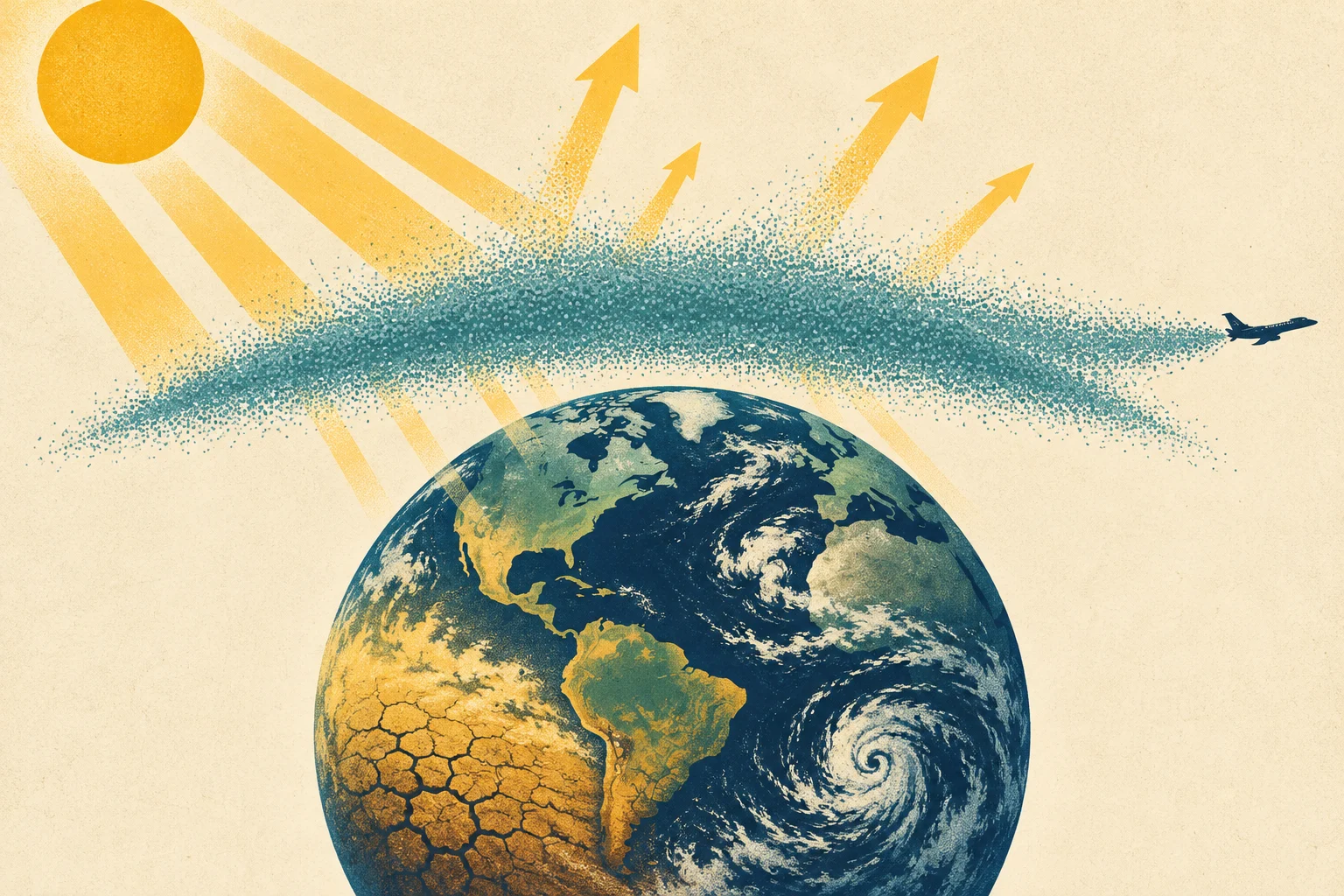
This used to be a fringe corner of climate science, and it’s moving out of the fringe quickly. Stardust Solutions raised $60 million in October 2025 in a round led by Lowercarbon Capital. WIRED calls Stardust a US-Israeli startup. Heatmap, which broke the funding news, described it as led by Israeli physicists and reported that its CEO said it would not deploy until governments around the world authorised it. In May the company published details of inventions it claims would let humans turn the global temperature down as they like. In August Elon Musk, whose SpaceX might be a candidate for delivering this sort of thing, posted on X: “Space satellites to control temperature and massive geo-engineering will be needed or it will be game over.” Cynthia Scharf, a former UN adviser, told WIRED the governance decisions are coming soon: “It’s not 15 years from now; it’s in the next decade, easily.”
Session one
While the players were trying to agree rules for outdoor experiments, the US and China both said they could not sign anything that limited research they considered to be in their “national interest,” and they could not accept a deal that let the other superpower take the technological lead. Jeffrey Nielsen, a US Army major who played a US national security attaché, put it as “worse than no deal at all is any deal that favors China.”
That position is perfectly coherent. It also guarantees there will be no deal. Any agreement that binds two rivals equally will look, to each of them, like it favours the other, because each one knows exactly what it is giving up and can only guess what the other is.
Then the organisers handed the Russian delegates an “intelligence report” about a plane near the Bering Strait believed to be part of a US geoengineering research programme. The US team accused Russia of disinformation. The US team was, in fact, flying research missions.

The US then became convinced that China had a programme too. Beijing’s players had tried to add language to the draft deal ruling out retroactive punishment for past experiments. China then went privately to the player representing SpaceX with the idea of a technology-sharing arrangement, and the SpaceX player immediately told the US team. The US demanded an international investigation, the accusations kept coming, and countries walked away from the talks. The Canadian representative called it a “humiliating defeat.” Nielsen told WIRED that within the game it was a “humungous victory” for the Americans.
According to Young, China was not running any experiments in the game. So the country that actually had planes in the sky called the true report about it disinformation, and the country without planes got caught. Everyone left convinced that everyone else was racing to build the capability.
I think the no-retroactive-punishment clause is the most interesting detail. Imagine you’re a negotiator with nothing to hide. You might still want that clause, because it costs you nothing and protects you if something you don’t know about turns up later. Your rival, though, can only read it as a confession. In a world where nobody can verify anything, ordinary caution and guilt look identical. Nielsen, speaking in a private capacity and not for the US government, said the session reflected “the likelihood, in my opinion, of the geoengineering arms race,” and that “any action related to the issue by one actor can be perceived as malintent by the other.” Most experts agree it would take a superpower’s reach to keep the delivery planes flying safely, and he said neither the US nor China would easily give up control of the global thermostat.

A former British diplomat with a national-security background, who wasn’t part of the game, told WIRED that fear of falling behind is “a very strong driver of research and development of capability” but that “that’s not at all the same thing as deployment.” Unlike nuclear weapons, this technology has obvious upsides along with its badly understood downsides. “There is an interdependence here,” the diplomat said. “It’s not an inherently zero-sum game.” Scharf, who played on the US team with Nielsen, said a “scientifically transparent international collaboration” between China and the US “might be the best we can do in terms of fending off a very dangerous competition between the two. But I certainly cannot imagine that happening under the Trump administration.”
The adviser
Colleen Golja, a climate researcher, was there to give technical advice so the players could make scientifically literate decisions. She had expected that part to be simple: “Like, we can all agree to do ethical research and make sure it’s for the better of all humans. And boy, was I wrong.” She was one of very few people in the room who could explain the climate effects of what was on the table, and she spent most of the game watching from the side. “I was just so surprised about how little anyone actually cared about the science,” she said. The field has never been very welcoming to begin with. One researcher told WIRED that his interest in geoengineering got him ostracised and held back his academic career, and he no longer works on it.
None of this would surprise Young. She has argued in an interview with Land and Climate Review that scientists tend to design multilateral governance schemes, while government and military officials think about this technology in terms of weapons and power. Rews has written about a simulated nuclear war where nobody pressed the button. In this game nobody pressed anything either. They just made sure no one could agree on what the button was for, and the only person who knew what it did spent the game on the sidelines.