
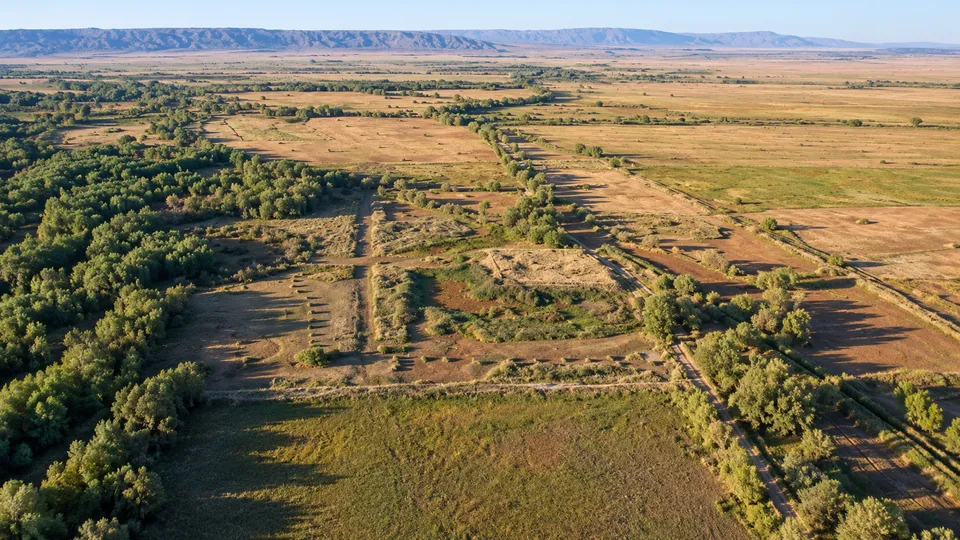
The empires of the steppe are known to history mostly through the records of those who feared them — the chroniclers of China, of Persia, of Byzantium. In eastern Kazakhstan, archaeologists have now uncovered something quieter: a fortified town where ordinary life went on under the khagans. As Leman Altuntaş reported in Arkeonews, the settlement, called Kalzhyr, lies between the villages of Kalzhyr and Boran in the Zaysan Basin, covers more than 25 hectares, and has already yielded substantial defensive walls and traces of buildings buried for roughly 1,400 years. Archaeological finds and radiocarbon analysis date it to the sixth and seventh centuries CE, with preliminary findings suggesting construction began in the early period of the First Turkic Khaganate. A team from Al-Farabi Kazakh National University excavated the site with support from Kazakhstan’s Ministry of Science and Higher Education.
A town behind its walls
The digging concentrated on the southern part of Kalzhyr, where the main fortifications stood. A major fire had destroyed much of those defenses — by what cause, and whether the flames ended the community, no one yet knows. Beyond the ruined walls lay earthen floors, fragments of reed-and-clay structures, and plaster still carrying decorative patterns: people here cared how their buildings looked, not merely that they stood. This was a permanent town, not a camp.
The soil also gave up charred wheat grains, legumes and ceramic vessels — the debris of storage and cooking. Whether the inhabitants grew their own crops or took them in trade awaits further work. Together the bones, ash and grain open a window onto a side of early Turkic history usually overshadowed by accounts of powerful rulers and mounted armies: the side that ate breakfast.
The power overhead
The sixth century was a hinge in Central Asia. In 552 CE, Bumin Qaghan defeated the Rouran rulers and founded the First Turkic Khaganate. Under his successors and his brother Istemi, Turkic influence swept westward until it touched the great commercial arteries joining China, Persia and the Byzantine Empire; by 568, Turkic envoys stood in Constantinople, treating with the Byzantines as one power to another.
The khaganate’s military strength came from mobile pastoral groups, but the lands under its hand also held settled communities, farming populations and trading centres, all existing side by side across the vastness of Central Asia. What Kalzhyr itself was for — a military outpost, an administrative centre, a settlement serving some other purpose — the evidence so far cannot say.
A bird that rattles
Among the discoveries stands one small, strange object: a ceramic bird figurine with a rattle sealed inside its body, which sounds when shaken. Birds carried weight in the beliefs and art of early Turkic peoples; eagles and falcons were bound to power, the sky and the spiritual world, and their figures appeared on monuments tied to the elite. Some researchers read the birds on ancient funerary stones as souls of the dead rising to heaven, others as guides into the afterlife; the eighth-century monument of Kül Tigin wears a bird motif on its sculpted headdress, an emblem of royal authority.
Against that backdrop the clay bird invites grand interpretations — a ceremonial object, its sound part of a rite. Or it may simply have been a child’s toy. Neither idea yet has firm archaeological support. Without knowing precisely where the artifact lay or how its maker built it, the researchers cannot choose, and the little bird keeps its counsel: a quiet glimpse of a world whose ordinary objects once meant things no longer easy to recover.
Stones from a much older age
The same expedition also found something far older than the khaganate: a kereksur, a stone burial monument of the Late Bronze Age, of the kind raised across parts of Inner Asia — a central mound ringed by carefully arranged stones, sometimes in circles or rectangular enclosures, characteristic above all of Mongolia and Xinjiang. Expedition leader Nikita Konstantinov says the find provides new evidence of how far west that burial tradition reached, widening the map of these monuments and of the prehistoric societies that built them.
The kereksur belongs to a different age and a different culture from the walled town. Together they show how community after community used this corner of the Zaysan Basin across thousands of years. The investigation brings together Al-Farabi Kazakh National University, D. Serikbayev East Kazakhstan Technical University and the A. Kh. Margulan Institute of Archaeology, working with surveys, aerial photography and thermal imaging to reconstruct how the region’s settlements shifted over time. What remains — buildings, food remains, strange small objects — may yet say more about the people who lived behind those walls while an empire formed above their heads.